Events Archive
This is the complete archive of events, from 2021 and onwards, hosted by CAFx Annual or it's partners.
On 10th December we’re happy to invite you to a preview of The Great Arch.
- Duration
- LanguageDanish
- SubtitlesDanish
- Year2025
- Rating
On 10th December we're happy to invite you to a screening of The Great Arch - a fictionalized account about the building of one of the emblematic monuments of modern architecture - La Grande Arche de la Défense in Paris. The film will be introduced by architect Hans Peter Hagens.
Hans Peter Hagens (b. 1963) is an architect as well as the founder and owner of Arkitekturværkstedet. He is known as the designer behind the Torvehallerne market halls in Copenhagen.
Before the film, Hagens will place the new Arch de Triomphe in an architectural-historical context and explain how the building reflects the era in which it was constructed.
Here is a little more about the film: "In 1982, the President of France, François Mitterrand, announces an anonymous architectural competition to create a monument that will complete the historic axis between the Louvre and the Arc de Triomphe in Paris.
To everyone’s surprise, the Danish architect Johan Otto von Spreckelsen (Claes Bang) wins—until then known only for four Danish churches and his own house. From his life in Denmark, Spreckelsen steps into the center of Paris’s political and cultural spotlight. He now finds himself at the head of a colossal project, but his idealistic vision is challenged by shifting political winds, power plays, and bureaucratic barriers."
CAFx Community Members get a 20 DKK discount
NB: The film is in French with Danish subtitles
On the 8th of December, you're all invited to a Holiday Celebration at Halmtorvet 27! We will be serving drinks and holiday-themed snacks.
- Duration
- LanguageEnglish
- Subtitles
- Year2025
- Rating
On the 8th of December, you're all invited to a Holiday Celebration at Halmtorvet 27! We will be serving drinks and holiday-themed snacks.
During the evening, you’ll also be able to purchase a Community Membership as a Christmas present for your loved ones. We’ve designed a beautiful physical gift card to place under the Christmas tree, and we’ll be offering it at a special discounted price of 100 DKK for a full year’s membership.
The evening is also a great opportunity to browse our new CAFx Magazine Store. Among the exciting titles in stock are Funambulist, Detail, and 2G b+. On the night, you’ll receive 15% off all purchases in the Magazine Shop.
As a special treat, we will also give a sneak peek presentation of some of the exhibitions and events we’ll be presenting in 2026.
Udstilling og bog: “Vi har brug for hinanden for at lykkes”
- Duration
- LanguageDanish
- Subtitles
- Year2025
- Rating
Oplev udstillingen med billeder og tekster fra bogen “Vi har brug for hinanden for at lykkes”. Udstillingen og bogen bygger på tyve års erfaringer og arbejde i boligområder og lokalsamfund. Den er skrevet af Bricoleurs bestående af Anders Hagedorn, Thor Salling, Martin Rosenkreutz Madsen og Felix Becker.
"Vi er et bindeled i lokalsamfundet, hvor vi blander os, faciliterer og formidler fællesskabende arenaer, som folk kan træde ind på og danne tråde med hinanden og derigennem få ting til at ske."
Der er også mulighed for at købe bogen i udstillingsperioden.
ㅤ
ㅤ
Vi inviterer til bogreception, udstilling og talk af bogen "Vi har brug for hinanden for at lykkes".
- Duration
- LanguageDanish
- Subtitles
- Year2025
- Rating
Bogen "Vi har brug for hinanden for at lykkes" bygger på tyve års erfaringer og arbejde i boligområder og lokalsamfund. Den er skrevet af Bricoleurs bestående af Anders Hagedorn, Thor Salling, Martin Rosenkreutz Madsen og Felix Becker. Vi inviterer til bogreception, udstilling og talk. Gæsterne til talken er blandt andre indslag forfatter Tor Nørretranders og Henrik Herlau, tidligere professor på CBS i filosofi, management og innovation.
"Vi er et bindeled i lokalsamfundet, hvor vi blander os, faciliterer og formidler fællesskabende arenaer, som folk kan træde ind på og danne tråde med hinanden og derigennem få ting til at ske."
Vi glæder os til at fejre bogudgivelsen med jer.
ㅤ
Join us on 1 December when the Post Assemble: Evening School concludes with a public presentation and discussion on zero extraction, rewilding, and material ownership.
- Duration
- LanguageEnglish
- Subtitles
- Year2025
- Rating
Do you want to discuss some of the key issues facing the building sector today and in the future?
Then join us on 1 December when the Post Assemble: Evening School concludes with a public presentation and discussion on zero extraction, rewilding, and material ownership.
The event builds on the three previous installments of the series, where the legislative proposals of the Assemble! Conference have been mapped using network theory, drawing connections between the central actors and networks of the building sector and the effects they have on the biosphere.
The evening’s event will be conducted by Nikola Gjorgjievski. Gjorgjievski is an architect and landscape architect, currently working as a researcher at the Royal Danish Academy, Institute of Architecture and Space.
Learn more by meeting Palestinian architects and planners who talk about their life and work under Israeli occupation.
- Duration
- LanguageEnglish
- Subtitles
- Year2025
- Rating
We look forward to inviting you to an evening where you can meet experienced Palestinian architects and urban planners, some of them civil servants, who fight daily against the violent consequences of illegal Israeli settlements and arbitrary restrictions on Palestinian freedom of movement. For example, did you know that Hebron, the largest city in the West Bank with over 200,000 inhabitants, currently has only one road in and out, controlled by the Israeli military?
We suggest watching the Oscar-winning documentary “No Other Land”, created in an Israeli-Palestinian collaboration, before the event. It can be seen for free on DR. The event is open and free for everyone but requires prior registration- link in bio
This initiative is supported by Danish Arts Foundation
ㅤ
A lecture on how microbes and human well-being is connected through soil ecologies, building materials, and urban planning—and how acknowledging processes of decay can inform healthier, more resilient cities. After the lecture Madland, MYCO, and Bygaard will serve a snack of mushrooms harvested from the exhibition (To be confirmed)
- Duration
- LanguageEnglish
- Subtitles
- Year2025
- Rating
A lecture on how microbes and human well-being is connected through soil ecologies, building materials, and urban planning—and how acknowledging processes of decay can inform healthier, more resilient cities. After the lecture Madland, MYCO, and Bygaard will serve a snack of mushrooms harvested from the exhibition (To be confirmed)
About Living With Other Species: An Evening School
The city is buzzing with life, yet we often overlook everything but the human. Living With Other Species is a six-part evening school—with talks, film screenings, and city walks—exploring how to plan for and live alongside other species in the cities of the future. Moving across scales from regional planning to the secret lives of bats, ants, and microbes, we shift our gaze to imagine new forms of interspecies cohabitation.
ㅤ
This evening explores the conflict surrounding Lake Tange, Denmark's largest artificial lake.
- Duration
- LanguageEnglish
- Subtitles
- Year2025
- Rating
The talk and exibition open up the debate towards full ecological restoration of the River Gudenåen. The project examines the relations between humans, landscape, and biodiversity. It highlights the losses and gains associated with removing the lake and considers how nature-culture heritage can be preserved in a new landscape design. Join the exibition to explore alternative design methods and communicative approaches, with emphasis on the need for a long-term, sustainable solutions that balances ecological and social aspects.
This event is based on a project in relation to the masters program of landscape architecture supervised by Svava Riesto.
A conversation on the role of insects as urban workers—pollinators, decomposers, and ecosystem engineers—and how designing with (and for) them challenges aesthetic norms, maintenance culture, and anthropocentric planning.
- Duration
- LanguageEnglish
- Subtitles
- Year2025
- Rating
A conversation on the role of insects as urban workers—pollinators, decomposers, and ecosystem engineers—and how designing with (and for) them challenges aesthetic norms, maintenance culture, and anthropocentric planning.
About Living With Other Species: An Evening School
The city is buzzing with life, yet we often overlook everything but the human. Living With Other Species is a six-part evening school—with talks, film screenings, and city walks—exploring how to plan for and live alongside other species in the cities of the future. Moving across scales from regional planning to the secret lives of bats, ants, and microbes, we shift our gaze to imagine new forms of interspecies cohabitation.
ㅤ
ㅤ
Gennem fem uger har 0.-1. klasserne på Børneuniversitetet undersøgt arkitekturen og særligt hvad det offentlige rum er for noget. Det er blevet til en udstilling med modeller, en lille film og børnenes egne fotografier. Kom og oplev udstillingen og mød børnene når vi holder fernisering onsdag d. 11. juni kl 15:30.
- Duration
- LanguageDanish
- Subtitles
- Year2025
- Rating
Børn og unge er fremtidens medborgere, beslutningstagere, bygherrer, rådgivere, arkitekter – og det er afgørende, at vi inviterer dem med ind i arkitekturens verden fra en tidlig alder!
Gennem fem uger har 0.-1. klasserne på Børneuniversitetet undersøgt arkitekturen og særligt hvad det offentlige rum er for noget. Det er blevet til en udstilling med modeller, en lille film og børnenes egne fotografier af favoritsteder og øv-steder i Vesterbros offentlige rum.
Kom og oplev udstillingen og mød børnene når vi holder fernisering onsdag d. 11. juni kl 15:30 på Halmtorvet 27 hos Copenhagen Architecture Forum CAFx.
Projektet er en del af undervisningsforløbet Vi Fællesskaber Vores By – Vesterbro som CAFx afvikler i samarbejde med Børneuniversitet og Skolen ved Dybbølsbro i 2025 med støtte fra Statens Kunstfonds arkitekturudvalg gennem puljen Børn, Unge og Arkitektur.
'Animal Antics' (Patrick Goddard) with introduction by Madeleine Kate McGowan and Mikkel Møller Roesdahl
- Duration
- LanguageEnglish
- Subtitles
- Year2025
- Rating
A talking dog narrates Patrick Goddards darkly humorous film about the borders of human and animal. Madelaine Kate will introduce the film, focussing on the political possibilitie of cross-species encounters.
The screening is part of our evening curriculum 'Living With Other Species: An Evening School'
The city is buzzing with life, yet we often overlook everything but the human. Living With Other Species is a six-part evening school—with talks, film screenings, and city walks—exploring how to plan for and live alongside other species in the cities of the future. Moving across scales from regional planning to the secret lives of bats, ants, and microbes, we shift our gaze to imagine new forms of interspecies cohabitation.
ㅤ
ㅤ
A conversation on regional planning for all species, infrastructural imagination, and perma culture. (Nb. The event is part of Living With Other Species: An Evening School)
- Duration
- LanguageEnglish
- Subtitles
- Year2025
- Rating
About Living With Other Species: An Evening School
The city is buzzing with life, yet we often overlook everything but the human. Living With Other Species is a six-part evening school—with talks, film screenings, and city walks—exploring how to plan for and live alongside other species in the cities of the future. Moving across scales from regional planning to the secret lives of bats, ants, and microbes, we shift our gaze to imagine new forms of interspecies cohabitation.
ㅤ
The city is buzzing with life, yet we often overlook everything but the human. Living With Other Species is a six-part evening school—with talks, film screenings, and city walks—exploring how to plan for and live alongside other species in the cities of the future. Moving across scales from regional planning to the secret lives of bats, ants, and m
- Duration
- LanguageEnglish
- Subtitles
- Year2025
- Rating
Programme
The City As a Garden
"Fingerplanen" With Anna Aslaug Lund, Skye Jin, Studio Coquille
26/5 | Halmtorvet 27
A conversation on regional planning for all species, infrastructural imagination, and perma culture.
A Plan for the Future: Copenhagen is a Delta!
Schønherr (Sanne Slot Hansen) on Karens Minde Aksen & Copenhagen Islands
27/ 5 | Karens Minde Aksen
A fieldtrip exploring Schønherr’s work on Karens Minde Aksen. You'll learn about climate adaptation, living with other species, and planning for a future shaped by rising water levels.
Interspecies Politics: Philosophizing with Dogs
‘Animal Antics’ (Patrick Goddard) with introduction by Madeleine Kate and Mikkel Moller Roesdahl
2/6 | Vester Vovvov
A talking dog narrates Patrick Goddards darkly humorous film about the borders of human and animal. Madelaine Kate will introduce the film, focussing on the political possibilitie of cross-species encounters.
Insect Urbanism: The Insect As Worker and Citizen
Hjalte Calberg Ro-Poulsen fra IGN, Biodiversity in Urban Nature
16/6 | Halmtorvet 27
A conversation on the role of insects as urban workers—pollinators, decomposers, and ecosystem engineers—and how designing with (and for) them challenges aesthetic norms, maintenance culture, and anthropocentric planning.
Twilight Ecology: The Secret Life of City Bats
Inger Kærgaard
11/8 | Unknown
A twilight exploration of the life of bats in Copenhagen. Inger Kærgaard will take you on a trip through Fælledparken, exploring sonic navigation and night ecologies through the lives of the red listed species.
Microbial Architectures: Sharing the City With Microbes
Adam Bencard
18/8 | Halmtorvet 27
A lecture on how microbes and human well-being is connected through soil ecologies, building materials, and urban planning—and how acknowledging processes of decay can inform healthier, more resilient cities.
After the lecture Madland, MYCO, and Bygaard will serve a snack of mushrooms harvested from the exhibition (To be confirmed)
Drawing is made by Studio Coquille.
Rewild Your Roots. Cultivate the Future.
- Duration
- LanguageEnglish
- Subtitles
- Year2025
- Rating
For the first time in Copenhagen, as part of the visionary exhibition The Habitable Skin, we are honored to host the legendary Darren Le Baron and his world-renowned Shroomshop:
Mushroom Cultivation Workshop.
In this immersive, hands-on day, we will journey into the wisdom of the wild—exploring how mushrooms teach us to grow, regenerate, and connect. Whether you’re a curious beginner or a long-time land steward, this workshop will root you in both the ancient stories and modern science of fungi.
Set within the living architecture of Bygaard, a pioneering urban farm and cultural haven, and woven into the curatorial fabric of CAFX's The Habitable Skin— exploring new relationships between human bodies, buildings, and biomes—this event invites you to experience cultivation as both act and metaphor.
What You’ll Learn:
- The life cycle of mushrooms and their ecological significance
- How to grow gourmet and medicinal mushrooms at home
- Creating your own grain spawn and fruiting tub
- Mycological aftercare, sourcing, and troubleshooting
- Insights into fungi as food, medicine, and spiritual ally
The Workshop Includes:
- Introduction to Kernekultur – A Source Cultural Movement
- Welcome by Bygaard and its regenerative, community-based vision
- Introduction to Darren Le Baron and his global mycological mission
- Mushroom Cultivation 101: full hands-on workshop
- Mushroom growkit to take home
- Digital cultivation notes for your continued journey
Practical Notes:
- All materials provided
- Workshop conducted in English
- Curiosity and an open mind required
About Darren Le Baron:
Darren is an educator, speaker, horticulturist, and mycological alchemist. Known internationally for his transformative Shroomshop masterclasses, he blends ancestral African wisdom with cutting-edge psychedelic science, empowering individuals and communities to regenerate soil, soul, and society.
The Habitable Skin
A visionary installation exploring how architecture can become a living interface—supporting not just human life, but entire ecosystems. Originally developed for the Danish Pavilion at the 2027 Venice Biennale, where it was shortlisted for curation, the project is now exhibited for the first time at CAFX. Blurring the lines between building and biome, this sensory, regenerative work invites us to reimagine the “skin” of architecture as a site of coexistence—where fungi, soil, water, and more-than-human species are not just welcomed, but woven into the future of design.
Come as you are. Leave with a deeper knowing.
May the spores be with you, allways in all ways.
Habitable Skin: living architecture for humans and other species—Venice Biennale 2027 explores cohabitation, porous façades, and interspecies design.
- Duration
- LanguageEnglish
- SubtitlesEnglish
- Year2025
- RatingA
Originally conceptualized for the Venice Biennale 2027 in collaboration with Professor Ellen Braae and PhD fellow Taryn Humphrey, the exhibition examines an architectural language of cohabitation between humans and more-than-human species.
On the evening of the opening, Studio Coquille and TERROIR will guide visitors through the outdoor "Insect Bridge"—a structure built specifically for the exhibition. Following the tour, enjoy a talk exploring the theoretical ideas behind a city designed for multiple kinds of life forms.
About the Exhibition
The Habitable Skin is an exhibition that reimagines the boundary as architecture’s most critical ecological Nexus. Not as a line of separation, but as a space of interaction. It asks what it would mean for the skin to be habitable - not only for humans, but for other forms of life? To create a skin that lets in rain, sound, light, breath—offering space for nesting, rooting, and coexisting?
With a natural bridge for insects linking green spaces in the urban fabric, and mushrooms cultivated indoors, Habitable Skin asks how we might design with space and time, instead of against them. The exhibition shows how façades, walls, roofs, and floors can become shared surfaces—porous, responsive, and alive - while reminding us how we are already living with and among other species. Habitable Skin is a living architectural experiment creating interactions and knowledge as species live together.
In this space, coexistence is no longer a condition. It is a design principle. A responsibility. And a possibility. To rethink the skin is to rethink the role of architecture itself: not as a shelter from the world, but as a structure within it—situated, sensory, and capable of coexistence.
🍷 There will be drinks
ㅤ
Join us for a walk-and-talk on ‘building with locally sourced materials’ with Ben Bosence from Local Works Studio and Jørn Aagaard, co-founder of Hedeskov.
- Duration
- Language
- Subtitles
- Year2025
- Rating
Ben and Jørn will discuss how materials from Hedeskov’s land were harvested, processed and used in transforming the former rural school building, designed by architects Djernes & Bell. You'll also have the chance to see these materials in their original locations and explore how they’ve been integrated into the building, highlighting the link between regenerative building practices and land stewardship.
Moderated by Mads Thimmer from Hedeskov, the conversation will focus on how bio-materials sourced from the landscape can support biodiversity and local habitats.
Join us for a conversation centered on core aspects of Djernes & Bell’s exhibition “Everything is Transformation”.
- Duration
- Language
- Subtitles
- Year2025
- Rating
With the Hedeskov project, Djernes & Bell transformed a former rural school in Djursland, Denmark, into the headquarters of Hedeskov Center for Regenerative Practices. Djernes & Bell’s approach challenges conventional architectural narratives, prioritising maintenance and adaptation over demolition and new construction. Their cross-disciplinary design works with the existing building and landscape surrounding Hedeskov - moraine clays, typha fiber, and timber - while engaging geologists, craftsmen, scientists, and anthropologists in a process of rethinking how we build in a fragile world.
Ben Bosence from Local Works Studio will be in conversation with Justine Bell about the local and vernacular crafts, material localism and his work with Hedeskov and Djernes and Bell. Moderated by Søren Nørkjær Bang, curator at CAFx.
Join us for the launch of the artist group A Kassen’s latest book, Works in Architecture, published by The Danish Architectural Press.
- Duration
- Language
- Subtitles
- Year2025
- Rating
Works in Architecture explores the blending of art and architecture in what they term the expanded domain of architecture. It highlights the creative exchanges between these two fields, offering a deeper dialogue that challenges traditional ideas of architecture as merely functional and aesthetic.
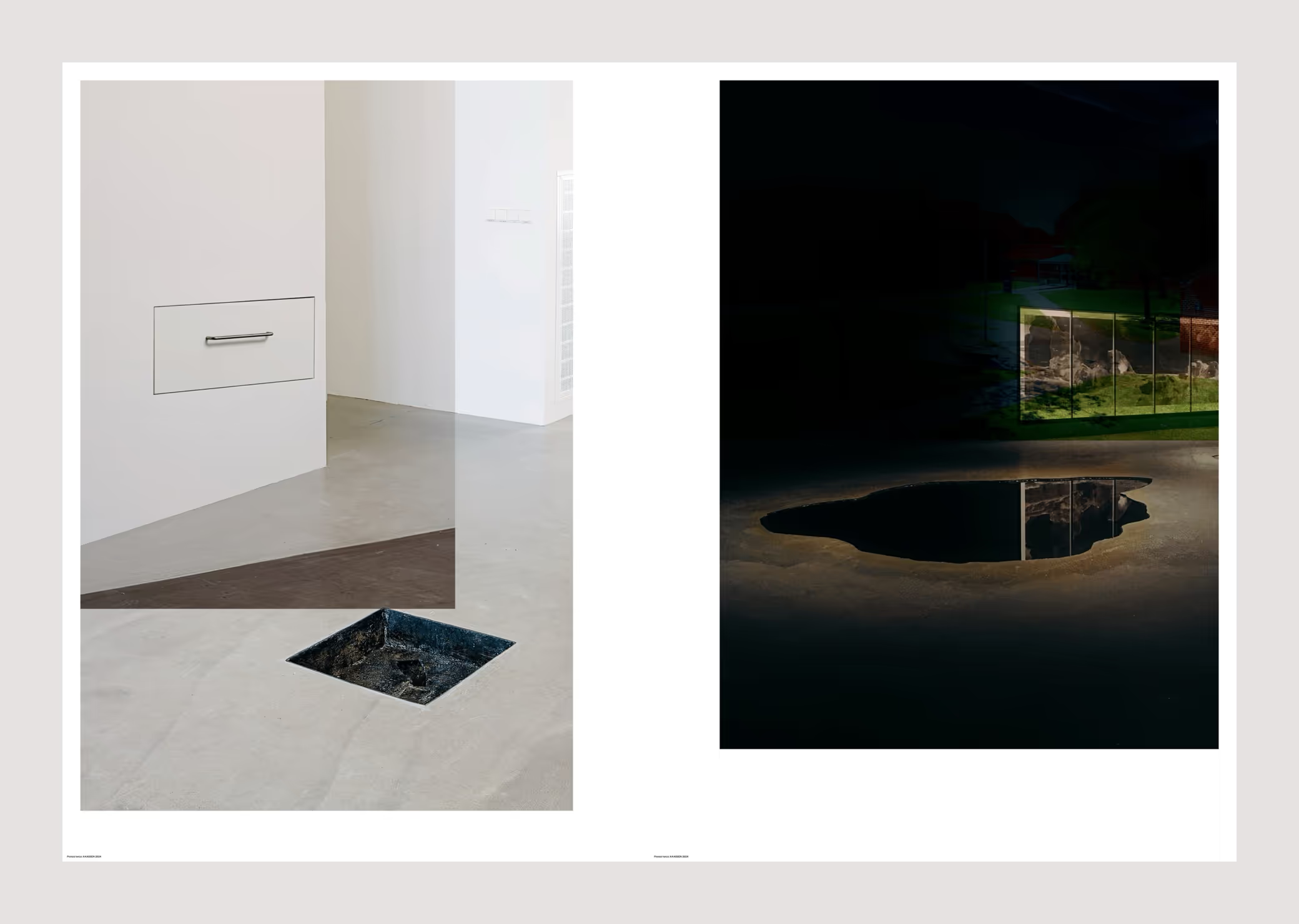
Through a series of projects, A Kassen introduces elements that disturb and distort reality, encouraging us to see and experience space in new ways.
We will be serving free wine.
Join us for a screening of the Golden Globe-winning epic starring Adrien Brody as visionary architect Lázló Tóth.
- Duration
- LanguageEnglish
- SubtitlesDanish
- Year2025
- Rating11
The Brutalist is a fictional portrait of Tóth, a Holocaust survivor trained at the Bauhaus, who embarks on a remarkable career while struggling to find his footing—both personally and professionally—in post-war America. At the heart of the movie is Tóth’s struggle to build a brutalist monument, commissioned by the industrialist Harrison Van Buren.
Martin Søberg will introduce the film and discuss how architects who immigrated from Europe to the United States around the time of World War II left a significant mark on post-war American architecture. Additionally Søberg will talk about Brutalism, a leading architectural movement of the 1960s, which also made its mark on Danish architecture—for example, in the Entrepreneurs’ School in Ebeltoft (1968) by architects Friis and Moltke, and in the Viking Ship Hall in Roskilde, designed by Erik Christian Sørensen (1969).
Martin Søberg is an architectural historian and associate professor at the Institute of Architecture and Culture at the Royal Danish Academy – Architecture, Design, Conservation in Copenhagen. His research focuses primarily on 20th-century architecture, with an emphasis on the relationship between work and idea.
As a special treat for our CAFx members, we are giving away six (6) tickets on a first-come, first-served basis. If you are a member, send an email to johann@cafx.dk to secure your free ticket.
Poor planning and profit-driven demolition are wasting resources and leaving people without homes. Join the conversation with HouseEurope! and support new EU laws prioritizing renovation over demolition.
- Duration120
- LanguageEnglish
- Subtitles
- Year2025
- Rating
This evening, HouseEurope! will officially launch its Danish campaign. The aim is to spark a renovation revolution across Europe. Poor urban planning, planned obsolescence, and financial speculation have led to the unnecessary demolition of millions of square meters of functional living and working spaces.
This wasteful practice deprives people of affordable homes and squanders resources, energy, and cultural heritage.
HouseEurope! calls for new EU laws that prioritize sustainable renovation and adaptation, ensuring that existing spaces are preserved and reused instead of being replaced by speculative real estate ventures.
HouseEurope! is using the European Citizens’ Initiative (ECI) to give people across the EU a voice in shaping policies that prioritize renovation over demolition. By collecting one million signatures from at least seven countries, the initiative aims to push the European Commission to consider legislation that ensures existing spaces are preserved and adapted for sustainable use, benefiting communities and the environment alike.
Panelists:
- Søren Pihlmann, Founder, Pihlmann Architects / Danish Architecture Pavilion - Venice Biennale 2025
- Lars Autrup, CEO, Arkitektforeningen
- Jacob Blak Henriksen, Head of Sustainability Architect, Cobe
- Tamara Kalantajevska, Head of Urbanism, Schmidt Hammer Lassen / KADK
- Kasper Benjamin Reimer Bjørkskov, Founder, No Objectives
- Erik Valdemar Eriksen, Activist, Den Grønne Studenterbevægelses Klimaaktivistisk Tegnestue
- Dominique Hauderowicz, Founder, Studio Dominique Serena / Danish Architecture Pavilion – Venice Biennale 2027
- Esben Thorlacius, Partner, Over Byen Arkitekter
- Moderated by Enlai Hooi, Head of Innovation, Schmidt Hammer Lassen
Event Program:
16:20 - Drinks Served
16:30 - Video Screening: "Demolition Drama"
Introduction by Alina Kolar, ETH Zurich / HouseEurope!.
Overview of Legal Proposals
17:00 - Short break
17:10 - Panel Debate
17:50 - Panel Switch
17:55 - Panel Debate
18:30 - Closing Drinks
Join the talk on how architecture can learn from eco-monitoring in the future – inspired by a vest that makes the user feel climate change.
- Duration
- LanguageEnglish
- Subtitles
- Year2024
- Rating
Human activity is accelerating the sixth mass extinction, putting over 1 million species at risk within decades, with vertebrate populations declining by 69% between 1970 and 2022. The Gaia Communication System uses haptic feedback to translate environmental data like air quality and soil health into tactile sensations.
The Gaia Communication System
This wearable device allows people to feel ecological changes, bridging the gap between data and sensory experience. With modular sensors tracking soil moisture, pH, and wildlife activity, The Gaia Communication System fosters empathy and inspires action, aiding conservation, urban planning, research, and more.
About the event series
For the current window exhibition, „Strange Adaptions“ by Inxects CAFx invited professionals from diverse backgrounds to unfold in conversation with Pavels Hedström some of the exhibition's speculations about present and future global challenges and adaptions through regenerative design concepts.
Inxects is a design practice founded by the acclaimed architect Pavels Hedström, on how architecture, art, and technology can minimise the gap between humans and the rest of nature through design and technology.
Deltag i samtalen om hvordan fremtidens arkitektur kan lære fra trans species-alliancer, inspireret af en bærbar og regenerativ dragt, der nedbryder giftigt plastik og omdanner det til spiseligt protein.
- Duration
- LanguageDanish
- Subtitles
- Year2024
- Rating
Konventionel proteinproduktion, primært gennem husdyrbrug, belaster i høj grad jord-, vand- og energiressourcer og bidrager samtidig til skovrydning, udledning af drivhusgasser og overforbrug af antibiotika. Denne uholdbare tilgang er ikke kun miljøskadelig, men også mindre effektiv i forhold til at imødekomme den stigende globale efterspørgsel på protein, i takt med at verdens befolkning vokser. Inxect Suit foreslår et design, der tilbyder en alternativ måde at producere protein på gennem et "symbiotisk forhold" mellem brugerens krop og en koloni af melorme.
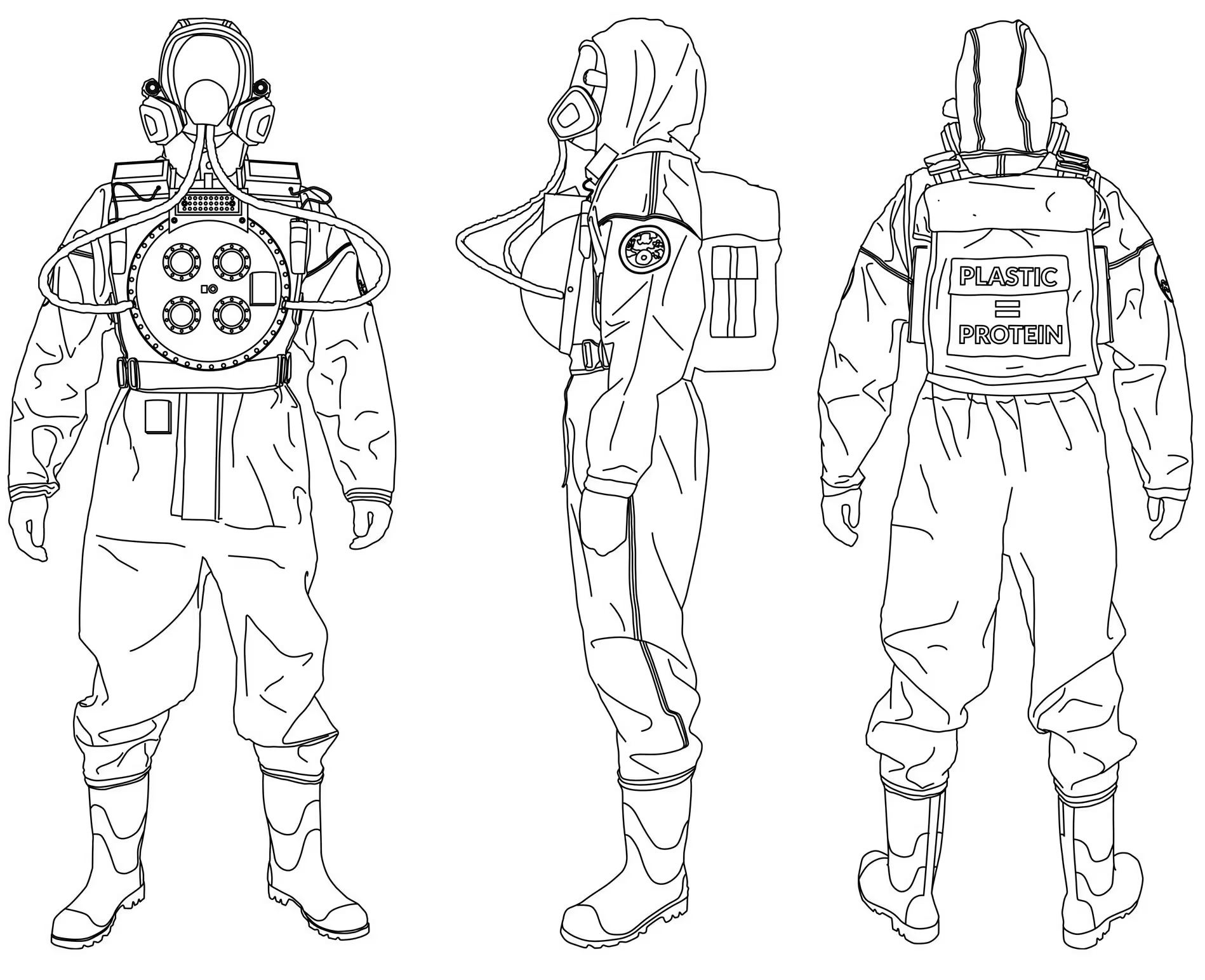
The Inxect Suit
Inxect Suit fremhæver den menneskelige krop som et kraftværk. Dragten opsamler brugerens varme og fugtighed, som derefter ledes til en melorme-habitat, der er integreret på forsiden af dragten. Melormene spiser giftigt plastikaffald, som brugeren fodrer dem med. Designet muliggør et "symbiotisk forhold" mellem brugerens krop og melormekolonien. Ved at bære dragten kan brugeren både bidrage til fremtidig fødevaresikkerhed og reducere plastikforurening, idet kroppens udledninger bliver drivkraften. Designet skaber et bærbart kunstigt økosystem, der på sigt ændrer brugerens tankegang og rejser spørgsmålet om, hvordan dualistiske relationer kan opstå med andre arter.
Om Arrangement-rækken
Til den aktuelle vinduesudstilling, "Strange Adaptions" af Inxects, har CAFx inviteret fagfolk fra forskellige baggrunde til at udfolde, i samtale med Pavels Hedström, nogle af udstillingens spekulationer om nutidige og fremtidige globale udfordringer og tilpasninger gennem regenerative designkoncepter. Inxects er en designpraksis, grundlagt af den anerkendte arkitekt Pavels Hedström, som undersøger, hvordan arkitektur, kunst og teknologi kan mindske kløften mellem mennesker og resten af naturen gennem design og teknologi.
Deltag i en samtale om, hvordan fremtidens arkitektur kan lære fra nomadiske livsstile, inspireret af et mobilt ørken habitat, der opfanger tåge og omdanner den til drikkevand.
- Duration
- LanguageDanish
- Subtitles
- Year2024
- Rating
Adgang til rent drikkevand er en akut global prioritet. I dag mangler 2 milliarder mennesker adgang til rent drikkevand, hvilket fører til destabilisering af menneskelige bosættelser, voksende uligheder og en trussel mod eksistensen af både menneskeligt og ikke-menneskeligt liv. En stigende tendens til privatisering af ferskvand kræver nye strategier for at skabe tilgængelige og alternative vandinfrastrukturer. Samtidig tvinger stadig mere u-levelige miljøer folk til at forlade deres hjem, hvilket kalder på en nytænkning af hjemmet som ét specifikt sted mod en mere nomadisk livsstil.
Fog-X Backpack
Fog-X Backpack er en mobil enhed, der giver brugeren mulighed for at samle op til 10 liter frisk vand om dagen, selv i de tørreste områder på planeten. Den blev udviklet som et mobilt habitat, der gør det muligt for brugeren at bevæge sig gennem tørre områder og opfange tåge til drikkevand. Enheden er udstyret med en foldbar antenne, der bruger et raschel-net til at høste tåge, som opsamles i en vandbeholder. Vandbeholderen fungerer også som et vindue til et foldbart sove modul, hvor brugeren kan hvile, mens tågen samles.
Om Arrangement-rækken
Til den aktuelle vinduesudstilling, "Strange Adaptions" af Inxects, har CAFx inviteret fagfolk fra forskellige baggrunde til at udfolde, i samtale med Pavels Hedström, nogle af udstillingens spekulationer om nutidige og fremtidige globale udfordringer og tilpasninger gennem regenerative designkoncepter. Inxects er en designpraksis, grundlagt af den anerkendte arkitekt Pavels Hedström, som undersøger, hvordan arkitektur, kunst og teknologi kan mindske kløften mellem mennesker og resten af naturen gennem design og teknologi.
Join the talk on how future architecture can learn from biomimetic design inspired by a jacket that catches fog and turns it into drinking water.
- Duration
- Languageenglish
- Subtitles
- Year2024
- Rating
Access to clean drinking water is an urgent global priority. Today 2 billion people lack access to clean drinking water which results in the destabilisation of human settlements, growing inequalities, and a threat to the existence of both human and non-human life. An increasing trend of privatization of freshwater demands new strategies of how to create accessible and alternative water infrastructures.
The Atacama Desert is the driest non-polar area on the planet, similar to the extreme environments on Mars. Through billions of years, life has learned to adapt to the harsh conditions in the Atacama Desert. Plants such as the Cactus have developed strategies for how to harvest and contain water from coastal fog. These intelligent systems have been studied in the making of the biomimetic design of the Fog-X Jacket.
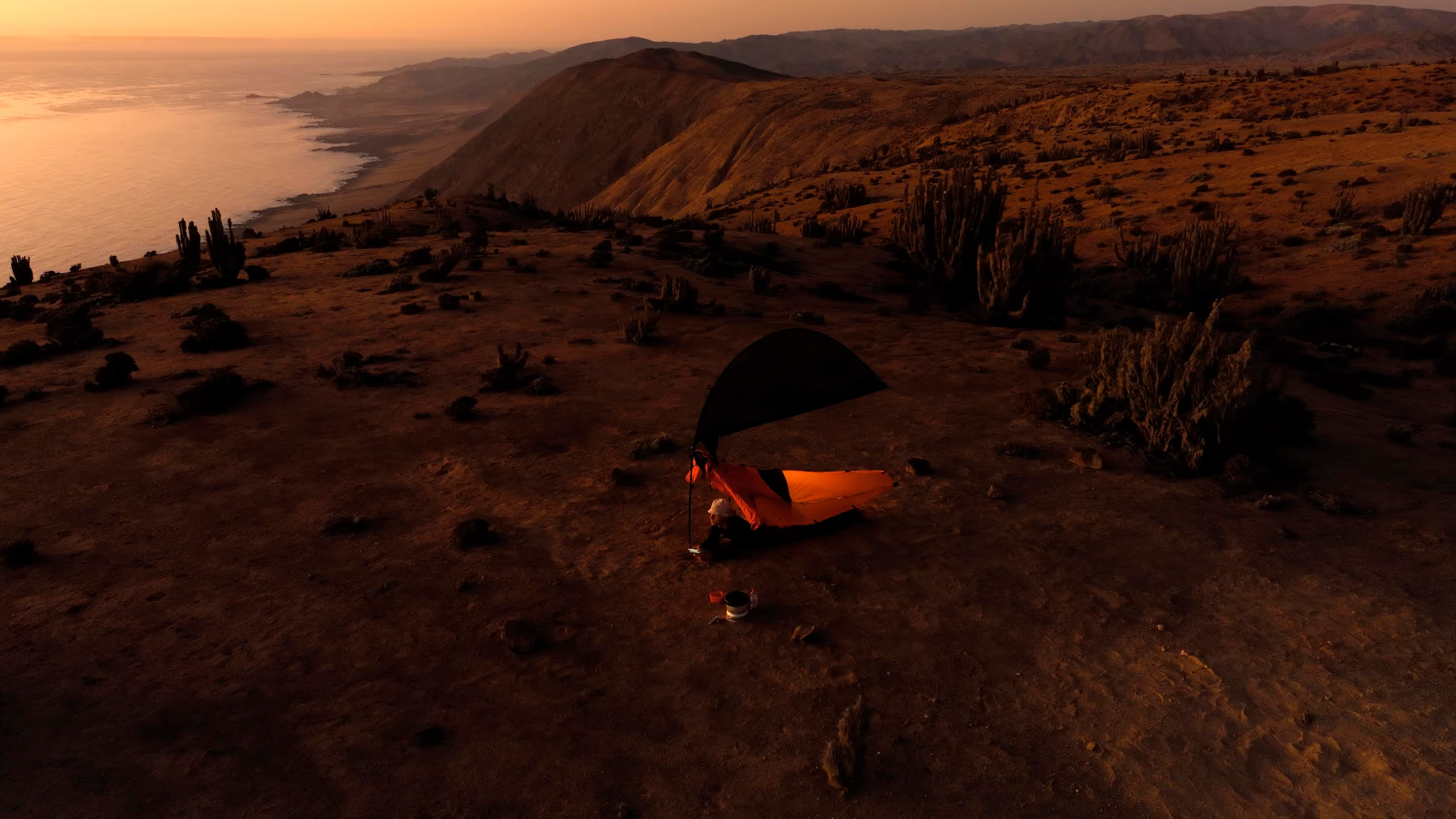
The Fog-X Jacket
Fog-X jacket gives the user the ability to collect up to 10 liters of drinkable water each day by collecting fog, even in the most arid areas on earth. The inflatable design of the jacket enables the user to be light and mobile in the landscape. With only a few steps of adjustments, the jacket can transform into a fog-catching station that provides shelter for the user, while harvesting fog.
Learn more about the Fog-X Jacket
About the event series
For the current window exhibition, “Strange Adaptions” by Inxects CAFx invited professionals from diverse backgrounds to unfold in conversation with Pavels Hedström some of the exhibition's speculations about present and future global challenges and adaptions through regenerative design concepts.
Inxects is a design practice founded by the acclaimed architect Pavels Hedström, on how architecture, art, and technology can minimise the gap between humans and the rest of nature through design and technology.
Join us as we dive into Lewerentz’s universe and become inspired by a high degree of architectural detail, immersion, and an architect who might be even more influential today than in his own time.
- Duration
- LanguageSwedish
- SubtitlesEnglish
- Year2024
- Rating
In a basement in Lund, there lies an unknown treasure. Film reels and audio tapes recorded by architect Bernt Nyberg with Lewerentz during his final years are stored here. Sigurd Lewerentz is among the most renowned Swedish architects, inspiring architects worldwide. Lewerentz did not want to be filmed or interviewed, preferring that his buildings speak for themselves. His unique solutions were decades ahead of their time.
He delved deeply into his architecture, was known for inspecting his construction sites down to the smallest detail, and focused on materials and durability. He emphasised craftsmanship over prefabrication. At a time when prefab construction and fast-growing cities have become the norm, we dive into Lewerentz’s universe and become inspired by a high degree of architectural detail, immersion, and an architect who might be even more influential today than in his own time.
About the Event
Architect Thomas Bo Jensen will introduce the film, followed by insights from director Sven Blume, who will share his thoughts, vision and the story behind this compelling documentary.
Film Details
- Director: Sven Blume
- Duration: 70 minutes
- Year: 2024
About CAFx Micro-Festival Vol. 2
How does our architecture shape the future? How can we create cities today that predict and anticipate tomorrow's problems? With six events spread over four days, we invite you to dive into the relationship between form and vision of the future through film premiers, unique screenings and lecture programs. Read more about CAFx Micro-Festival Vol.2 here.
How has water been perceived historically and today? What are future perspectives? For an afternoon, Copenhagen Architecture Forum (CAFx) and Center for Emerging Landscapes at the Aarhus School of Architecture (AAA) have joined forces to focus on our meeting with the water.
- Duration
- LanguageEnglish
- Subtitles
- Year2024
- Rating
In the past century, the temperature of the global ocean has increased more rapidly than at any given time in the past 11,000 years. Storm surges and cloud bursts have intensified, and the level of our groundwater is rising—a scenario that seems to only worsen in the future. As sea levels rise and storm surges increase, the interactions between humans and water intensify. This is a call to renegotiate our relationship with natural processes and nature. Our future landscapes call us to establish new perceptions and renewed landscape practices spanning from our daily lives to policies and politics.
For an afternoon, Copenhagen Architecture Forum (CAFx) and Center for Emerging Landscapes at the Aarhus School of Architecture (AAA) have joined forces to focus on our meeting with the water: How has water been perceived historically and today?, What are future perspectives? What are current landscape practices and what points of actions and policies are needed to adapt to and mitigate these anthropogenic climatic changes? We have invited international experts and artists from Georgia to give us their perspective on the above together with some of Denmark’s leading researchers, practitioners and policy makers within the field.
The day is divided into blocks under these themes:
- Notions of water, cities and processes
- Agencies of rivers and forming landscape practices
- Present policies and future landscapes
Program
2:00 PM Welcome + introduction by Josephine Michau, Director of CAFx and Katrina Wiberg, Head of Center for Emerging Landscapes at AAA.
2:15 PM
Block 1: Concepts - Notions of water, cities and processes / Blue, grey and green landscapes: deep concepts and future perspectives
In a rapidly changing climate with changing waterscapes, growing urbanization and declining biodiversity – how do we perceive and understand deep concepts of water and the entanglement between geological and human processes and take on a renewed perception of the modernistic views on cities?
1st. Speaker:
Tinatin Gurgenidze, an urban researcher, curator, author and co-Founder, Curator at Tbilisi Architecture Biennial:
Perceptions of water in Georgia - “Water Blessing- Tskaloba”
The geography of Georgia is shaped by the Caucasus Mountains, resulting in a rich abundance of water resources, including rivers, lakes, springs, and mineral waters. These elements sustain the environment and economy and hold significant cultural and spiritual meaning. Water symbolizes life, vitality, and divine energy in Georgian mythology and traditions. Conversely, its obstruction is seen as a source of evil. This reverence for water is reflected in rituals, folklore, and the naming of rivers after gods, which serves to emphasize its central role in shaping identity and belonging. The current exploitation of these resources has disrupted this historical relationship. From the policies implemented during the Soviet era to the neoliberal commodification of water, the mismanagement of these resources has caused environmental degradation, inequality, and displacement.
2nd. Speaker:
Tom Nielsen, an architect and professor of urban and landscape planning at the Aarhus School of Architecture. (AAA):
Earthly Cities - Tom will introduce his 2024 book Earthly Cities (Danish Architectural Press), in which he explores how ideas of ‘landing on earth’ (Latour) and of living within planetary boundaries can be translated into a new understanding of what cities could be.
3rd. Speaker:
Thomas Juel Clemmensen, professor of landscape architecture at UiT The Arctic University of Norway :
Geologic Resonance (or Humanly Modified Ground and Time-based Aesthetics) -
The Anthropocene not only questions perceptions of nature, but also inspires us to expand and rethink the aesthetic repertoire of landscape architecture. The discussion is centred around a study of the Port of Aarhus in Denmark. The study includes a description of material conditions found at the port and a discussion of their aesthetic potential in sensitizing humans to the environmental conditions of the Anthropocene.
3.00 PM - Break
3.10 PM
Block 2: Case studies, architectural practice - Agencies of rivers and forming landscape practices
Climate change causes changing waterscapes. However, flood disasters are closely related to human practices and understanding of control. Furthermore, land use changes are critically required. Thus, landscape practices and new perceptions and practices are needed. The case studies exemplify how we may engage to form new practices and understandings.
1st. Speaker:
Gigi Shukakidze, director of the architectural practice Wunderwerk and Co-founder of the Tbilisi Architecture Biennial:
Vere: The Lost River of Tbilisi (more information will follow soon)
2nd. Speaker:
Rikke Munck Petersen, Architect and Landscape Architect KU:
Ribe Riversystem (more information will follow soon)
3rd. Speaker:
Kasper Albrektsen, postdoctoral researcher at the Center for Emerging Landscapes at Aarhus School of Architecture and Aarhus Municipality:
Co-shape - In the future, we face extensive changes in how we perceive and use our urban landscapes. This requires not only technical planning but also an architectural and aesthetic approach to ensure well-being, biodiversity, and a balance between urban and natural spaces. The CO-SHAPE research project explores urban and landscape architectural methods for developing emerging urban landscapes.
4th. Speaker:
Lado Shonia, Architect and co-founded the studio W2KSHOP and MAUDI.
Currently he is lecturer at VA[A]DS, Free University of Tbilisi:
How politics have shaped the ecological landscape in Georgia - “Common Water Bodies “
The coastal town of Anaklia in western Georgia, near the de facto border with Abkhazia covers the region and is also highlighted, particularly its role as a major waterway and the location of a key hydroelectric dam. Anaklia is unique because the Enguri River meets the Black Sea, forming a delta that creates a biodiverse environment rich in flora and fauna. Finally, the presentation looks ahead to Anaklia's future, including plans for a deep-sea port in collaboration with Chinese companies to transform the town into a node for trade between China and Europe. This summer, a summer school, "Common Water Bodies", was organized in Anaklia, focusing on the Enguri River, the Enguri Delta, and the town's shaping.
5th. Speaker:
Jakob Miland-Samuelsen, Architect at Urland (more information will follow soon)
4.15 PM - Break
4.20 PM
Block 3: Present policies and future landscapes / Policy Making - a way forward
Which policies halter the blue-green transition, and which policies are needed to move forward? What are the key disputes, and do we know of best practices from which we can learn?
1. Speaker: Karsten Arnbjerg-Nielsen, Climate Scientist DMI (more information will follow soon)
4.50 PM - Brea
5 PM
Block 4: "Unmapping Energy Geographies”
Film + introduction by Tekla Aslanishvili, an artist, filmmaker, and essayist based between Berlin and Tbilisi. Currently, Aslanishvili is a postgraduate fellow at the Berlin Centre for Advanced Studies in Arts and Sciences (BAS) at Berlin University of the Arts.
The symposium will be moderated by Katrina Wiberg, Associate Professor in landscape architecture and climate adaptation and head of Center for Emerging Landscapes at the Aarhus School of Architecture (AAA). Katrina´s current research is on sea-level rise, coastal cities and adapting urban landscapes to changing waterscapes with cross-scalar and cross-temporal perspectives. Some of her main methods are interaction research and mapping, thus focusing on transferring data and knowledge via visual formats and interaction.
The program is still under development - it will be updated.
Price: 50 kroner, free for CAFx Community Members.
Coffee, tea and water included.
The symposium has been made possible by the generous support of The Agency of Culture and Palaces, Denmark
What happens when an entire community moves into a high-rise building? What is the relationship between power and verticality? And what is the future of high-rise construction? Join us for the discussion and the screening of the film adaptation of a J.G. Ballard’s sci-fi classic.
- Duration
- LanguageEnglish
- Subtitles
- Year2024
- Rating
Pool, park, gym, supermarket, luxurious penthouse apartments, and cramped sleeping quarters at affordable prices. What happens when an entire community moves into a high-rise building? What is the relationship between power and verticality? And what is the future of high-rise construction?
We will discuss these questions with the film adaptation of J.G. Ballard’s sci-fi classic High-Rise—a sharp and humorous portrayal of the surveillance society, the culture of perfection, and alienation in the high-tech high-rises of modernity. Sink deep into your cinema seat and follow surgeon Robert Laing as he moves into a prestigious high-rise project, where the parties escalate and morality disintegrates in a mysterious parallel world, where class differences gradually become more pronounced.
The film is introduced by Mads Brügger, responsible editor-in-chief and CEO at Mediehuset Friheden.
ENTRANCE FEE: 110 kr. / 75 kr. for members of CAFx Community and Cinemateket. Send us an email to receive the discount code!
About High-Rise
DIRECTOR: Ben Wheatley
DURATION: 119'
YEAR: 2015
COUNTRY: United Kingdom
About CAFx Micro-Festival Vol. 2
How does our architecture shape the future? How can we create cities today that predict and anticipate tomorrow's problems? With six events spread over four days, we invite you to dive into the relationship between form and vision of the future through film premiers, unique screenings and lecture programs. Read more about CAFx Micro-Festival Vol.2 here.
How do we distinguish between what’s worthy of preservation and what’s not? Join us for the screening and discussion and gain a deeper understanding of how and why we preserve for the future.
- Duration
- LanguageDanish
- SubtitlesEnglish
- Year2024
- Rating
Waves crash against the building’s concrete shell. Water seeps in and pools on the floor in front of the centuries-old wooden ships. Architects call the building a brutalist masterpiece, politicians call it a cultural elite monument, and in 2018, the Minister of Culture delisted the Viking Ship Museum in Roskilde. We ask: Which stories do we choose to immortalise in stone? How do we distinguish between what’s worthy of preservation and what’s not? And is it out of respect for history, or is there a deeper impulse at play when we protect heritage—a need to anchor our fleeting existence to something more lasting? Join the discussion and gain a deeper understanding of how and why we preserve for the future with Hans Christian Post’s new film Vikingeskibshallen.
Participate in the conversation about the future of delisting with Kristoffer Lindhardt Weiss from Arkitektens Forlag and architect Dag Petersson, author of Delisted — A Political Story. There will also be the opportunity to meet and ask questions to the film’s director, Hans Christian Post.
ENTRANCE FEE: 110 kr. / 75 kr. for members of CAFx Community and Cinemateket. Send us an email to receive the discount code!
About Vikingeskibshallen
DIRECTOR: Hans Christian Post
DURATION: 30'
YEAR: 2024
COUNTRY: Denmark
About CAFx Micro-Festival Vol. 2
How does our architecture shape the future? How can we create cities today that predict and anticipate tomorrow's problems? With six events spread over four days, we invite you to dive into the relationship between form and vision of the future through film premiers, unique screenings and lecture programs. Read more about CAFx Micro-Festival Vol.2 here.
How can the architecture of the future meet humanity’s spiritual needs within the framework of a secular culture? Learn about Emilio Ambasz, cosmic longing, and the monumental architecture of the future!
- Duration
- LanguageItalian
- SubtitlesEnglish
- Year2024
- Rating
Emilio Ambasz does not design buildings but situations: Views over Andalusian forest landscapes, ascents along hanging gardens, and walks through underground greenhouses. It’s all about connecting human consciousness with the forces of nature, the timelessness of myths, and a perception of deep cosmic temporality that allows us to transcend our individual interests and life circumstances. But what do these buildings really say about architecture’s ability to connect humans to something greater? And how can the architecture of the future meet humanity’s spiritual needs within the framework of a secular culture? Learn about Ambasz, cosmic longing, and the monumental architecture of the future with the film Green Over Gray.
The film will be introduced by Panuela Aasted and Kristiane Fenger from the architectural firm Stadia Arkitekter.
ENTRANCE FEE: 110 kr. / 75 kr. for members of CAFx Community and Cinemateket. Send us an email to receive the discount code!
About Green Over Gray
DIRECTORS: Francesca Molteni and Mattia Colombo
DURATION: 55'
YEAR: 2024
COUNTRY: Italy
About CAFx Micro-Festival Vol. 2
How does our architecture shape the future? How can we create cities today that predict and anticipate tomorrow's problems? With six events spread over four days, we invite you to dive into the relationship between form and vision of the future through film premiers, unique screenings and lecture programs. Read more about CAFx Micro-Festival Vol.2 here.
Join us for an evening focusing on two major future visions: cities without loneliness and urban spaces that better support the needs of an aging population.
- Duration
- LanguageEnglish
- Subtitles
- Year2024
- Rating
A damp cloth glides over a shiny plastic surface at a Japanese capsule hotel in central Tokyo. Nothing is personal, nothing is unique, nothing is superfluous. Is this the home of the future? Is it even a home? And how can architecture strengthen social relationships in a world where more and more people choose to live alone? This event focuses on two significant future visions: Cities without loneliness and urban spaces that better support the needs of an ageing population.
Meet directors Daniel Schwartz and Giovanna Borasi as we raise the discussion about future living arrangements, the relationship between private and public spaces in future megacities, and how we can address the challenge of more elderly people and senior housing in the future with the films When We Live Alone and When We Grow Older.
ENTRANCE FEE: 110 kr. / 75 kr. for members of CAFx Community and Cinemateket. Send us an email to receive the discount code!
About When We Live Alone
DIRECTORS: Giovanna Borasi and Daniel Schwartz
DURATION: 27'
YEAR: 2021
COUNTRY: Canada
About Where We Grow Older
DIRECTORS: Giovanna Borasi and Daniel Schwartz
DURATION: 30'
YEAR: 2023
COUNTRY: Canada
About CAFx Micro-Festival Vol. 2
How does our architecture shape the future? How can we create cities today that predict and anticipate tomorrow's problems? With six events spread over four days, we invite you to dive into the relationship between form and vision of the future through film premiers, unique screenings and lecture programs. Read more about CAFx Micro-Festival Vol.2 here.
How do we build, and how can we build better, before it’s too late? Join us for the opening of CAFx Micro-Festival Vol.2, an exploration of the grandeur and folly of humanity and its precarious relationship with nature through Kossakovsky’s inquisitive lens.
- Duration
- LanguageItalian
- SubtitlesDanish
- Year2024
- Rating
Please note that the reading will take place in Danish, and the film will have Danish subtitles; however, the film is not dialogue-based and can be enjoyed by non-Danish speakers.
From filmmaker Victor Kossakovsky (Gunda, Aquarela) comes an epic, intimate and poetic meditation on architecture and how the design and construction of buildings from the ancient past reveal our destruction — and offer hope for survival and a way forward.
Centering on a landscape project by the Italian architect Michele De Lucchi, Kossakovsky uses the circle to reflect on the rise and fall of civilisations, capturing breathtaking imagery from the temple ruins of Baalbek in Lebanon, dating back to AD 60 to the recent destruction of cities in Turkey following a 7.8-magnitude earthquake in early 2023.
Rocks and stone connect the disparate societies, from ghostly monoliths stuck in the earth to tragic heaps of concrete rubble waiting to be hauled off and repurposed anew. Through Kossakovsky’s inquisitive lens, the grandeur and folly of humanity and its precarious relationship with nature posits the urgent question: How do we build, and how can we build better, before it’s too late?
The film is introduced with a reading by writer and visual artist Amalie Smith.
ENTRANCE FEE: 100 kr.
About Architecton
DIRECTOR: Victor Kossakovsky
DURATION: 94'
YEAR: 2024
COUNTRY: Germany
About CAFx Micro-Festival Vol. 2
How does our architecture shape the future? How can we create cities today that predict and anticipate tomorrow's problems? With six events spread over four days, we invite you to dive into the relationship between form and vision of the future through film premiers, unique screenings and lecture programs. Read more about CAFx Micro-Festival Vol.2 here.
The future of protection. The future of a community. Immersion of the future. Join us for a four-day exploration discovering fresh perspectives on architecture through the lens of film.
- Duration
- Language
- Subtitles
- Year2024
- Rating
How does architecture shape our future? And how can we create cities that anticipate and address tomorrow’s challenges today?
Over the course of four days, CAFx will explore the relationship between form and future visions through premiere films, unique special screenings, and a varied lecture program. Visit Cinemateket and learn about topics such as:
The Future of Conservation
Waves crash against the concrete shell of the building. Water seeps in, pooling on the floor in front of the centuries-old wooden ships. Architects call the building a Brutalist masterpiece, politicians label it a culturally elitist monument, and in 2018, the Minister of Culture delisted the Viking Ship Museum in Roskilde. We ask: Which stories do we choose to immortalise in stone? How do we distinguish between what is worth preserving and what is not? And is it out of respect for history, or is there a deeper impulse at play when we preserve; a need to anchor our fleeting existence in something more enduring? Gain a deeper understanding of how and why we preserve for the future with Hans Christian Post’s new film, The Viking Ship Hall.
The Future of Community
A damp cloth glides over a shiny plastic surface in a Japanese capsule hotel in central Tokyo. Nothing is personal, nothing is unique, and nothing is superfluous. Is this the home of the future? Is it even a home? And how can architecture foster social connections in a world where more and more people choose to live alone? Join the discussion on the living arrangements of the future and the relationship between private and public spaces in tomorrow’s megacities with Daniel Schwartz’s films When We Live Alone and Where We Grow Older.
The Future of Contemplation
Emilio Ambasz doesn’t design buildings; he creates situations: views over Andalusian forest landscapes, ascents along hanging gardens, and walks in underground greenhouses. It’s all about connecting human consciousness with the forces of nature, the timelessness of myths, and a sense of deep cosmic temporality that allows us to transcend our individual interests and life circumstances. But what do these buildings really say about architecture’s ability to connect humanity to something greater? And how can future architecture meet humanity’s spiritual needs within the framework of a secular culture? Learn about Ambasz, cosmic longing, and the monumental architecture of the future with the film Green Over Gray.
If, like us, you are fascinated by the dreams, philosophies, buildings, and urban plans that shape our ways of life and living spaces, and what the art of film can teach us about architecture, keep an eye on our event section. There, you can find detailed descriptions of each event comprising the Micro-Festival Vol.2.
Credits
CAFx Team: Josephine Michau, Pernille Maria Bärnheim, Ida Willadsen Bang Kjeldsen, Valeria Granillo, Søren Nørkjær Bang, Janosh Heydorn.
Lancering af bog og film fra Heidi Svenningsen Kajita’s forskningsprojekt 'Klager i praksis'. Projektet belyser besværlige og snørklede praksisser i almene boligområder.
- Duration
- LanguageDanish
- Subtitles
- Year2024
- Rating
Grøn omstilling hænger sammen med social og økonomisk omstilling. Heidi Svenningsen Kajita’s forskningsprojekt Klager i praksis (Københavns Universitet) sætter fokus på behovet for at gentænke demokratiske tilgange til byplanlægning og arkitektur. Projektet handler om nysgerrige og omsorgsfulde tilgange til arbejdet med beboere i almene boligområder, der gennem historien har kæmpet med problemer som misligholdelse, nedrivninger og stigmatisering af 'parallelsamfund.'
Et fiktivt manuskript, skrevet for vidensteater sammen med dramatiker Rosa Sand, samler beretninger fra folk, der arbejder med brok og klager i den almene sektor. Uddrag fra manuskriptet er opført og filmatiseret med Anne Marie Helger i rollen som fortæller, der guider os gennem et roadmap for klager i praksis. Resultaterne peger mod en langsom praksis, hvor det besværlige og snørklede får plads og viser vej til en mere bæredygtig fremtid.
Tak til: Aktion Arkiv (aktionarkiv.org), Alex Young Pedersen, Anne Marie Helger, Aske Tybirk Kvist, Asta McNair, Beata Hemer, bureaus publishing, Claudia Schenk, Dreyers Fond, Ecoture, Elsebeth Frederiksen, Fatma Tounsi, Henriette Houth, Jette Kildegaard, Jörg Koopmann, Lene Harbo, Gitte Juul, Kris Nilsson, Marie Northroup Christensen, Mette Jo Leisner, Mette Prag, Michael Willumsen, Mikkel Høghøj, folk fra Revolver/Republique, Rosa Sand, Statens Kunstfond, Søren Nielsen, Søren-Emil Schütt, Tanja Zabell og Tobias Hentzer Dausgaard. Også tak til dem der valgte at deltage i projektet Klager i praksis uden navn og til dem, der ikke ønskede at deltage.
Projektet er støttet af: Statens Kunsfond, Dreyers Fond, Østerbro Teater, Københavns Universitet, bureaus publishing og Anne Marie Helger.
Programmet præsenteres i samarbejde mellem CAFx, TilVaegs, AKK, og Københavns Universitet.
Nyt forslag kræver 30% af Danmarks areal som beskyttet natur. Fri natur skal fremover indgå som grundelement i byplanlægning – på lige fod med energiforsyning, drikkevand og infrastruktur. Deltag i diskussionen, når ‘Cirkularitetskommissionen’ åbner dørene for sin femte høring!
- Duration
- LanguageDanish
- Subtitles
- Year2024
- Rating
Cirkularitetskommissionen åbner dørene for sin femte høring. Det bliver med et lovforslag af Pil Thielst, partner i Lundgaard & Tranberg Arkitekter. Vi håber meget, at du vil deltage i denne offentlig eftermiddagsdrøftelse om fremtidige forhold mellem formgivning og lovgivning i Danmark.
Paneldeltager:
- Pil Thielst, partner i Lundgaard & Tranberg Arkitekter
- Holger Bisgaard, arkitekt og byplanskonsulent
Billetpris: 30 kr. / gratis for CAFx Community medlemmer
Om Arrangementrækken
Høringen er en del af den kommission, CAFx har nedsat, der undersøger sammenhængen mellem lovgivning og formgivning. CAFx har i den forbindelse inviteret 5 fremtrædende arkitekter til at komme med hvert deres lovforslag, der testes i en offentlig høring og et panel bestående af en økonomisk, en juridisk og en politisk ekspert. De andre 4 forslagsstillere er Justine Bell fra Djernes & Bell, Anders Lendager fra Lendager Group, Sinus Lynge fra EFFEKT, samt Søren Nielsen fra Vandkunsten. Vi ved, at fremtidens cirkulære byggeri kræver nye juridiske betingelser, og vi mener, at disse betingelser formuleres bedst i offentligheden og i mellemrummet mellem arkitekter, eksperter og borgere. Vi håber, at Cirkularitetskommissionen kan være et sådant mellemrum, og at du vil deltage og løfte denne dagsorden med os!
Om Pil Thielst
Pil Thielst er arkitekt og partner i Lundgaard & Tranberg Arkitekter. Pil er forperson for ekspertgruppen for ny national arkitekturpolitik, som Kulturministeriet udpegede i 2022. Ekspertgruppen udgav i foråret 2024 sin analyse af arkitekturens udfordringsbillede, som er udgangspunktet for gruppens anbefalinger til en ny politik. Heri anslås et skarpt fokus på bedre brug af eksisterende bygninger, mere cirkularitet, øget biodiversitet og naturfølelse samt høj arkitektonisk kvalitet som afgørende bæredygtighedsparametre.
Vær med til en samtale og debat med specialkonsulent i universelt design, Louis Mølsted Andersen, og universelt design koordinator Kathrine Elnegaard fra Københavns Kommune.
- Duration
- LanguageDanish
- Subtitles
- Year2024
- Rating
Vær med til en samtale og debat med specialkonsulent i universelt design, Louis Mølsted Andersen, universelt design koordinator Kathrine Elnegaard fra Københavns Kommune og Københavns Stadsarkitekt Lars Jensen.
Er der plads til dig i Jernbanebyen? Bland dig og vær med til at afgøre, hvem der får plads i Jernbanebyen i fremtiden sammen med Louis Mølsted Andersen, specialkonsulent i universelt design, Kathrine Elnegaard, som koordinerer Københavns Kommunes indsatser vedrørende universelt design, samt Københavns Stadsarkitekt Lars Jensen og CAFx. Vi diskuterer blandt andet, hvordan vi sikrer os en infrastruktur, der tager højde for forskellige kroppe og behov. Og hvad står i vejen for at alle føler sig velkomne og trygge?
Under høringsperioden af lokalplanforslaget af Jernbanebyen berører vi disse og andre spørgsmål til film og samtale.
Tidspunkt: 15:00 – 16:00
Vær med til en samtale og debat med Michael Alexander Ulfstjerne, Emergency Architecture & Human Rights og en repræsentant fra Socialforvaltningen i Københavns Kommune.
- Duration
- LanguageDanish
- Subtitles
- Year2024
- Rating
Vær med til en samtale og debat med Michael Alexander Ulfstjerne, Emergency Architecture & Human Rights og gadeplansmedarbejder i Københavns Kommune Line Køllgaard, samt Københavns Stadsarkitekt Lars Jensen
Hvordan kan Jernbanebyen blive en inkluderende bydel? Bland dig i samtalen med Michael Alexander Ulfstjerne, Emergency Architecture & Human Rights, og Line Køllgaard, gadeplansmedarbejder i Borgercenter voksne i Københavns Kommunes socialforvaltning, samt Københavns Stadsarkitekt Lars Jensen og CAFx. Vi taler blandt andet om, hvordan vi får plads til alle typer borgere og hvordan det muliggøres i en ny bydel som Jernbanebyen.
Under høringsperioden af lokalplanforslaget af Jernbanebyen berører vi disse og andre spørgsmål til film og samtale.
Tidspunkt: 13:30 – 14:30
Vær med til en samtale og debat om kulturarv med sekretariatschef i By og Land Stefanie Høy Brink og arkitekt fra Københavns Kommune Sandra Gonon.
- Duration
- LanguageDanish
- Subtitles
- Year2024
- Rating
Bland dig i Jernbanebyens kulturarv og kulturmiljøer i samtale med Stefanie Høy, sekretariatschef i By og Land Danmark, arkitekt Sandra Gonon fra Københavns Kommune og CAFx. Vi taler blandt andet om, hvor meget der vil være tilbage af den nuværende identitet i området efter udbygningen. Hvilken rolle spiller den industrielle fortid for kvarterets fremtid? Hvad skal bevares i Jernbanebyen? Og hvilke andre prioriteter komplicerer bevaringen?
Under høringsperioden af lokalplanforslaget af Jernbanebyen berører vi disse og andre spørgsmål til en samtale om kulturarv.
Tidspunkt: 13:30 – 14:30 og 15:00 – 16:00
Vær med til samtale og debat med Rasmus Vincentz fra Habitats og landskabsarkitekt og specialkonsulent hos Københavns Kommune Viggo Meng Folkmann.
- Duration
- LanguageDanish
- Subtitles
- Year2024
- Rating
Bland dig i Jernbanebyens biodiversitet og natur sammen med Rasmus Vincentz, grundlægger af Habitats, Viggo Meng Folkmann fra Københavns Kommune og CAFx.
Vi spørger blandt andet: Hvilken rolle spiller naturen for Jernbanebyens fremtid? Hvordan kan andre arter løse centrale urbane problematikker? Og hvilke interesser komplicerer visionen om den grønne bydel?
Under høringsperioden af lokalplanforslaget af Jernbanebyen berører vi disse og andre spørgsmål til en samtale og debat.
Tidspunkt: 13:30 – 14:30 og 15:00 – 16:00
Jernbanebyen på Vesterbro skal udvikles til et kvarter med boliger og arbejdspladser og du har mulighed for at blande dig!
- Duration
- LanguageDanish
- Subtitles
- Year2024
- Rating
Området ved Otto Busses Vej har i mere end 100 år dannet ramme om DSB’s centralværksted. Den lidt hemmelige lomme, som ligger midt mellem Vesterbro, Indre By og Sydhavnen, har fået navnet Jernbanebyen.
Jernbanebyen skal nu udvikles til en delvist bilfri bydel, hvor der skal bo ca. 9.000 mennesker og være skole, daginstitutioner, plejehjem, indkøbsmuligheder, arbejdspladser og store parker. Det store spørgsmål er nu, hvordan man bedst udvikler området, så det bliver en levende bydel med plads til fællesskaber, grønne områder og hverdagsliv - samtidig med, at den særlige identitet i det gamle jernbaneområde bevares?
Lokalplanforslaget er nu i offentlig høring, og du har mulighed for at deltage i debatten til arrangementer og komme med din holdning til rammerne for udviklingen ved et skriftligt høringssvar. Jo flere stemmer vi får, jo bedre en by kan vi skabe sammen!
Du kan læse lokalplanforslaget og afgive høringssvar ved at klikke ind på linket: https://blivhoert.kk.dk/hoering/jernbanebyen-lokalplanforslag-og-kommuneplantillaeg.
Vesterbro Lokaludvalg inviterer sammen med Teknik- og Miljøforvaltningen og CAFx til arrangementet “Bland dig i Jernbanebyen”, som åbner samtalen i tre tematiske nedslag: Biodiversitet og Natur, Kulturarv og Den Inkluderende By.
Program
13:00 – 13:30
Velkomst
13:30 – 14:30
Samtale og debat om Naturrum: Et Godt Miljø for Alle Arter?
Samtale og debat om Kulturarv: En By, Der Husker?
Film og samtale om Den Inkluderende By: Plads til Socialt Udsatte?
14:30 – 15:00
Pause
15:00 – 16:00
Samtale og debat om Naturrum: Et Godt Miljø for Alle Arter?
Samtale og debat om Kulturarv: En By, Der Husker?
Film og samtale om Den Inkluderende By: Universelle Design Løsninger?
Cirkularitetskommissionen åbner dørene for sin femte høring!
- Duration
- LanguageDanish
- Subtitles
- Year2024
- Rating
Cirkularitetskommissionen åbner dørene for sin femte høring. Det bliver med et lovforslag af Anna Mette Exner, akademirådscensor, kunstudvalgsmedlem og arkitekt med fokus på renovering, kulturarv og fredning. Vi håber meget, at du vil deltage i denne offentlig eftermiddagsdrøftelse om fremtidige forhold mellem formgivning og lovgivning i Danmark.
Billetpris: 30 kr. / free for CAFx Community medlemmer
Om Arrangementrækken
Høringen er en del af den kommission, CAFx har nedsat, der undersøger sammenhængen mellem lovgivning og formgivning. CAFx har i den forbindelse inviteret 6 fremtrædende arkitekter til at komme med hvert deres lovforslag, der testes i en offentlig høring og et panel bestående af en økonomisk, en juridisk og en politisk ekspert. De andre 5 forslagsstillere er Justine Bell fra Djernes & Bell, Anders Lendager fra Lendager Group, Sinus Lynge fra EFFEKT, Pil Thielst fra Lundgaard & Tranberg samt Søren Nielsen fra Vandkunsten. Vi ved, at fremtidens cirkulære byggeri kræver nye juridiske betingelser, og vi mener, at disse betingelser formuleres bedst i offentligheden og i mellemrummet mellem arkitekter, eksperter og borgere. Vi håber, at Cirkularitetskommissionen kan være et sådant mellemrum, og at du vil deltage og løfte denne dagsorden med os!
Om Anna Mette Exner
Anna Mette Exner (f. 1962), arkitekt maa og siden sommer 2015 ene-indehaver af tegnestuen Anna Mette Exner Arkitektur, som arbejder med renovering og ny brug af fredede og bevaringsværdige bygninger, kirkeligt byggeri og landdistrikt udvikling. Anna Mette Exner er bl.a. akademirådscensor på statens arkitekt- og designskoler, rådgiver for kommuner ved præmieringer for smukke nybygninger, dommer i arkitektkonkurrencer, skribent og foredragsholder. Anna Mette Exner har bl.a. været medlem af fredningsudvalget for Ny Tids Arkitektur under Landsforeningen for Bygnings- og Landskabskultur, rådgiver ved kampagnen for 1940’erne og 1950’ernes murede boligbebyggelser under Realdania m.fl.
To reportager fra udstillings-begivenheden i Sonsbeek Park i Arnhem i Holland til den nationale tv-station VRT – fra 1971 og 1986.
- Duration
- LanguageIntroduction in Danish
- SubtitlesEnglish
- Year2024
- Rating
Sonsbeek Park i Arnhem i Holland er internationalt kendt for sine offentlige skulpturpark-udstillinger. En tradition, som går helt tilbage til 1949.
Den sjette udgave fandt sted i 1971 og var et vendepunkt, da den hovedsagelig udstillede ny kunst med særlig vægt på land art og minimalisme. Efter 15 års pause fulgte så den syvende udgave i 1986, hvor en ny generation af kunstnere indtog Park Sonsbeek.
Både i 1971 og 1986 producerede Jef Cornelis reportager fra udstillings-begivenheden til den nationale tv-station VRT, og sammen fungerer de to reportager som et billede på billedkunstfeltets rivende udvikling i perioden.
Introduktion ved billedkunstnerne Eva la Cour og Mia Edelgart. Introduktionen varer 30 minutter og foregår på dansk.

Sonsbeek Buiten de Perken
Instruktør: Jef Cornelis
’Sonsbeek buiten de perken’ (titlen betyder ’Sonsbeek, ud over grænserne’) er en dokumentarfilm/tv-reportage, der tager udgangspunkt i den offentlige skulpturudstilling Sonsbeek i 1971. Jef Cornelis undersøger kunstbegrebet i et udvidet felt, mere præcist overgangen fra skulptur til en række nye udtryksformer som betegnes som land art, konceptkunst, proces kunst, minimalisme, performance og videokunst. En udvikling som fandt sted i slutningen af 1960’erne og et godt stykke ind i 1970’erne.
Belgien, 1971
Kendes ikke, 36 min.
Engelske undertekster
Tilladt for børn over 15 år

Spaziergaenger mit Hund - Sonsbeek 86
Instruktør: Jef Cornelis
I reportagen fra skulpturudstillingen Sonsbeek ’86 følger vi en ung Chris Dercon, en iscenesat reporter, som bevæger sig gennem parken i Arnhem. I denne syvende udgave af kunstmanifestationen vises de fleste værker – i modsætning til dens tidligere udgaver – i særligt designede glaspavilloner.
Værkerne er af kunstnere som Robert Smithson, Katharina Fritsch, Marcel Broodthaers, Richard Artschwager, Michael Asher, Panamarenko (Zeppelin 1971), Luciano Fabro, Ettore Spaletti, Thomas Schütte, Bruce Nauman, Claes Oldenburg og Rebecca Horn.
Reportagen mediterer over, hvordan parken, ikke ulig museet, er et afgrænset og defineret område, med kulturelle koder og normer for kunstens handlingsrum.
Belgien, 1986
Kendes ikke, 31 min.
Engelske undertekster
Tilladt for børn over 15 år
CAFx inviterer til en samtale om den nye arkitektoniske arbejderisme.
- Duration
- LanguageDanish
- Subtitles
- Year2024
- Rating
I dag søger nye generationer at blotlægge – eller endda forstærke og iscenesætte – spor af arbejde i arkitekturens materialer som en modreaktion til det 20. århundredes arkitektoniske materialebearbejdelse, der forsøgte at udslette alle arbejdsspor. Vi undersøger, hvad det er for en etik og æstetik, der driver den nye generation af arkitekter, hvorfor den er opstået, og hvordan den udspiller sig i teori og praksis. Samtalen vil foregå i CAFx’ udstilling ‘Cirkularitetskommissionen’.
Program
16:30 — 16:32 Velkomst CAFx
16:32 — 17:15 Martin Søberg om arbejdets forsvinden og genkomst i arkitekturen
17:15 — 18:00 Samtale mellem Verna Arkitekter og Martin Søberg om håndværk i arkitekturen
Nyt lovforslag fra arkitekt Sinus Lynge kræver CO₂-reduktion eller kompensation 1:1 gennem skovrejsning. Deltag i diskussionen, når 'Cirkularitetskommissionen' åbner dørene for sin fjerde høring!ag i diskussionen
- Duration
- LanguageDanish
- Subtitles
- Year2024
- Rating
Cirkularitetskommissionen åbner dørene for sin fjerde høring. Det bliver med et lovforslag af Sinus Lynge, medstifter af tegnestuen EFFEKT. Vi håber meget, at du vil deltage i denne offentlig eftermiddagsdrøftelse om fremtidige forhold mellem formgivning og lovgivning i Danmark.
Paneldeltager:
- Sinus Lynge, Medstifter af EFFEKT
- Camilla van Deurs, Head of Urban Development i Nordic Office of Architecture og tidligere Stadsarkitekt i Københavns Kommune
- Annemarie Munk Riis, CEO for Rådet for Bæredygtigt Byggeri
Billetpris: 30 kr. / gratis for CAFx Community medlemmer
Om Arrangementrækken
Høringen er en del af den kommission, CAFx har nedsat, der undersøger sammenhængen mellem lovgivning og formgivning. CAFx har i den forbindelse inviteret 6 fremtrædende arkitekter til at komme med hvert deres lovforslag, der testes i en offentlig høring og et panel bestående af en økonomisk, en juridisk og en politisk ekspert. De andre 4 forslagsstillere er Søren Nielsen fra Vandkunsten, Justine Bell fra Djernes & Bell, Anders Lendager fra Lendager Group samt Pil Thielst fra Lundgaard & Tranberg. Vi ved, at fremtidens cirkulære byggeri kræver nye juridiske betingelser, og vi mener, at disse betingelser formuleres bedst i offentligheden og i mellemrummet mellem arkitekter, eksperter og borgere. Vi håber, at Cirkularitetskommissionen kan være et sådant mellemrum, og at du vil deltage og løfte denne dagsorden med os!
Om Sinus Lynge
Sinus Lynge er medstifter af tegnestuen EFFEKT og har spillet en nøglerolle i Projektet Reduction Roadmap, et videnskabsbaseret transformationværktøj, der oversætter Paris-aftalen og de planetære grænser til branchespecifikke reduktionsmål for nye danske boligprojekter. Han har også bidraget til at tranformere Reduction Roadmap til en national kampagne, som har formået at mobilisere støtte fra over 600 virksomheder og organisationer på tværs af værdikæden i den danske byggebranche.
To mellemlange studier af henholdsvis byen og gaden – fra 1995 og 1972.
- Duration
- LanguageIntroduction in Danish
- SubtitlesEnglish
- Year2024
- Rating
Hvordan forvandlede Bruxelles sig, mediterer Cornelis i ‘Brussel, scherven van geluk‘ (1995, 57 min.), fra at være en behagelig til en umulig by at bo i? ‘De Straat‘ (1972, 40 min.) spørger i stedet: Hvad er en gade? En trafikåre eller stedet, hvor livet leves? ’De straat’ er et studie, der både fremstår videnskabeligt og kunstnerisk.
Introduktion ved billedkunstnerne Eva la Cour og Mia Edelgart. Introduktionen varer 20 minutter og foregår på dansk.

De straat
Instruktør: Jef Cornelis
Hvad er en gade? En trafikåre eller stedet, hvor livet leves? ’De straat’ er et studie, der både fremstår videnskabeligt og kunstnerisk.
Genkendelig gadestøj, musik og en nøgtern, forklarende voice-over akkompagnerer de betagende billeder filmet fra helikopter og gade- og markedsscener i Belgien, Italien og andre steder. Det hele gennemskåret af effektive jump-cuts, så man ikke bare fornemmer, men næsten fysisk mærker kontrasterne.
Omdrejningspunktet er, hvordan effektivisering og kontrol af trafikal infrastruktur i 1970'erne påvirkede ikke kun eksisterende beboelsesområder, men også grundlæggende ændrede betingelserne for sociale liv.
Belgien, 1972
Kendes ikke, 40 min.
Engelske undertekster
Tilladt for børn over 15 år

Brussel, scherven van geluk
Instruktør: Jef Cornelis
Direkte oversat betyder filmens titel ’Bruxelles, skår af lykke’. Her er ikke tale om en traditionel dokumentar om den belgiske hovedstad, men et filmessay, som forsøger at forstå byens udvikling, hvor tusinder ankommer hver dag med tog eller bil for at gå på arbejde, men forlader byen igen om aftenen.
Hvordan, mediterer Cornelis, forvandlede Bruxelles sig fra at være en behagelig til en umulig by at bo i? Ved at blande arkivmateriale og skildringer fra samtiden belyses splittelsen mellem visioner, forandring og virkelighed.
Udgangspunktet er bydelen Molenbeek, som i 1990’erne udviklede sig fra at være arbejder- og lavindkomst-kvarter til en multikulturel immigrantforstad.
Belgien, 1995
Kendes ikke, 58 min.
Engelske undertekster
Tilladt for børn over 15 år
I september præsenterer CAFx i samarbejde med Cinemateket en af mediets helt store kunstformidlere: Den legendariske belgiske filmmager og tv-producent Jef Cornelis.
- Duration
- Language
- Subtitles
- Year2024
- Rating
1970’ og 80’erne var en storhedstid inden for tv-produktion. Inden for rammerne af public service-tv blev der eksperimenteret med film-essays, reportager og live-produktioner.
Jef Cornelis var fastansat ved VRT – det belgiske svar på DR – og mellem 1964 og 1998 instruerede han mere end 200 dokumentarfilm, filmessays og live-udsendelser om moderne kunst, arkitektur og andre emner inden for det kulturelle domæne. Gennem et nøje kurateret udvalg af Cornelis' produktioner sætter Cinemateket fokus på nogle af verdens største og vigtigste kunstbegivenheder, kunst i det offentlige rum og ikke mindst byens gentrificering og gadens afvikling.
Det er de to danske billedkunstnere Eva la Cour og Mia Edelgart, som har sammensat programmet. Parallelt med Cinematekets præsentation vises deres udstilling ’Heart on the Tongue’, hvor de belyser og undersøger betydningen af Jef Cornelis praksis gennem produktion af egne værker. Der sker fra 9. august til 26. oktober i udstillingsstedet HEIRLOOM i Sølvgade 36 – lige på den modsatte side af Kongens Have fra Cinemateket. Læs mere på heirloom-caa.org.
Programmet præsenteres i samarbejde med Cinemateket og Heirloom og er støttet af Augustinus Fonden og Ny Carlsberg Fondet.
Hvem har ansvar for materialernes livscyklus? Deltag i diskussionen, når ‘Cirkularitetskommissionen’ åbner dørene for sin tredje høring!
- Duration
- LanguageDanish
- Subtitles
- Year2024
- Rating
Cirkularitetskommissionen åbner dørene for sin tredje høring. Det bliver med et lovforslag om materialeejerskab i byggebranchen af Anders Lendager, stifter af Lendager Group. Vi håber meget, at du vil deltage i denne offentlig eftermiddagsdrøftelse om fremtidige forhold mellem formgivning og lovgivning i Danmark.
Paneldeltager:
- Anders Lendager, stifter af Lendager Group
- Lars Autrup , direktør i Arkitektforeningen
- Frederik Waitz, adm. direktør for Rådet for Bæredygtigt Byggeri
Billetpris: 30 kr. / gratis for CAFx Community medlemmer
Om Arrangementrækken
Høringen er en del af den kommission, CAFx har nedsat, der undersøger sammenhængen mellem lovgivning og formgivning. CAFx har i den forbindelse inviteret 6 fremtrædende arkitekter til at komme med hvert deres lovforslag, der testes i en offentlig høring og et panel bestående af en økonomisk, en juridisk og en politisk ekspert. De andre 5 forslagsstillere er Søren Nielsen fra Vandkunsten, Justine Bell fra Djernes & Bell, Sinus Lynge fra EFFEKT, Pil Thielst fra Lundgaard & Tranberg samt Anna Mette Exner fra Anna Mette Exner Arkitektur. Vi ved, at fremtidens cirkulære byggeri kræver nye juridiske betingelser, og vi mener, at disse betingelser formuleres bedst i offentligheden og i mellemrummet mellem arkitekter, eksperter og borgere. Vi håber, at Cirkularitetskommissionen kan være et sådant mellemrum, og at du vil deltage og løfte denne dagsorden med os!
Om Anders Lendager
Anders Lendager er arkitekt, kreativ direktør og grundlægger af Lendager. Han er en unik profil, da der findes få som ham i den danske byggebranche, der har kæmpet for bæredygtigheden – selv før det rigtig blev moderne. Hans entreprenante tilgang til at ville ændre verden til noget bedre, gør ham til en eftertragtet foredragsholder, underviser og paneldeltager inden for bæredygtighed og cirkularitet. Gennem sit engagement bidrager han til at skubbe udviklingen af dansk byggeri i en mere bæredygtig retning med nytænkende projekter, publikationer og demonstrationsprojekter, der på hver deres måde har vist nye veje for CO2-reduktion og ressource-etik.
Et midlertidigt byggestop i Danmark? Deltag i diskussionen, når Cirkularitetskommissionen åbner dørene for sin anden høring!
- Duration
- LanguageDanish
- Subtitles
- Year2024
- Rating
Cirkularitetskommissionen åbner dørene for sin anden høring. Det bliver med et lovforslag af Søren Nielsen, partner hos tegnestuen Vandkunsten og professor på Arkitektskolen i Aarhus. Vi håber meget, at du vil deltage i denne offentlig eftermiddagsdrøftelse om fremtidige forhold mellem formgivning og lovgivning i Danmark.
Paneldeltager:
- Søren Nielsen, partner hos Vandkunsten og professor på Arkitektskolen Aarhus
- Lars Autrup , Direktør i Arkitektforeningen
- Annemarie Munk Riis, Adm. direktør for Rådet for Bæredygtigt Byggeri
- Linda Nielsen, Juraprofessor og tidligere rektor for Københavns Universitet
Billetpris: 30 kr. / free for CAFx Community medlemmer
Om Arrangementrækken
Høringen er en del af den kommission, CAFx har nedsat, der undersøger sammenhængen mellem lovgivning og formgivning. CAFx har i den forbindelse inviteret 6 fremtrædende arkitekter til at komme med hvert deres lovforslag, der testes i en offentlig høring og et panel bestående af en økonomisk, en juridisk og en politisk ekspert. De andre 5 forslagsstillere er Justine Bell fra Djernes & Bell, Anders Lendager fra Lendager Group, Sinus Lynge fra EFFEKT, Pil Thielst fra Lundgaard & Tranberg samt Anna Mette Exner fra Anna Mette Exner Arkitektur.
Vi ved, at fremtidens cirkulære byggeri kræver nye juridiske betingelser, og vi mener, at disse betingelser formuleres bedst i offentligheden og i mellemrummet mellem arkitekter, eksperter og borgere. Vi håber, at Cirkularitetskommissionen kan være et sådant mellemrum, og at du vil deltage og løfte denne dagsorden med os!
Om Søren Nielsen
Søren Nielsen er professor i arkitekturens praksis på Arkitektskolen i Aarhus og partner hos tegnestuen Vandkunsten; en afgørende kraft i efterkrigstidens økologisk-orienterede arkitektur. Søren er medlem af kunstfondens arkitekturudvalg og en vigtig polemiker i den danske arkitekturdebat.
A screening and performance lecture with architect Skafte Aymo-Boot and conceptual sculptor and filmmaker Maria Lalou presenting and unfolding the phenomenon of a particular pending architecture.
- Duration
- LanguageEnglish
- Subtitles
- Year2024
- Rating
In collaboration with AHC, CAFx invites you to participate in a screening and performance lecture with architect Skafte Aymo-Boot and conceptual sculptor and filmmaker Maria Lalou. The evening will take its starting point in their newly published book, [UN]FINISHED - Atlas of Athens’ Incomplete Buildings - A Story of Hidden Antimonuments, in which they present and unfold the phenomenon of a particular pending architecture.
The architectural archetype of the unfinished concrete building can be found everywhere in the Athenian cityscape. Those structures, left in the middle of a discontinued building process in a seemingly never-ending pause, are signs of invisible financial and political structures defining the physical appearance of the city. With its character of a ruin of a forgotten purpose the unfinished building is at the same time pointing to the past and to the future, as a frozen moment of time preserved ever since its volume reached that concrete state.
Program
5.00PM: Welcome & short presentation
5.10PM: Lecture performance by Skafte Aymo-Boot and Maria Lalou
5.40PM: Screening of Barbaresou Legacy, or The Cursed One
5.55PM: Q&A
6.15PM: Drinks
7.00PM: Thanks for coming and goodbye!
About Maria Lalou
Maria Lalou is a Greek conceptual sculptor and experimental filmmaker. Her work focuses on the political of the viewer, in the form of installations, performances, filmic documents and publications. She has published two monographs [theatro], Onomatopee - 2015 & the camera, Dolce Publications - 2019.
About Skafte Aymo-Boot
Skafte Aymo-Boot is a Danish architect with an independent design and research practice. He has realised a variety of permanent and temporary works in Europe and Asia, many of which are the result of collaborations with artists operating in the overlap between architecture and visual art. He is also a partner at the architectural office OP – Open Platform in Copenhagen.
Since 2012, Lalou & Aymo-Boot work together on [UN]FINISHED, their continuous research on the unfinished concrete buildings of Athens. In 2020, they founded ‘cross section archive’ in Athens, a space for art & architecture, exploring urban phenomena that occur in the intersection of those disciplines and how historical facts, political structures and everyday circumstances have been interfering with, forming, and directing them. They curate an annual thematic program of research and exhibitions, inviting artists, architects and thinkers to collectively investigate and expand the theme at stake, and publish the zine ‘Document’.
Er du nysgerrig på, hvad byudvikling er? Så skal du gå til byudvikling i August!
- Duration
- LanguageDanish
- Subtitles
- Year2024
- Rating
Kære Medborger
Er du nysgerrig på, hvad byudvikling er? Vil du forstå, hvorfor der ikke er træer overalt i byen? Vil du blive klogere på hvorfor veje og cykelstier ser ud, som de gør? Eller vil du vide, hvordan du kan påvirke byens udvikling? Så skal du gå til byudvikling! Sammen med direktøren for Dansk Byplanlaboratorium og tidligere stadsarkitekt i København, Tina Saaby og gæsteundervisere tager vi på en rejse fra det første, sansede møde med byens rum og huse til arbejdet med kommune-, helheds- og lokalplaner.
Vi snakker om processerne i kommunen og bliver klogere på, hvordan du som borger kan involvere og engagere dig i byudviklingen og øve indflydelse. På kurset skaber vi et fælles sprog og afsæt for forståelsen af udformningen af vores by. Og vi ser nærmere på arkitekturens virkemidler, når vi – i fællesskab – oplever byen i øjenhøjde.
OM KURSUS
Kurset består af 3 lærerige aftener. Alle kan være med – du møder op som du er!
MODUL I: “Byens rum og rammer: Et fælles sprog”
I kursets første modul bliver du klogerere på fagudtryk, begreber og vendinger, der beskriver byens karakter, form og udtryk. Sammen skaber vi
et sprog som et fælles udgangspunkt for samtalen om byens rum og rammer og bliver konkrete og præcise i beskrivelsen af dét, vi ser og oplever.
• 12. august kl. 19-21.30 hos CAFx på Halmtorvet 27, 1700 København V
MODUL II: “Byens rum og rammer: Vi skal ud i byen”
I kursets andet modul bevæger vi os ud i byen og kigger, sanser og taler om byens rum og rammer. Her genbesøger vi fagudtryk, begreber og
vendinger fra første modul og bruger dem i praksis. Sammen oplever vi kontrasterne mellem forskellige bydele og -rum, når vi bevæger os fra et
sted i byen til et andet. Undervejs taler vi om æstetiske og planlægningsmæssige greb og variationer, efterhånden som vi oplever dem.
• 19. august kl. 19-21.30. Vi mødes hos CAFx på Halmtorvet 27, 1700 København V
MODUL III: “Byudviklingens processer: Dine muligheder for indflydelse”
I kursets tredje modul bliver vi klogere på processerne bag byudvikling og inviterer dig med ind i maskinrummet. Vi dykker ned i dine muligheder
for at øve indflydelse på byens fremtidige karakter og udtryk.
• 26. august kl. 19-21.30. Vi mødes hos CAFx på Halmtorvet 27, 1700 København V
Pris: 150 kroner i alt.
Gå til byudvikling støttes af Vesterbro Lokaludvalg og arrangeres i samarbejde mellem Dansk Byplanlaboratorium og CAFx — Copenhagen Architecture Festival.
Experience Arne Jacobsen as the primary scenographer in Jessica Hausner's latest thriller-comedy 'Club Zero'.
- Duration
- Language
- Subtitles
- Year2024
- Rating
Pre-premiere: Experience Arne Jacobsen as the primary scenographer in Jessica Hausner's latest thriller-comedy Club Zero, with Mia Wasikowski in the lead role of a teacher and Sidse Babett-Knudsen in the role of a rector.
Sometimes, the interest in a film is sparked not by the lead actor or the director but instead by the set design. Club Zero captivates, partly because of the director and the lead actor — but for architecture-passionate cinemagoers, the film stands out, as most of it was filmed at St. Catherine's College, Oxford. The site is a late project by Arne Jacobsen and, like other significant projects by Jacobsen, can still be experienced as a Gesamtkunstwerk.
The buildings are still in use — and as good architecture often does, the place continues to inspire.
As an introduction to this preview of Club Zero, architecture and design specialist Marie-Louise Høstbo will introduce Arne Jacobsen's work St. Catherine's College in Oxford, from 1964, which represents the background for the film's scenography. After the film, there will be the opportunity to share the film experience over a drink at the bar.
Ticket price: 100 DKK
Bevaringspligt for bygninger i Danmark? Cirkularitetskommissionen åbner dørene for sin første høring!
- Duration
- LanguageDanish
- Subtitles
- Year2024
- Rating
Cirkularitetskommissionen åbner dørene for sin første høring. Det bliver med et lovforslag af Justine Bell, medstifter af Djernes & Bell. Vi håber meget, at du vil deltage i denne offentlig eftermiddagsdrøftelse om fremtidige forhold mellem formgivning og lovgivning i Danmark.
Billetpris: 30 kr. / free for CAFx Community medlemmer
Om Arrangementrækken
Høringen er en del af den kommission, CAFx har nedsat, der undersøger sammenhængen mellem lovgivning og formgivning. CAFx har i den forbindelse inviteret 6 fremtrædende arkitekter til at komme med hvert deres lovforslag, der testes i en offentlig høring og et panel bestående af en økonomisk, en juridisk og en politisk ekspert. De andre 5 forslagsstillere er Søren Nielsen fra Vandkunsten, Anders Lendager fra Lendager Group, Sinus Lynge fra EFFEKT, Pil Thielst fra Lundgaard & Tranberg samt Anna Mette Exner fra Anna Mette Exner Arkitektur. Vi ved, at fremtidens cirkulære byggeri kræver nye juridiske betingelser, og vi mener, at disse betingelser formuleres bedst i offentligheden og i mellemrummet mellem arkitekter, eksperter og borgere. Vi håber, at Cirkularitetskommissionen kan være et sådant mellemrum, og at du vil deltage og løfte denne dagsorden med os!
Om Justine Bell
Uddannet arkitekt, MAA. Partner og stifter af Djernes & Bell tegnestue i København. Justine har fokus på det ‘der allerede eksisterer’ samt muligheder inden for regenerative processer i byggeri. Hun har mange års erfaring med transformationsprojekter i både UK og DK. Hun drømmer om Symbiocænens tidsalder, og at byggeri kan bidrag til en regenerativ fremtid.
Kom til fejringen af årets bygningspræmiering, og vær med i samtalen om, hvad der kendetegner det gode byggeri idag.
- Duration
- LanguageDanish
- Subtitles
- Year2024
- Rating
Disse beslutninger er et stort ansvar, da det, der bygges nu, vil præge byen i de kommende mange år. Hvordan sikrer man, at de mange projekter giver noget tilbage til byen? Hvad betyder æstetikken for vores liv i byen og hvordan sikres æstetiske kvaliteter når mange hensyn skal tages i udviklingen af projekter og byområder i forhold til bæredygtighed, økonomi, pladsmangel og andre begrænsninger.
Siden 1903 har Københavns Kommune præmieret bygninger, der i særlig grad har formået at fremme kvaliteten af byens fysiske rammer. Hensigten er at rette opmærksomheden imod særligt vellykkede byggerier og byrum for at anerkende indsatsen fra arkitekter og bygherrer, der bidrager til at skabe en god by.
Kom forbi Halmtorvet 27, når Københavns Kommune i samarbejde med Copenhagen Architecture Festival inviterer til fejring og offentliggørelse af årets præmierede byggerier i København og til en samtale med et udvalg af eksperter om det gode byggeri.
PROGRAM
15.30-15.35: Velkomst v. CAFx og Mia Nyegaard, Kultur- og Fritidsborgmester
15.35-15.45: Præsentation af bygningspræmiering og årets projekter v. moderator Holger Dahl
15.45-16.30: Paneldebat v. Mia Nyegaard, Kultur- og Fritidsborgmester, Nikoline Dyrup Carlsen, medstifter og partner Spacon&x, Ole Schrøder, medstifter og partner Tredje Natur og Holger Dahl, arkitekturredaktør og moderator
16.30-16.50: Overrækkelse af præmier til projektteams v. Mia Nyegaard, Kultur- og Fritidsborgmester
16.50-16.55: Offentliggørelse og overrækkelse af publikumsprisen v. Mia Nyegaard, Kultur- og Fritidsborgmester
16.55-17.30: Reception
DE NOMINEREDE ER:
Nordøstamager Skole
Operaparken
Karensminde Aksen
Plads 23
Århusgade Kvarteret
BIG HQ
Naturpark Amager
Rød Lagerbygning
Dive into the intersection of art, desire, and geology in 'The Magic Mountain,' followed by a discussion on the relationship between architecture and geology, framed by the film's unique visual reflections.
- Duration
- LanguageEnglish
- SubtitlesEnglish
- Year2024
- Rating
The film The Magic Mountain is introduced with a presentation about art, architecture, and geology. The presentation by Minik Rosing, Professor in Geobiology at the University of Copenhagen and lead of the Geological Museum in Copenhagen, is in English and lasts for 20 min.
'The Magic Mountain'
DIRECTOR: Daniel Mann, Eitan Efrat
An award-winning story about art, desire, and geology, challenging our understanding of the world and our place in it: the beauty of granite, the healing powers of radon gas, and pearls found in deep Polish cave formations. Dive deep into the darkness of the cinema for a picturesque exploration of the planet's depths underground!
ENTRANCE FEE: 105 kr. / 75 kr. for members of CAFx Community and Cinemateket
About CAFx Micro-Festival (Vol. 1)
With 9 events spread over 4 days, CAFx - Copenhagen Architecture Festival explores new architectural perspectives through premiere screenings and unique film and lecture programs. We investigate what we can learn from children about urban spaces, what fair urban planning looks like across cultural, geographical and species boundaries, and what we can do to embed architecture in nature's infinite material cycles. Read more here.
Experience Studio Mumbai architect Bijoy Jain's unique vision in 'The Sense of Tuning,' integrating natural materials with urban fabric.
- Duration
- LanguageEnglish
- Subtitles
- Year2024
- Rating
The director and artist duo Ila Bêka (born 1967) and Louise Lemoine (born 1981) explore new narratives and forms of representation in relation to modern architecture and urban environments. The New York Times has called them "cult figures in the European architecture world" and they are widely recognised for their unique contributions to our contemporary understanding of architecture and the perception of the city.
The event is made possible thanks to the generous support from the Institut Francais.
'The Sense of Tuning'
DIRECTORS: Ila Bêka, Louise Lemoine
Modern Mumbai prefers glass and glamour, but architect Bijoy Jain from Studio Mumbai chooses a different approach. He embraces materials such as basalt, bamboo, concrete, and soil to create simple yet elegant homes around courtyards and water basins that perceives in harmony with their tropical surroundings. The Sense of Tuning captures a day-long encounter between the director duo Bêka & Lemoine and Jain - twelve hours of intense wandering that takes us deep into the vital energies flowing through the streets of Mumbai.
ENTRANCE FEE: 105 kr. / 75 kr. for members of CAFx Community and Cinemateket
About CAFx Micro-Festival (Vol. 1)
With 9 events spread over 4 days, CAFx - Copenhagen Architecture Festival explores new architectural perspectives through premiere screenings and unique film and lecture programs. We investigate what we can learn from children about urban spaces, what fair urban planning looks like across cultural, geographical and species boundaries, and what we can do to embed architecture in nature's infinite material cycles. Read more here.
Experience a curated selection of short films addressing environmental justice and biodiversity in urban environments, followed by a conversation on bio-inclusive design solutions for cities.
- Duration
- LanguageEnglish
- Subtitles
- Year2024
- Rating
About FILM MOSAIC
For 4 years, CAFx has focused on how to build and plan with inclusion in mind. This has been done through, among other things, a short film competition that culminated last year with more than 340 submissions from around the world on the subject, as well as a wide range of continued film and architecture workshops around the world. This year, we have had a close collaboration with partners in Azerbaijan, Armenia, and Georgia to address social and environmental justice, and through the camera lens, to explore and convey the good practices of this in our construction and planning. Short films, introduction, and possible discussion about the films last a total of 150 min. and will be in English.
The event is made possible thanks to the generous support from the New Democracy Fund and the Embassy of Georgia.
'Environmental Equality and Urban Ecosystems'
DIRECTORS: Various
What are the conditions for the more-than-human life forms in our cities? And how can we develop bio-inclusive design solutions within the built, grown, and planned environments? Experience 10 short films by Georgian and Copenhagen-based filmmakers addressing these questions. The screening will be followed by a discussion on how we can build and plan our cities with biodiversity and inclusion of the more-than-human in mind.
ENTRANCE FEE: 30 kr. for members of CAFx Community and Cinemateket
Experience Studio Mumbai architect Bijoy Jain's unique vision in 'The Sense of Tuning,' integrating natural materials with urban fabric, introduced by directors Ila Bêka and Louise Lemoine.
- Duration
- LanguageEnglish
- Subtitles
- Year2024
- Rating
The director and artist duo Ila Bêka (born 1967) and Louise Lemoine (born 1981) explore new narratives and forms of representation in relation to modern architecture and urban environments. The New York Times has called them "cult figures in the European architecture world" and they are widely recognised for their unique contributions to our contemporary understanding of architecture and the perception of the city. Presentation by the directors. The introduction lasts approx. 10 min. and will be in English.
The event is made possible thanks to the generous support from the Institut Francais.
'The Sense of Tuning'
DIRECTORS: Ila Bêka, Louise Lemoine
Modern Mumbai prefers glass and glamour, but architect Bijoy Jain from Studio Mumbai chooses a different approach. He embraces materials such as basalt, bamboo, concrete, and soil to create simple yet elegant homes around courtyards and water basins that perceives in harmony with their tropical surroundings. The Sense of Tuning captures a day-long encounter between the director duo Bêka & Lemoine and Jain - twelve hours of intense wandering that takes us deep into the vital energies flowing through the streets of Mumbai.
ENTRANCE FEE: 105 kr. / 75 kr. for members of CAFx Community and Cinemateket
About CAFx Micro-Festival (Vol. 1)
With 9 events spread over 4 days, CAFx - Copenhagen Architecture Festival explores new architectural perspectives through premiere screenings and unique film and lecture programs. We investigate what we can learn from children about urban spaces, what fair urban planning looks like across cultural, geographical and species boundaries, and what we can do to embed architecture in nature's infinite material cycles. Read more here.
Discover LGBTQI+ filmmakers' perspectives from Armenia and Azerbaijan in 'Social Equality and Urban Safe Spaces,' investigating the intersection of urbanism, minority expression, and LGBTQI+ rights.
- Duration
- LanguageEnglish
- SubtitlesEnglish
- Year2024
- Rating
About FILM MOSAIC
For 4 years, CAFx has focused on how to build and plan with inclusion in mind. This has been done through, among other things, a short film competition that culminated last year with more than 340 submissions from around the world on the subject, as well as a wide range of continued film and architecture workshops around the world. This year, we have had a close collaboration with partners in Azerbaijan, Armenia, and Georgia to address social and environmental justice, and through the camera lens, to explore and convey the good practices of this in our construction and planning. Short films, introduction, and possible discussion about the films last a total of 105 min. and will be in English.
The event is made possible thanks to the generous support from the New Democracy Fund and the Embassy of Georgia.
'Social Equality and Urban Safe Spaces'
DIRECTORS: Various
What is the relationship between intersectionality and urbanism? And what is it like to live in a political reality that limits the existence and possibilities for expression of minorities? Experience 10 short films by Azerbaijani and Armenian filmmakers who identify as LGBTQI+. The screening will be followed by a discussion about LGBTQI+ rights and body politics in relation to architecture and urban planning and we invite you to participate!
ENTRANCE FEE: 30 kr. for members of CAFx Community and Cinemateket
Join Bêka & Lemoine and urban planner Jan Gehl for a conversation on children's interaction with urban environments, followed by a program of captivating short films curated by the artist duo.
- Duration
- LanguageEnglish
- SubtitlesEnglish
- Year2024
- Rating
The event opens with a conversation between the artist duo Bêka & Lemoine and Jan Gehl about children's use of urban space and the role of childhood in our increasingly controlled urban society. The conversation lasts approx. 60 min. and will be conducted in English; the short films together last approx. 75 min.
The event is made possible thanks to the generous support from the Institut Francais.
About the guests
Jan Gehl (born in 1936) is one of Denmark's most comprehensive and prominent urban planning architects and is a beacon internationally. His theories on life between buildings have had - and continue to have - significant importance for the development of sustainable urban environments worldwide.
The director and artist duo Ila Bêka (born 1967) and Louise Lemoine (born 1981) explore new narratives and forms of representation in relation to modern architecture and urban environments. The New York Times has called them "cult figures in the European architecture world" and they are widely recognized for their unique contributions to our contemporary understanding of architecture and the perception of the city.
About 'Spatial Disobedience. Children in Space'
JSince CAFx's inception in 2014, the festival has had the pleasure of showcasing a large selection of the productive film pair Bêka & Lemoine's many films. Now, the festival has invited the couple to curate a program for the festival and is therefore delighted to present the audience with the program Spatial Disobedience. Children in Space. Visit cafx.dk for more information.
'Spatial Disobedience. Children in Space'
DIRECTORS: Various
A short film program that gathers extraordinary cinematic documents about children's street life from the 1940s to the 1960s: from the canals of Venice to the Spanish quarters in Harlem, from junk playgrounds in Copenhagen to the working-class neighborhood of Belleville in Paris. With a unique freshness, they depict how children, liberated from adult control, make the street their own and transform the city into a place of imagination, exploration, play, and excitement.
The event is made possible thanks to the generous support from the Institut Francais.
ENTRANCE FEE: 105 kr. / 75 kr. for members of CAFx Community and Cinemateket
Film program
Venezia Minore / Francesco Pasinetti, 1940 / Italian language / English subtitles / 15 min.
In the Street / Helen Levitt, 1948 / English language / 16 min.
Le Ballon rouge / Albert Lamorisse, 1956 / no dialogue / 34 min.
Skrammellegepladsen / Sune Lund-Sørensen, 1967 / Danish language / English subtitles / 11 min.
About CAFx Micro-Festival (Vol. 1)
With 9 events spread over 4 days, CAFx - Copenhagen Architecture Festival explores new architectural perspectives through premiere screenings and unique film and lecture programs. We investigate what we can learn from children about urban spaces, what fair urban planning looks like across cultural, geographical and species boundaries, and what we can do to embed architecture in nature's infinite material cycles. Read more here.
Embark on a cinematic exploration of decay in abandoned spaces with the mesmerizing documentary 'Homo Sapiens,' hailed as a masterpiece for its evocative compositions and suspenseful energy, prefaced by an introduction on how architecture can be reinscribed within the eternal material circles of the natural world.
- Duration
- LanguageEnglish
- SubtitlesEnglish
- Year2024
- Rating
The film Homo Sapiens is introduced with a presentation on decay, unused resources and how we can reinscribe architecture into nature's endless circular material cycle. The presentation by architect and postdoctoral researcher with the Royal Danish Academy of Fine Arts, Schools of Architecture, Design and Conservation Stine Dalager Nielsen takes place in English and lasts 20 minutes.
'Homo Sapiens'
DIRECTOR: Nikolaus Geyrhalter
The Guardian's review called it "the most extraordinary documentary film in years," while other critics compared the film's compositions to the iconic works of artists such as Anselm Kiefer, Andreas Gursky, and Christian Boltanski. Homo Sapiens is, in other words, a masterpiece; a patient film about decay in abandoned spaces, but with a suspenseful energy like a post-apocalyptic drama.
ENTRANCE FEE: 105 kr. / 75 kr. for members of CAFx Community and Cinemateket
About CAFx Micro-Festival (Vol. 1)
With 9 events spread over 4 days, CAFx - Copenhagen Architecture Festival explores new architectural perspectives through premiere screenings and unique film and lecture programs. We investigate what we can learn from children about urban spaces, what fair urban planning looks like across cultural, geographical and species boundaries, and what we can do to embed architecture in nature's infinite material cycles. Read more here.
Join Bêka & Lemoine and architect Anna Heringer for a conversation on how children engage their bodies in space as sensorial exploratory tools, followed by a program of short films curated by the artist duo.
- Duration
- LanguageEnglish
- SubtitlesEnglish
- Year2024
- Rating
It's through constant wandering, exploration, and testing that children experience their being in the world. Their bodies are in a perpetual state of alert, through the electric antennas of their senses. It's by exploring their surrounding space that they become aware of themselves, others, and the complexities of their environment. The short films gathered in this program offer magnificent and subtle observations of how children engage their bodies in space as sensorial exploratory tools.
The screening will be accompanied by a conversation led by Bêka & Lemoine with Anna Heringer, architect of several outstanding projects dedicated to childhood and education, such as the METI school in Bangladesh (Aga Khan Award for Architecture).
After the movie, Goethe Institut Denmark extends an invitation for a glass of wine. The event is made possible thanks to the generous support from the Obel Award and Institut Francais.
About 'Spatial disobedience. Children in space'
Curated by artists-filmmakers Bêka & Lemoine, in close line with their long term research on the sensorial and emotional impact of space, Spatial disobedience. Children in space is a program of films and talks plugged into the unconditional energy and curiosity with which children explore space. Children are undoubtedly the forgotten ones of our cities. For them, everything is dangerous, distressful or forbidden since everything is designed by and for adults. Too small to open a door, to ring an intercom, to stop the traffic to cross the street, children are constantly adapting to an oversized world. They undergo constant limitation and regulation of their behavior, their movements and bodies to channel their bursting energy into safe and socially accepted manners. And yet it is through physical exploration of their surrounding space that children learn who they are and what kind of world they live in. Through a selection of short filmic gems, adopting the scale and perspective of children, this program is dedicated to the explorative and inventive force of childhood. The accompanying conversations will be the occasion to question what our cities would look like if we would listen to children a little more.
About Anna Heringer
For Anna Heringer architecture is a tool to improve lives. As an architect and honorary professor of the UNESCO Chair of Earthen Architecture, Building Cultures, and Sustainable Development she is focusing on the use of natural building materials. She received numerous honors: the Obel Award 2020, the Global Award for Sustainable Architecture, the AR Emerging Architecture Awards in 2006 and 2008, the Loeb Fellowship at Harvard's GSD and a RIBA International Fellowship. Her work was widely published and exhibited in the MoMA New York, the V&A Museum in London and at the Venice Biennale among other places.
About Bêka & Lemoine
Ila Bêka and Louise Lemoine are visual artists who work in a variety of media, such as film, video installation, photography and books. They experiment with new narrative and cinematic forms to explore how people experience, perceive, and relate to space from an emotional, social, and cultural standpoint. Their films are widely shown at renowned museums and cultural institutions, as well as various biennials and international film festivals. Presented by The New York Times as the "cult figures in the European architecture world", Bêka & Lemoine's work has been widely acclaimed as "a new form of criticism" which "has deeply changed the way of looking at architecture".
Film program
Nest, Hlynur Palmason, 2022, 22'Children games, Francis Alÿs, 1999-now, 15'
Children games, Francis Alÿs, 1999-now, 15'
Blind Kind, Van der Keuken, 1964, 25'
About CAFx MICRO-FESTIVAL (Vol. 1)
With 9 events spread over 4 days, CAFx - Copenhagen Architecture Festival explores new architectural perspectives through premiere screenings and unique film and lecture programs. We investigate what we can learn from children about urban spaces, what fair urban planning looks like across cultural, geographical and species boundaries, and what we can do to embed architecture in nature's infinite material cycles. Read more here.
Witness the transformation of Japanese architecture post-disaster in 'Make Do With Now,' offering an optimistic view of ecological and socially just design, followed by a dialogue on emerging architectural paradigms.
- Duration
- LanguageEnglish
- SubtitlesEnglish
- Year2024
- Rating
The film Make Do With Now will be introduced with a presentation on the new trends in Japanese architecture. The presentation by Alex Hummel Lee, assistant professor and expert of Japanese architecture at the Royal Danish Academy, lasts approx. 30 min. and will be in English.
'Make Do With Now'
DIRECTORS: Anne Gross, Sebastian Gross
The earthquake in eastern Japan in 2011, followed by the nuclear disaster in Fukushima, created significant social and economic turmoil in Japan. Interest in 'starchitecture' disappeared among young architects, who immediately intensified the pursuit of more critical, ecological, and socially just approaches. Make Do With Now offers an enthusiastic look at the new trends in Japanese architecture and an optimistic narrative of architectural renewal in a world of ecological and economic constraints.
Entrance fee: 105 kr. / 75 kr. for members of CAFx Community and Cinemateket
About CAFx Micro-Festival (Vol. 1)
With 9 events spread over 4 days, CAFx - Copenhagen Architecture Festival explores new architectural perspectives through premiere screenings and unique film and lecture programs. We investigate what we can learn from children about urban spaces, what fair urban planning looks like across cultural, geographical and species boundaries, and what we can do to embed architecture in nature's infinite material cycles. Read more here.
Join us for the opening of our new exhibition project 'Commission on Circularity', operating at the nexus of documentation and recommendation!
- Duration
- LanguageEnglish
- Subtitles
- Year2024
- Rating
Today, the building and construction sectors account for 39% of total carbon emissions and 40% of global waste output. Digging, demolition, and dumping are the rules of this zero-sum game, where the habitability of some always entails the inhabitability of others, altering ecosystems into areas unfit to sustain life.
The exhibition project Commission on Circularity operates at the nexus of documentation and recommendation. On one front, it gathers world-leading researchers, artists, curators, and designers to construct an archive exploring ways of making the material economies of architecture visible via tangible objects, models, cartographies, concepts, and narratives. A sequence of events, comprising witness statements from experts, will perform, unfold and extend the archive during the exhibition period.
Secondly, the Commission on Circularity invites a series of prominent Danish architects to propose new circular legislation during a series of assemblies occurring from late May to late September, creating a temporary space for exploring law as a site of design. Here, the methods of architecture will be reconsidered, and the fabric of governance rewoven with the ethos of circularity and the expertise of architectural practice, giving rise to a new legal lexicon for shaping a new societal architecture.
Credits
Contributors
Global Extraction Observatory, Amelyn Ng, Marija Maric & Francelle Cane, Nina Canell, Countdown 2030, Ang Li, Materia Prima, Metasitu, Beauty of Oil, Jonathan Foote, Ecology of Stone, Lendager Group, Margarida Waco, and Students from the Royal Danish Academy.
CAFx Team
Josephine Michau, Søren Nørkjær Bang, Valeria Granillo, Alexandra Wedderkopp Emelianov, Xenia Hitz, Kaiu Meiner.
The Exhibition Project is Supported by
Dreyers Fond, Realdania, Statens Kunstfond, and the Municipality of Copenhagen.
Opening Hours and Admission
The opening of the exhibition is free of charge. Free drinks will be served.
The window exhibition can be experienced 24/7, free of charge.
If you want to know more about the exhibition, you are welcome to drop by our space at Halmtorvet 27. It is open to the public every Friday from 13:00 to 17:00, granting full access to the archive.
Admission to the space is 30 DKK; it is free for members of CAFx Community.
Public Program
The events included into the exhibition event program are listed into the event collection Commission on Circularity.
Guests: Justine Bell from Djernes & Bell, Søren Nielsen Vandkunsten, Anders Lendager from Lendager Group, Sinus Lynge from EFFEKT, Pil Thielst from Lundgaard & Tranberg.
An exhibition project gathering world-leading researchers, artists, curators, and designers to construct an archive exploring ways of making the material economies of architecture visible, and inviting a series of prominent Danish architects to propose new circular legislation.
- Duration
- LanguageEnglish
- Subtitles
- Year2024
- Rating
Look around you! Everything that meets the eye has left a void. Everything you rely on in your everyday physical environment takes part in an operation that translates mountains into gravel, forests into clay pits, and villages into sand mines. Everything you touch was once in touch with another environment.
Today, the building and construction sectors account for 39% of total carbon emissions and 40% of global waste output. Digging, demolition, and dumping are the rules of this zero-sum game, where the habitability of some always entails the inhabitability of others, altering ecosystems into areas unfit to sustain life.
Exhibition Project
The exhibition project Commission on Circularity operates at the nexus of documentation and recommendation. On one front, it gathers world-leading researchers, artists, curators, and designers to construct an archive exploring ways of making the material economies of architecture visible via tangible objects, models, cartographies, concepts, and narratives. A sequence of events, comprising witness statements from experts, will perform, unfold and extend the archive during the exhibition period.
Credits
Contributors
Global Extraction Observatory, Amelyn Ng, Marija Maric & Francelle Cane, Nina Canell, Countdown 2030, Ang Li, Materia Prima, Metasitu, Beauty of Oil, Jonathan Foote, Ecology of Stone, Lendager Group, Margarida Waco, and Students from the Royal Danish Academy.
CAFx Team
Josephine Michau, Søren Nørkjær Bang, Valeria Granillo, Alexandra Wedderkopp Emelianov, Xenia Hitz, Kaiu Meiner.
The Exhibition Project is Supported by
Dreyers Fond, Realdania, Statens Kunstfond, and the Municipality of Copenhagen.
Opening Hours and Admission
The window exhibition can be experienced 24/7, free of charge.
If you want to know more about the exhibition, you are welcome to drop by our space at Halmtorvet 27. It is open to the public every Friday from 13:00 to 17:00, granting full access to the archive.
Admission to the space is 30 DKK; it is free for members of CAFx Community.
Public Program
The Commission on Circularity invites a series of prominent Danish architects to propose new circular legislation during a series of assemblies occurring from June to September, creating a temporary space for exploring law as a site of design. Here, the methods of architecture will be reconsidered, and the fabric of governance rewoven with the ethos of circularity and the expertise of architectural practice, giving rise to a new legal lexicon for shaping a new societal architecture. Read more about the event program below.
Guests: Justine Bell from Djernes & Bell, Søren Nielsen Vandkunsten, Anders Lendager from Lendager Group, Sinus Lynge from EFFEKT, Pil Thielst from Lundgaard & Tranberg.
Kom med til 1. maj-arrangementet, hvor vi diskuterer arbejdsforholdene for kunstnere, arkitekter og designere, i samarbejde med Art Hub Copenhagen, FAOD og BKF.
- Duration
- LanguageDanish
- Subtitles
- Year2024
- Rating
Kom og vær med til at markere Arbejdernes internationale kampdag, når Art Hub Copenhagen (AHC) og Copenhagen Architecture Festival (CAFx) inviterer kunstnere, arkitekter og designere til at fortælle og samtale om de prekære forhold i kulturbranchen.
Hvordan finder vi nye modeller for at arbejde bæredygtigt inden for kulturens verden? Og kan vi sammen ændre kulturen med tankegangen om, at den bæredygtige omstilling starter hos os selv?
Det er nogle af de spørgsmål, som vil blive diskuteret på dagen, hvor også fagforeningerne BKF og FAOD deltager og bringer deres store kendskab til branchens lange og intense arbejdsdage, lave lønninger og svære arbejdsmiljøer med i samtalen.
Program
15.00: Velkommen
15.05-15.15: 1. maj-tale ved strategisk designer Brian Frandsen om ’Det Grænseløse Arbejdsliv’
15.15-16.15: Samtale mellem syv kunstnere, arkitekter og designere, modereret af Marie Thams, forperson i BKF.
16.30: Mingling og lidt at drikke
17.00: Tak for i dag.
Læs om alle de deltagende nedenfor.
Eventet er gratis, men kræver tilmelding her.
Samtalen foregår på dansk.
DELTAGERNE
METTE RIISE
I en verden af PowerPoint-slides, jakkesæt, klimarapporter og kunstgræs undersøger Mette Riise, hvad kunstnerens værdi er i den ’kapitalocæne’ tidsalder. Det gør hun ved at bruge sit eget kunstnerskab som eksperiment og ved at engagere sig i andre brancher såsom tv, stand-up, comedy og regnskab. Resultatet er performative, installationsbaserede og videodrevne værker, der leger med for- og bagsiden af det senkapitalistiske teater. I dette skæringsfelt mellem økonomisk rationale, systemkritik og populærkultur befinder Riises værker sig i en kritisk, post-kritisk, humoristisk og dybt alvorlig søgen efter værdi. Mette Riise (DK, 1992) har en BFA fra Akademie der bildenden Künste Wien (2021) og MFA fra Malmø Kunstakademi (2023).
OSCAR YRAN
Oscar Yran udstiller i øjeblikket på Statens Museum for Kunst og arbejder på en offentlig udsmykning til Nyboder i København. Arbejdet udforsker de materialer, som vores omgivelser er skabt af, og hvilke konsekvenser det har for mennesket i det lille og store perspektiv. Arbejdet refererer til historie og myter igennem figuration. Skulpturer, tryk og installationer materialiseres i træ, plastik og sten, ofte med kontrast mellem syntetiske og organiske substanser. Oscar Yran (NO, 1990) bor og arbejder i Danmark.
BRIAN FRANDSEN
Brian Frandsen er selvstændig strategisk designer og hjælper mennesker, organisationer og fællesskaber med at navigere i en foranderlig verden og drømme om en bedre og mere bæredygtig fremtid. Han har arbejdet med design- og forandringsprocesser, ledelsesudvikling og organisationsdesign i en række både store og små, danske og internationale organisationer og har tidligere været ansat i blandt andet Dansk Design Center og Alternativet.
JOHANNE AARUP HANSEN
Johanne Aarup Hansen er uddannet interaktionsdesigner fra Designskolen Kolding (2011) og bor og arbejder i København. I sin praksis arbejder hun med selvorganiserede og researchbaserede designprojekter, som skaber rum for at opleve og diskutere designfagets politiske og sociomaterielle aspekter, bl.a. i en række samarbejdsprojekter. Ud over en selvstændig praksis har Johanne Aarup Hansen siden 2019 været tilknyttet Institut for Mennesker og Teknologi på Roskilde Universitet som underviser og vejleder og har siddet i bestyrelsen i Forbundet Arkitekter og Designere i årene 2014-2021.
JOSEFINE KRABBE MUNCK
Josefine Krabbe er uddannet møbeldesigner og medstifter af udstillingsplatformen Ukurant, der viser eksperimenterende design fra unge talenter. Ud over at præsentere innovative tilgange til materialer, teknikker og form fokuserer Ukurant på at skabe forbindelser mellem den etablerede designverden og nye designere med fokus på at fremme fællesskab og arbejdsvilkår. I sit eget virke har Josefine Krabbe Munck hovedsageligt arbejdet freelance med filmscenografi og set design i projekter, der rummer alt fra tv-serier og reklamer til mere kunstneriske produktioner.
LAUGE FLORIS
Drømmekontoret er skabt af Lauge Floris Larsen, som er uddannet arkitekt MAA på Det Kongelige Akademi i København. Drømmekontoret er en fremtidsundersøgelse og en form for tegnestue, indrullet i dimensionen mellem virkelighed og utopiske drømmeverdener. Drømmekontoret arbejder uafhængigt og gerne i samarbejde med andre inden for skriverier, arkitektur og kunst.
MARIE THAMS
Marie Thams (1982, DK) er billedkunstner med base i København. Hun har en MFA Det Kongelige Danske Kunstakademis Billedkunstskoler (2011) og en BA(Hons) i Fine Arts and History of Art fra Goldsmiths, London (2009). Siden 2022 har Thams været forperson for Billedkunstnernes Forbund, BKF. I sit kunstneriske arbejde forener Thams mange discipliner; installation, skulptur, lyd, film, poesi og performance, i et samlet udtryk. Hun skaber derved flere indgange til samtaler, der omhandler emner som køn og ligestilling, arbejdsliv og produktivitet samt retorik. Hun har tidligere været medlem af Statens Kunstfonds Repræsentantskab (2017–20) og i de seneste år været gæstelærer ved blandt andet Det Kongelige Danske Kunstakademis Billedkunstskoler.
ANNA WEBER HENRIKSEN
Anna Weber Henriksen (1990, DK) er billedkunstner, uddannet fra Det Fynske Kunstakademi (2018). Hun laver samskabende værker i dialog med det omgivende miljø, hvor landskabet både er kunstnerens lærred, materiale, motiv og udtryk. Landskabets råmaterialer og performance indgår i det, Anna Weber Henriksen betegner som “udvindingen” af værkerne. En del af hendes virke er kunstnerdrevne platforme og tværæstetiske samarbejder, og sideløbende med hendes praksis iværksatte hun i 2009 Spirefestival på Tuse Næs med ambitionen om at skabe et tværkunstnerisk samlingspunkt på landet.
Join us for conversation centering on food waste and urban metabolisms, and hear about what happens to the food waste.
- Duration
- LanguageEnglish
- Subtitles
- Year2024
- Rating
[ENG]
FOOD WASTE. What happens to it when it leaves our eyesight? How are cities and villages designed to get rid of it? And how can we optimize its reuse? Thinking in terms of digestion means thinking in terms of connections.
Join us for a conversation centring on food waste and urban metabolisms, and hear about what happens to food waste - from packaging to peel. How are cities and villages designed to eliminate waste, and how can we redesign and reuse it? Can waste be used as a building material?
Waste is the future.
Program
16:30: Welcome by CAFx [ENG]
16:35: Introduction to film by elii and Maria Jerez (online/zoom) [ENG]
16:50: Film - DIGESTION EPISODE / Cannibal Carnival (14.15’)
Episode five / Digestion—Ca.Ca. (Cannibal Carnival)
Elii (Uriel Fogué, Carlos Palacios, Eva Gil) + María Jerez
When we eat, we are not the only ones involved in the process of digestion. The UN estimates that around 17% of the food we produce ends up in the bin. Here, alongside the by-products of our own digestive processes, our leftovers begin an invisible journey, wending their way through the underground bowels of our cities. It is in these hidden places that the contracts between urban spaces and the ecologies that sustain them are established. This episode delves into the invisible journey taken by our food when we discard it as waste. We will explore the intricate, often hidden infrastructures that manage and metabolise these materials, revealing the complex entanglements of urban and ecological systems underpinning our daily lives.
17:05: Performance - Tusca 7 (compost canteen, site-specific compost installation)
17:15-18:00: Conversation [ENG]
- Phil Ayres, Professor at The Royal Danish Academy
- Jacob Kirkegaard, Sound artist
- Anne Lerche, Managing director of BioSolution
Moderator: Enlai Hooi, Head of Innovation at Schmidt Hammer Lassen
18:00-18:15: 'Testimonium', Sound work by Jacob Kirkegaard
The event is part of the FOODSCAPES event program.
Tickets: 30 kr. or free for CAFx Community members
FOODSCAPES Public Program:
Offline Events and Online Cinema:
FOUNDATION
02/03 19:15-21:15
'Landet' with Jacob Kirkegaard and Alexander Holm
06/03 16:30-18:30
FOUNDATION: 'Just a few centimetres beneath your feet'
PRODUCTION
13/03 16:30-18:30
PRODUCTION: 'Their plastic skins wrap around the bodies'
14-20/03
EPISODE TWO: Biological Agent by Marina Otero Verzier + Manuel Correa
DISTRIBUTION
20/03 16:30-18:30
DISTRIBUTION: 'Route from the sun'
21-27/03
EPISODE THREE: Cold Route by Gerard Ortín Castellví + Pol Esteve Castelló
CONSUMPTION
09/04 17:45-21:00
CONSUMPTION: 'Where cultural exchanges take place
10-16/04
EPISODE FOUR: Chop, Chop, Chop by MAIO (María Charneco, Alfredo Lérida, Guillermo López, Anna Puigjaner) + Agnes Essonti Luque
11/04 19:15-21:15
Fremtidens Fødevaresystem: Kortfilm og Samtale
DIGESTION
17/03 20:00-22:00
Film Screening and Talk: Food Inc. 2, organised in collaboration with CPH:DOX
10-16/04
EPISODE FIVE: Ca.Ca. (Cannibal Carnival) by Elii (Uriel Fogué, Carlos Palacios, Eva Gil) + María Jerez
17/04 17:45-21:00
DIGESTION: 'Invisible yet omnipresent'
Automated sensor farming, data-driven greenhouses and futuristic food robots. Join us at the cinema and learn about the challenges and opportunities linked to the food systems of the future.
- Duration
- LanguageEnglish
- SubtitlesEnglish
- Year2024
- Rating15
Award-winning director Gerard Ortín Castellví creates artistic short films about our globalised food systems: Automated sensor agriculture, data-driven greenhouses and futuristic food robots. During the day, tulip bulbs, chrysanthemum stems, and tomatoes are processed fleetingly and efficiently, but at night, the machinery stops and the greenhouse is transformed into a dream-like chamber where plants, animals and machines form new entanglements.
Two short films by Gerard Ortín Castellvís will form the starting point for discussing the challenges and opportunities linked to future food systems.
Prior the screening Sophia Schuff*, Director, Urban Anthropologist, and Lead of Gehl’s EMEA team, will do a lecture about Gehl's project Foodscapes — 'By examining the role of the built environment and community in shaping a neighborhood’s foodscape, Gehl supported clients in creating actionable solutions to improve access to healthy, affordable, culturally appropriate food for vulnerable groups and in disinvested communities.'
Event organised in collaboration with Cinemateket. The introduction and conversation last approx. 30 minutes.
Ticket price: 105 kr., 75 kr. for Cinematekets and CAFx Community members
About the films:
AGRILOGISTICS
Director: Gerard Ortín Castellví
Spain, Great Britain 2022
21 min.
COLD ROUTE
Director: Gerard Ortín Castellví
Spain 2023
13 min.
*Olivia Flynn, a key member of Gehl's team will step in for Sophia Schuff, who, unfortunately, could not join us today.
Kom med til en talk om mad af direktør i Sct. Hans Have Tina Unger.
- Duration
- LanguageDanish
- Subtitles
- Year2024
- Rating
[DK]
TALLERKENEN. Se på den. Ved Du, hvad du spiser? Og ville du mon spise anderledes, hvis du var tættere knyttet til mulden, hvor maden blev produceret?
At være opmærksom er at muliggøre forandring.
Kom med til en talk om mad af direktør i Sct. Hans Have Tina Unger. Om hvad der sker, når byliv sammenfiltres med sit nære opland. Tina er inspireret af en 100 år gammel bevægelse udviklet af byplanlæggeren Ebenezer Howard – the Garden City Movement, der tog det bedste fra landet og byen på én gang. Med en høj grad af selvforsyning og afgrøder - og næringsstoffer, der cirkulerede lokalt fra land til by og tilbage igen. Tankerne er gamle, men stadig top-relevante og Tina inviterer hele Absalon til et kig ud på landet – med udgangspunkt i tallerkenen.
Kom forbi Absalon til fællesmiddag med film, byutopisamtale og madquiz:
Program
18:00: Velkommen CAFx [DK]
18:05: Film - CONSUMPTION EPISODE / Chop, Chop, Chop (6' 13'') [ENG]
Episode four / Consumption — Chop, Chop, Chop
MAIO (María Charneco, Alfredo Lérida, Guillermo López, Anna Puigjaner) + Agnes Essonti Luque
Our kitchens are battlefields. Far more than a space for cooking and preparing meals, they are sites of profound political significance where our social realities are constructed. Here, we witness the normalization of gender roles, domestic labor, family structures, and even architectural typologies. Yet, if we are to rethink these domestic laboratories, we can unlock their potential as tools for constructing alternative imaginaries and forging new models of community building and collectivity. This chapter delves into the power of the kitchen as a site for political and social transformation and how their redefinition can challenge established norms and hierarchies, creating more just and equitable social and ecological structures in the process.
18:15: Middag
19:30: Talk af Tina Unger, direktør i Sct. Hans Have om mad, byliv, livgivende sammenfiltringer og the Garden City Movement. [DK]
20:00: Mad quiz [DK]
The event is part of the FOODSCAPES event program.
Tickets: 100 kr.
FOODSCAPES Public Program:
Offline Events and Online Cinema:
FOUNDATION
02/03 19:15-21:15
'Landet' with Jacob Kirkegaard and Alexander Holm
06/03 16:30-18:30
FOUNDATION: 'Just a few centimetres beneath your feet'
PRODUCTION
13/03 16:30-18:30
PRODUCTION: 'Their plastic skins wrap around the bodies'
14-20/03
EPISODE TWO: Biological Agent by Marina Otero Verzier + Manuel Correa
DISTRIBUTION
20/03 16:30-18:30
DISTRIBUTION: 'Route from the sun'
21-27/03
EPISODE THREE: Cold Route by Gerard Ortín Castellví + Pol Esteve Castelló
CONSUMPTION
09/04 17:45-21:00
CONSUMPTION: 'Where cultural exchanges take place
10-16/04
EPISODE FOUR: Chop, Chop, Chop by MAIO (María Charneco, Alfredo Lérida, Guillermo López, Anna Puigjaner) + Agnes Essonti Luque
11/04 19:15-21:15
Fremtidens Fødevaresystem: Kortfilm og Samtale
DIGESTION
17/03 20:00-22:00
Film Screening and Talk: Food Inc. 2, organised in collaboration with CPH:DOX
10-16/04
EPISODE FIVE: Ca.Ca. (Cannibal Carnival) by Elii (Uriel Fogué, Carlos Palacios, Eva Gil) + María Jerez
17/04 17:45-21:00
DIGESTION: 'Invisible yet omnipresent'
A love triangle of jealousy in the Parisian art scene of the 1930s is brought to life in a stylish docufiction about iconic artist and architect Eileen Gray, who built her modernist dream house on the Riviera, only to be upstaged by Le Corbusier.
- Duration
- LanguageEnglish
- Subtitles
- Year2024
- Rating
[ENG]
Eileen Gray had a truly eminent sense of design. The Irish artist and architect created some of the most iconic furniture of the 20th century, so when she focussed her unique artistic vision on developing a house for herself on the Riviera in 1929, the result was a modernist triumph. A house and a work of art in one, overlooking the sun-sparkled infinity of the Mediterranean. The house is named E.1027, a cryptic contraction of the names of Gray and her lover, Romanian architect Jean Badovici. But when the Swiss-French star architect Le Corbusier learns of the house, he becomes obsessed – perhaps because Gray breathes light, air and soul into her building, which is not just a machine to live in. ‘E.1027 – Eileen Gray and the House by the Sea’ reconstructs the dramatic story of Gray and the house that Le Corbusier amazingly managed to convince the world he had built himself.
A stunningly beautiful and cinematic docufiction where the inspiration from Gray is present in lines, colours and shapes – but where they serve the narrative of a brilliant female artist who spent a long life in the shadow of her male colleagues.
Info
English Title: E.1027 - Eileen Gray and the House by the Sea
Original Title: E.1027 - Eileen Gray and the House by the Sea
Directors: Beatrice Minger & Christoph Schaub
Producers: Philip Delaquis & Frank Matter
Year: 2024
Country: Switzerland
Languages: French & English
Subtitle: English
Runtime: 1hr 29m
Premiere Type: World Premiere
Screenings
March 24th, at 12:00, SMK
Members of CAFx Community get 20% discount with a discount code
A film about architecture, bodies and universal design that could revolutionize the way we shape our shared spaces.
- Duration
- LanguageEnglish and Danish
- Subtitles
- Year2024
- Rating
[ENG]
How can a building become part of the treatment in physical and mental rehabilitation? A film about architecture, bodies and universal design that could revolutionise the way we shape our shared spaces.
In Basel, Herzog & de Meuron has designed and created the REHAB rehabilitation centre. A hyper-modern building that offers specialised treatment for physical and neurological disabilities. The architecture is based on a holistic approach where the building is part of the treatment. There are windows in the ceiling so bedridden patients can see the sky. There are animals to be fed, wheelchair basketball, stairs to rehabilitate on, an art workshop and music therapy. In this innovative setting, we meet people who have been affected by strokes, industrial accidents or by the unfortunate play of chance. Filmmaker Louise Lemoine tells her own story of spending much of her childhood with her severely disabled father in various rehabilitation centres, which she describes as the worst rooms of her life. ‘Rehab (from Rehab)’ is a personal narrative and an inspiring take on how universal design and thoughtful architecture can change the way we organise the world.
The film is followed by a panel discussion (in Danish) on healing architecture and universal design between head of research at the Bevica Foundation, Camilla Ryhl, and co-founder of Nord Architects, Johannes Molander Pedersen. The conversation will be moderated by urbanist and architecture mediator Niels Bjørn.
Info
English Title: Rehab (From Rehab)
Original Title: Rehab (From Rehab)
Directors: Louise Lemoine & Ila Bêka
Year: 2023
Country: France & Switzerland
Language: Swiss German, English, Italian & German
Runtime: 1hr 26m
Screenings
March 22nd, at 15:30, SMK
Members of CAFx Community get 20% discount with a discount code
[DA]
Hvordan kan en bygning blive en del af behandlingen i den fysiske og mentale genoptræning af mennesker? En film om arkitektur, kroppe og universelt design, der kan revolutionere måderne, vi indretter vores fælles rum på.
I schweiziske Basel har to arkitektfirmaer tegnet og skabt rehabiliteringscenteret REHAB. En hyper-moderne bygning, der tilbyder specialiseret behandling af fysiske og neurologiske handikap. Arkitekturen er skabt ud fra en holistisk tankegang, hvor bygningen er en del af behandlingen. Der er vinduer i loftet, så sengeliggende kan se himlen. Der er dyr, der skal fodres, kørestolsbasketball, trapper man kan genoptræne på, et kunstværksted og musikbehandling. I disse nytænkende rammer møder vi mennesker, der er blevet ramt af blodpropper, arbejdsulykker eller tilfældighedernes spil. Sideløbende fortælles filmskaberen Louise Lemoine sin egen historie om at tilbringe en stor del af sin barndom med sin svært handikappede far på forskellige rehabiliteringscentre, hun beskriver som sit livs værste rum. ’Rehab (from Rehab)’ er en personlig fortælling og et inspirerende bud på, hvordan universelt design og velgennemtænkt arkitektur kan ændre måden vi indretter verden på.
Info
Engelsk Titel: Rehab (From Rehab)
Instruktører: Louise Lemoine & Ila Bêka
År: 2023
Lande: Frankrig and Schweiz
Sprog: Swiaa German, Engelsk, Italiensk and Tysk
Undertekster: Engelske
Spilletid: 1t 26m
Visninger
22. marts, 15:30, SMK
Members of CAFx Community get 20% discount with a discount code
Turbo chickens, plant-based steaks and a pandemic. A lot has happened since the first 'Food Inc.' film, and it's time for a fresh in-depth look at the food industry and at possible solutions.
- Duration
- LanguageEnglish and Danish
- Subtitles
- Year2024
- Rating
[ENG]
Organic food is taking up more and more space on supermarket shelves and local vegetable markets are popping up in more and more neighbourhoods. But there are also more and more people on the planet, and 15 years after the Oscar-nominated mega hit ‘Food Inc.’, it turns out that the modern food industry still needs a thorough overhaul. This is exactly what we get here, and you don’t need to have seen the first film to understand just what an incredible impact agriculture and the food industry has not only on what we eat, but on the world around us. Directing duo Melissa Robledo and Robert Kenner uncover everything from monopolisation, lobbying and the logic of capitalism to what exactly happens in your brain when you eat a McDonald’s burger. But they also look at possible solutions and what the kitchen of the future might look like.
Info
English Title: Food Inc. 2
Original Title: Food Inc. 2
Directors: Melissa Robledo & Robert Kenner
Year: 2023
Country: USA
Language: English
Runtime: 1hr 34m
Screenings
March 17th, at 20:00, Pressen, Politiken Hus
Talk
Join us as we delve into the food industry and debate food systems, climate and food justice - and the relationship between country and city.
Meet Madland founder, Marie Jeng, farmer and director of the circular and organic small-scale farm Hegnsholt, Johanne Schimming, and political leader of Alternativet, Franciska Rosenkilde, as we examine our relationship with all the food we grow, buy and consume, and explore what the food systems of the future could look like instead.
The conversation will be moderated by consumer journalist at Politiken, Mette Guldagger.
Presented in collaboration with Madland and CPH:DOX.
Language: Danish
Members of CAFx Community get 20% discount with a discount code — Send an email to us if you didn't receive it!
The event is part of the FOODSCAPES event program.
[DA]
Turbokyllinger, plantebøffer og en pandemi. Der er sket meget siden den første ‘Food Inc.’-film, og det er tid til et kritisk, dybdegående eftersyn af fødevareindustrien - og til at se på mulige løsninger. Opfølgeren til det 15 år gamle kæmpehit leverer varen.
Økologiske madvarer fylder mere og mere på supermarkedshylderne, og lokale grøntsagsmarkeder dukker op i flere og flere nabolag. Men vi bliver også flere og flere mennesker på planeten, og 15 år efter det Oscar-nominerede filmhit ’Food Inc.’ viser det sig, at den moderne fødevareindustri stadig trænger til et grundigt eftersyn. Det får vi her, og man behøver ikke at have set den første film for at blive uendeligt meget klogere på hvor ubegribeligt stor indflydelse, landbruget og fødevarebranchen har ikke blot på hvad vi spiser, men på hele verden omkring os. Instruktørparret Melissa Robledo og Robert Kenner afdækker alt fra monopolisering, lobbyisme og kapitalismens logik, til hvad der helt præcis sker i din hjerne, når du spiser en burger fra McDonald’s. Men de ser også på mulige løsninger og på, hvordan fremtidens køkken kan komme til at se ud.
Info
Engelsk Titel: Food Inc. 2
Original Titel: Food Inc. 2
Instruktører: Melissa Robledo & Robert Kenner
År: 2023
Land: USA
Sprog: Engelsk
Spilletid: 1t 34m
Screenings
17. marts, 20:00, Pressen, Politiken Hus
Debat
Vær med, når vi dykker ned i fødevareindustrien og debatterer madsystemer, klima og retfærdig mad - og forholdet mellem land og by.
Mød stifter af Madland, Marie Jeng, landmand og direktør for det cirkulære og økologiske småskalalandbrug Hegnsholt, Johanne Schimming, og politisk leder af Alternativet, Franciska Rosenkilde, når vi undersøger vores forhold til al den mad, vi dyrker, køber og indtager, og undersøger, hvordan fremtidens madsystemer i stedet kunne se ud.
Samtalen modereres af forbrugerjournalist ved Politiken, Mette Guldagger.
Præsenteres i samarbejde med Madland og CPH:DOX.
Sprog: Dansk
Medlemmer af CAFx Community får 20% rabat på denne visning ved brug af rabatkode — Send en mail til os!
Food Inc. 2 vises som en del af et større offentligt program, der sætter fokus på fremtidens fødevaresystemer.
FOODSCAPES Public Program:
Offline Events and Online Cinema:
FOUNDATION
02/03 19:15-21:15
'Landet' with Jacob Kirkegaard and Alexander Holm
06/03 16:30-18:30
FOUNDATION: 'Just a few centimetres beneath your feet'
PRODUCTION
13/03 16:30-18:30
PRODUCTION: 'Their plastic skins wrap around the bodies'
14-20/03
EPISODE TWO: Biological Agent by Marina Otero Verzier + Manuel Correa
DISTRIBUTION
20/03 16:30-18:30
DISTRIBUTION: 'Route from the sun'
21-27/03
EPISODE THREE: Cold Route by Gerard Ortín Castellví + Pol Esteve Castelló
CONSUMPTION
09/04 17:45-21:00
CONSUMPTION: 'Where cultural exchanges take place
10-16/04
EPISODE FOUR: Chop, Chop, Chop by MAIO (María Charneco, Alfredo Lérida, Guillermo López, Anna Puigjaner) + Agnes Essonti Luque
11/04 19:15-21:15
Fremtidens Fødevaresystem: Kortfilm og Samtale
DIGESTION
17/03 20:00-22:00
Film Screening and Talk: Food Inc. 2, organised in collaboration with CPH:DOX
10-16/04
EPISODE FIVE: Ca.Ca. (Cannibal Carnival) by Elii (Uriel Fogué, Carlos Palacios, Eva Gil) + María Jerez
17/04 17:45-21:00
DIGESTION: 'Invisible yet omnipresent'
Vær med til en samtale om, hvordan vi kan genskabe fødevareproduktionen og redesigne vores byer og samfund mere holistisk med lokal fødevareproduktion i tankerne.
- Duration
- LanguageEnglish
- Subtitles
- Year2024
- Rating
[DK]
MAD. Det former vores daglige liv, det former strukturen i vores byer, og det forbinder til over 25 % af de globale CO2-udledninger. At ændre klodens fødevaresystemer er at ændre måden, hvorpå vi bebor kloden.
Danmark skiller sig ud som Europas mest dyrkede nation, hvor landbruget dækker cirka 60 procent af landets samlede areal. Tre fjerdedele af denne dyrkede jord er dedikeret til husdyrfoderproduktion, hvilket kun efterlader sparsomme 4 procent afsat til direkte dyrkning af fødevareafgrøder til konsumere.
Vær med til en samtale om, hvordan vi kan genskabe fødevareproduktionen og redesigne vores byer og samfund mere holistisk med lokal fødevareproduktion i tankerne.
Program
16:30: Velkommen CAFx [ENG]
16.35: Introduktion til film af Manuel Correa og Marina Otero Verzier (online/zoom) [ENG]
16:50: Film - PRODUCTION EPISODE / Biological Agent (25' 06'') [ENG]
Episode two / Production — Biological Agent
Marina Otero Verzier + Manuel Correa
Although our cities occupy only a tiny fraction of the Earth’s crust, the operational landscapes required to sustain them sprawl across vast expanses of land. In Spain for instance, more than 23 million hectares—nearly half of the country’s surface area—is used for this purpose. This chapter turns the spotlight on the agricultural landscapes that feed our cities, and the architectures and dynamics that enable them to function. Within these productive geographies, a complex interplay of bodies—territorial, human, animal, and machinic—occurs, each body playing its part in a multifaceted, interscalar dance. It is against this backdrop that land colonisation converges with urgent issues, such as animal instrumentalisation and the exploitation of migrant labour.
17:15-18:00: Samtale [ENG]
- Lasse Antoni Carlsen - Bygaard
- Christer Bredgaard - Il Buco
- Kristine Fisker, Designspecialist i bæredygtige forandringer i fødevaresystemet og Designrådgiver hos INVI - Institut for Vilde Problemer
Moderator: Mia Maja Hansson, direktør og underviser, Kitchen Collective
[ENG]
FOOD. It shapes our daily lives, molds the structure of our cities, and connects to over 25% of global CO2 emissions. Transforming the world's food systems means transforming the ways of inhabiting the world.
Denmark stands out as Europe's most intensively cultivated nation, where agriculture blankets approximately 60 percent of the country's total area. Three-quarters of this cultivated land is dedicated to fodder production for livestock, leaving only a scant 4 percent allocated for directly cultivating food crops for human consumption.
Join us for a conversation on how to reimagine food production and redesign our cities and communities holistically, with local food production in mind.
Program
16:30: Welcome CAFx [ENG]
16.35: Introduction to the film of Manuel Correa and Marina Otero Verzier (online/zoom) [ENG]
16:50: Film - PRODUCTION EPISODE / Biological Agent (25' 06'') [ENG]
Episode two / Production — Biological Agent
Marina Otero Verzier + Manuel Correa
Although our cities occupy only a tiny fraction of the Earth’s crust, the operational landscapes required to sustain them sprawl across vast expanses of land. In Spain for instance, more than 23 million hectares—nearly half of the country’s surface area—is used for this purpose. This chapter turns the spotlight on the agricultural landscapes that feed our cities, and the architectures and dynamics that enable them to function. Within these productive geographies, a complex interplay of bodies—territorial, human, animal, and machinic—occurs, each body playing its part in a multifaceted, interscalar dance. It is against this backdrop that land colonisation converges with urgent issues, such as animal instrumentalisation and the exploitation of migrant labour.
17:15-18:00: Conversation [ENG]
- Lasse Antoni Carlsen - Bygaard
- Christer Bredgaard - Il Buco
- Kristine Fisker, Design specialist in sustainable changes in food industry and Design advisor at INVI
Moderator: Mia Maja Hansson, director and teacher, Kitchen Collective
The event is part of the FOODSCAPES event program.
Tickets: 30 kr. or free for CAFx Community members
FOODSCAPES Public Program:
Offline Events and Online Cinema:
FOUNDATION
02/03 19:15-21:15
'Landet' with Jacob Kirkegaard and Alexander Holm
06/03 16:30-18:30
FOUNDATION: 'Just a few centimetres beneath your feet'
PRODUCTION
13/03 16:30-18:30
PRODUCTION: 'Their plastic skins wrap around the bodies'
14-20/03
EPISODE TWO: Biological Agent by Marina Otero Verzier + Manuel Correa
DISTRIBUTION
20/03 16:30-18:30
DISTRIBUTION: 'Route from the sun'
21-27/03
EPISODE THREE: Cold Route by Gerard Ortín Castellví + Pol Esteve Castelló
CONSUMPTION
09/04 17:45-21:00
CONSUMPTION: 'Where cultural exchanges take place
10-16/04
EPISODE FOUR: Chop, Chop, Chop by MAIO (María Charneco, Alfredo Lérida, Guillermo López, Anna Puigjaner) + Agnes Essonti Luque
11/04 19:15-21:15
Fremtidens Fødevaresystem: Kortfilm og Samtale
DIGESTION
17/03 20:00-22:00
Film Screening and Talk: Food Inc. 2, organised in collaboration with CPH:DOX
10-16/04
EPISODE FIVE: Ca.Ca. (Cannibal Carnival) by Elii (Uriel Fogué, Carlos Palacios, Eva Gil) + María Jerez
17/04 17:45-21:00
DIGESTION: 'Invisible yet omnipresent'
Milking machine, poultry farm, combine harvester, agrarian techno. Join us at Cinemateket and listen in as Jacob Kirkegaard and Alexander Holm accompany us to the countryside.
- Duration
- LanguageIntroduction in Danish
- Subtitles
- Year2024
- Rating
[EN]
The internationally acclaimed composer Jacob Kirkegaard spent a year and a half capturing the recordings for his sound piece 'LANDET', which included visits to a pig, cattle, and chicken farm, as well as the large slaughterhouse Danish Crown. The result is a sonic portrait of mechanised agriculture, offering an immersive journey into foreign soundscapes of hypnotic rhythms and endless pulsations.
This special event is organised by the Copenhagen Architecture Festival in collaboration with Cinemateket.
Composer Jacob Kirkegaard and specialist in nature conservation and communication Alexander Holm introduce the sound work.
The introduction is in Danish and lasts approx. 30 minutes.
Ticket price: DKK 105, DKK 75 for Cinemateket's and CAFx Community's members
[DA]
Denne særlige lyttebiograf er arrangeret af Copenhagen Architecture Festival i samarbejde med Cinemateket.
Komponist Jacob Kirkegaard og naturformidler Alexander Holm introducerer lydværket.
Introduktionen er på dansk og varer i alt ca. 30 minutter.
Billetpris: 105 kr., dog 75 kr. for Cinematekets og CAFx Community medlemmer
Om værket:
LANDET
Komponist: Jacob Kirkegaard
Den internationalt prisbelønnede komponist Jakob Kirkegaard har foretaget optagelserne til lydværket ’LANDET’ over halvandet år, bl.a. på en svine-, kvæg- og kyllingefarm, men også på storslagteriet Danish Crown. Det er blevet til et lydportræt af det mekaniserede landbrug og en invitation ind i et fremmedartet klangunivers af endeløs pulseren og hypnotiserende hamren.
Danmark 2023
60 min.
Dansk tale. Tilladt for børn over 15 år
Medvirkende ikke anført
FOODSCAPES Public Program:
Offline Events and Online Cinema:
FOUNDATION
02/03 19:15-21:15
'Landet' with Jacob Kirkegaard and Alexander Holm
06/03 16:30-18:30
FOUNDATION: 'Just a few centimetres beneath your feet'
PRODUCTION
13/03 16:30-18:30
PRODUCTION: 'Their plastic skins wrap around the bodies'
14-20/03
EPISODE TWO: Biological Agent by Marina Otero Verzier + Manuel Correa
DISTRIBUTION
20/03 16:30-18:30
DISTRIBUTION: 'Route from the sun'
21-27/03
EPISODE THREE: Cold Route by Gerard Ortín Castellví + Pol Esteve Castelló
CONSUMPTION
09/04 17:45-21:00
CONSUMPTION: 'Where cultural exchanges take place
10-16/04
EPISODE FOUR: Chop, Chop, Chop by MAIO (María Charneco, Alfredo Lérida, Guillermo López, Anna Puigjaner) + Agnes Essonti Luque
11/04 19:15-21:15
Fremtidens Fødevaresystem: Kortfilm og Samtale
DIGESTION
17/03 20:00-22:00
Film Screening and Talk: Food Inc. 2, organised in collaboration with CPH:DOX
10-16/04
EPISODE FIVE: Ca.Ca. (Cannibal Carnival) by Elii (Uriel Fogué, Carlos Palacios, Eva Gil) + María Jerez
17/04 17:45-21:00
DIGESTION: 'Invisible yet omnipresent'
Lær at designe permanente grønne miljøer og regenerative sociale kulturer i Københavns nye fælles permakulturhave Skovhavelunden på Lundtoftegade.
- Duration
- LanguageDansk
- Subtitles
- Year2024
- Rating
Har du været nysgerrig på permakultur i et stykke tid eller tænkt på, hvordan man designer permanente grønne miljøer og regenerative sociale kulturer midt i byen? Så er det her kursus noget for dig!
Vi kommer ind på:
- Permakultur: hvad er det?
- Etikker, Principper og Design
- Social permakultur, socioøkonomi og sociokrati
- Selvforsyning i byen og flerårige grøntsager
- Invasive arter fra et permakultur perspektiv
- Community og engagement: hvordan skaber man det?
- Økosystemer
- Levende jord
- Vand
Hvad: Alt foregår hands-on i engagerende øvelser og i spændende oplæg, hvor vi både trækker på den allernyeste internationale viden og den forankrede lokale erfaring med byfornyelse og inklusion.
Hvor: Lundtoftegade 23, 2200 København N i Københavns nye fælles permakulturhave Skovhavelunden, hos de socialøkonomiske virksomheder og kunstplatformen Til Vægs. 2.-3. marts kl. 10-16 inkl. pauser, lækker vegetarisk frokost kl 12 og snacks kl 14.
Hvem: Eva Max og Skye Jin. Certificerede permakulturdesignere, undervisere med mange års praktisk og teoretisk erfaring plus en Agronomuddannelse og en MFA i kunst, redaktører på PERMAKULTUR, hvor de formidler den nyeste viden samt begge medlemmer af Permakultur Danmarks bestyrelse, hvor de arbejder for en solidarisk, grøn og regenerativ fremtid.
Hvordan: Prisen for kurset er mellem 1100-1500 kr. og inkluderer dejlig vegetarisk frokost begge dage og afspejler at vi har forsøgt at gøre det så billigt at flest mulige kan deltage og fair share med 5 gratis pladser for Lundtoftegades beboere. Har du meget lav eller ingen indkomst, så kontakt os på skyejinpermaculture@gmail.com for mulig deltagelse. Før kursus sender vi en formular ud, hvor du kan udfylde omsorgsbehov, eller ting vi skal være opmærksomme på.
Som medlem af CAFx Community får du 200 kr. i rabat på normalprisen. Promo-koden modtager du med CAFx Community's nyhedsbrev eller ved at sende en mail til community@cafx.dk. Ikke medlem? Tilmeld dig her.
Kurset er arrangeret af Eva Max og Skye Jin.
An exhibition prompting us to focus on the overlooked but crucial architecture that supports our food systems, from the domestic laboratories of our kitchens to the vast operational landscapes that nourish our cities.
- Duration
- LanguageEnglish
- Subtitles
- Year2024
- Rating
By Eating We Digest Territories
Every time we eat, without being aware of it, we connect our plate to a plethora of remote sites: supermarkets, greenhouses, farms, cold chains, logistics networks, warehouses, and wastelands. But regrettably, the architecture facilitating these processes rarely garners attention and does not grace the pages of glossy architectural magazines, remaining mostly unnoticed despite its immense importance. Yet, in a world where every bite we take reverberates across the planet, now more than ever, we must redesign these food systems with their ecosystemic implications in mind.
FOODSCAPES prompts us to focus on the overlooked but crucial architecture that supports our food systems, from the domestic laboratories of our kitchens to the vast operational landscapes that nourish our cities.
The exhibition is composed of three main parts: an audiovisual project of five short films, an archive in the form of a recipe book, and a comprehensive public programme:
Part 1: The short films—the food system as an architecture
If the agri-food system is an architecture, then what is its anatomy? The main course of foodscapes is an audiovisual feast of five short films, each delving into a distinct layer of the agrologistic process: FOUNDATION, PRODUCTION, DISTRIBUTION, CONSUMPTION and DIGESTION. Crafted by interdisciplinary teams of architects and filmmakers, these episodes are insightful explorations into the systemic, political and ecological implications of the architectures behind our meals.
Part 2: The total recipes—11 case studies exploring the agri-food system end-to-end
Whereas the short films offer an in-depth taxonomy of the constitutive layers of the food system, the total recipes are case studies of how different dishes cut across the five layers, providing a cross-section of how the entire system works. Unlike traditional recipes, which only cover the mixing protocols of the ingredients readily available in our kitchens, these TOTAL RECIPES go further to encompass the long infrastructural chain that is necessary for their elaboration.
Part 3: Public Program
While the short films and various recipes examine the current state of our foodscapes, the core of the exhibition is a public program of collaborative research aimed at envisioning future sustainable models for feeding the world without devouring the planet. Through lectures, workshops, film screenings, and guided tours, we extend an invitation for you to engage in an exploration of the intricacies of global food systems, encouraging deeper understandings, unearthing hidden narratives, and cultivating a collective commitment to building more sustainable, equitable, and resilient futures.
The events included into the exhibition event program are listed into the event collection FOODSCAPES.
Credits
FOODSCAPES is curated by Eduardo Castillo-Vinuesa and Manuel Ocaña for the Spanish Pavilion during the 18th International Venice Architecture Biennale. The project has been brought to Copenhagen and adapted to its space and local context by CAFx team: Josephine Michau, Søren Nørkjær Bang, Valeria Granillo, Alexandra Wedderkopp Emelianov, Ida Willadsen Bang Kjeldsen, Katrine Kretzschmar Nielsen.
The Exhibition Project is Supported by
Its Danish version has been made possible with the generous support of Realdania, The Municipality of Copenhagen, and The European Platform LINA supported by Creative Europe.
The exhibition was initially commissioned by the Ministry of Housing and Urban Agenda of the Government of Spain in collaboration with AC/E and AECID, and the support of Arquia Foundation, TBA21 and ECF.
Opening Hours and Entrance Fee
The window exhibition and the online cinema can be experienced 24/7, free of charge.
If you want to know more about the exhibition, you are welcome to drop by our space at Halmtorvet 27 between March 8th and April 26th. It is open to the public every Friday from 13:00 to 17:00.
Admission to the space is 30 DKK; it is free for members of CAFx Community.
Offline Events and Online Cinema
FOUNDATION
02/03 19:15-21:15
'Landet' with Jacob Kirkegaard and Alexander Holm
06/03 16:30-18:30
FOUNDATION: 'Just a few centimetres beneath your feet'
PRODUCTION
13/03 16:30-18:30
PRODUCTION: 'Their plastic skins wrap around the bodies'
14-20/03
EPISODE TWO: Biological Agent by Marina Otero Verzier + Manuel Correa
DISTRIBUTION
20/03 16:30-18:30
DISTRIBUTION: 'Route from the sun'
21-27/03
EPISODE THREE: Cold Route by Gerard Ortín Castellví + Pol Esteve Castelló
CONSUMPTION
09/04 17:45-21:00
CONSUMPTION: 'Where cultural exchanges take place
10-16/04
EPISODE FOUR: Chop, Chop, Chop by MAIO (María Charneco, Alfredo Lérida, Guillermo López, Anna Puigjaner) + Agnes Essonti Luque
11/04 19:15-21:15
Fremtidens Fødevaresystem: Kortfilm og Samtale
DIGESTION
17/03 20:00-22:00
Film Screening and Talk: Food Inc. 2, organised in collaboration with CPH:DOX
10-16/04
EPISODE FIVE: Ca.Ca. (Cannibal Carnival) by Elii (Uriel Fogué, Carlos Palacios, Eva Gil) + María Jerez
17/04 17:45-21:00
DIGESTION: 'Invisible yet omnipresent'

CAFx invites you to the opening of the exhibition FOODSCAPES with drinks and introductions by the curators from the Spanish Pavilion during the 18th International Venice Architecture Biennale.
- Duration
- LanguageEnglish
- Subtitles
- Year2024
- Rating
Join us for the opening of the exhibition FOODSCAPES, this year's Spanish contribution to the Architecture Biennial in Venice, adapted to Halmtorvet 27 and the local context by CAFx.
At the event, you can meet the curators Eduardo Castillo-Vinuesa and Manuel Ocaña and the Future Foodscapes Research Unit, who will present the exhibition and their work. Afterwards, we will serve drinks. The event is free – just come by!
By Eating We Digest Territories
Every time we eat, without being aware of it, we connect our plate to a plethora of remote sites: supermarkets, greenhouses, farms, cold chains, logistics networks, warehouses, and wastelands. But regrettably, the architecture facilitating these processes rarely garners attention and does not grace the pages of glossy architectural magazines, remaining mostly unnoticed despite its immense importance. Yet, in a world where every bite we take reverberates across the planet, now more than ever, we must redesign these food systems with their ecosystemic implications in mind.
FOODSCAPES prompts us to focus on the overlooked but crucial architecture that supports our food systems, from the domestic laboratories of our kitchens to the vast operational landscapes that nourish our cities.
The exhibition is composed of three main parts: an audiovisual project of five short films, an archive in the form of a recipe book, and a comprehensive public programme:
Part 1: The short films—the food system as an architecture
If the agri-food system is an architecture, then what is its anatomy? The main course of foodscapes is an audiovisual feast of five short films, each delving into a distinct layer of the agrologistic process: FOUNDATION, PRODUCTION, DISTRIBUTION, CONSUMPTION and DIGESTION. Crafted by interdisciplinary teams of architects and filmmakers, these episodes are insightful explorations into the systemic, political and ecological implications of the architectures behind our meals.
Part 2: The total recipes—11 case studies exploring the agri-food system end-to-end
Whereas the short films offer an in-depth taxonomy of the constitutive layers of the food system, the total recipes are case studies of how different dishes cut across the five layers, providing a cross-section of how the entire system works. Unlike traditional recipes, which only cover the mixing protocols of the ingredients readily available in our kitchens, these TOTAL RECIPES go further to encompass the long infrastructural chain that is necessary for their elaboration.
Part 3: Public Program
While the short films and various recipes examine the current state of our foodscapes, the core of the exhibition is a public program of collaborative research aimed at envisioning future sustainable models for feeding the world without devouring the planet. Through lectures, workshops, film screenings, and guided tours, we extend an invitation for you to engage in an exploration of the intricacies of global food systems, encouraging deeper understandings, unearthing hidden narratives, and cultivating a collective commitment to building more sustainable, equitable, and resilient futures.
The events included into the exhibition event program are listed into the event collection FOODSCAPES.
Credits
FOODSCAPES is curated by Eduardo Castillo-Vinuesa and Manuel Ocaña for the Spanish Pavilion during the 18th International Venice Architecture Biennale. The project has been brought to Copenhagen and adapted to its space and local context by CAFx team: Josephine Michau, Søren Nørkjær Bang, Valeria Granillo, Alexandra Wedderkopp Emelianov, Ida Willadsen Bang Kjeldsen, Katrine Kretzschmar Nielsen.
The Exhibition Project is Supported by
Its Danish version has been made possible with the generous support of Realdania, The Municipality of Copenhagen, and The European Platform LINA supported by Creative Europe.
The exhibition was initially commissioned by the Ministry of Housing and Urban Agenda of the Government of Spain in collaboration with AC/E and AECID, and the support of Arquia Foundation, TBA21 and ECF.
Opening Hours and Entrance Fee
The opening of the exhibition is free of charge. Free drinks and snacks will be served.
The window exhibition and the online cinema can be experienced 24/7, free of charge.
window exhibition and the online cinema can be experienced 24/7, free of charge.
If you want to know more about the exhibition, you are welcome to drop by our space at Halmtorvet 27 between March 8th and April 26th. It is open to the public every Friday from 13:00 to 17:00.
Admission to the space is 30 DKK; it is free for members of CAFx Community.
Kan vi overføre fortidens byggetraditioner til fremtidens byggebranche? Og giver det overhovedet mening at prøve?
- Duration
- LanguageDansk
- Subtitles
- Year2024
- Rating
Brugen af mursten som byggemateriale har været definerende for den danske byggeskik og arkitektoniske kulturarv. Men den teknologiske og industrielle udvikling har ændret måden vi bygger på og dermed også vilkårene for brugen af traditionelle byggematerialer og -metoder.
I det sidste CAFx ARKEN arrangement ser vi nærmere på, hvordan unge tegnestuer i dag forholder sig til dansk byggeskik og håndværkstraditioner i deres egen arkitekturpraksis. I selskab med arkitekterne Kim Lenschow og Justine Bell, spørger vi, hvordan man kan gentænke den vernakulære arkitektur i en nutidig kontekst og arbejde med regenerative tilgange til moderne byggeri. Samtalen bliver modereret af forlægger Kristoffer Weiss.
Justine Bell er arkitekt og partner i tegnestuen Djernes & Bell, som har en særlig interesse for arkitekturens lokale forankring. De er optaget af bio-inklusive og regenerative praksisser, og undersøger hvordan arkitektur kan imødekomme vores planetariske begrænsninger gennem især reparation og renovering.
Kim Lenschow er arkitekt og partner i Office Kim Lenschow, der søger at udfordre indgroede værdier, overbevisninger og materielle fortællinger gennem arkitektur og kritisk design.
Kristoffer Weiss er filosof, tidligere partner i Effekt og direktør for Arkitektens Forlag. Han har bl.a. været medforfatter til bogen 'Den ny bølge i dansk arkitektur'.
Arrangementet er gratis med entré til museet.
Medlemmer af CAFx får 10% rabat på museumsentré på dagen for arrangementet.
CAFx ARKEN
I forbindelse med udstillingen Bricks – Per Kirkeby samarbejder CAFx med ARKEN om at kuratere et bredspektret offentligt program gennem flere medier og formater og med gæster fra ind- og udland.
Tak til Realdania, som generøst har støttet formidlingsprogrammet
An occasion to try old building customs that are still relevant today with architect Anne Dorthe Vester and master bricklayer Max Kejser Mortensen.
- Duration
- LanguageEnglish
- Subtitles
- Year2023
- Rating
The second edition of the successful workshop!
Architect Anne Dorthe Vester and master bricklayer Max Kejser Mortensen invites you to a workshop for the whole family where you can make your own hand-laid bricks and help build a wall from scratch. Here, you get to try old building customs that are still relevant today.
The museum admission ticket gives access to the events. On the occasion of the events CAFx is co-hosting, the ticket will be reduced by 10% for CAFx Community Members.
CAFx ARKEN
From 13 October 2023 to 16 February 2024, ARKEN Museum for Contemporary Art is showing the large-scale exhibition Bricks - Per Kirkeby, which is dedicated to Per Kirkeby's (1938-2018) monumental brick sculptures. Late in life, the well-known Danish artist gave permission for the brick sculptures to be built posthumous, and a selection of the rare sculptures now fills the museum's large Art Axis.
Brick is typically Danish — an integral part of the building culture from medieval churches to modernist detached houses. Kirkeby's sculptures are at once recognisable in their everyday use of bricks and sublime in their monumental primaeval forms. However, much has happened since Per Kirkeby created his brick sculptures. Topics such as nature-based solutions, raw materials, material and resource consumption have become hot topics in relation to the construction industry's gigantic CO2 footprint, natural crises and the role of architecture. We strongly emphasize this in the borderland between art and architecture.
In connection with the exhibition Bricks - Per Kirkeby, CAFx collaborates with ARKEN on curating a broad-spectrum public program through several media and formats and with guests from home and abroad.
The full program will be announced soon.
Thanks to Realdania for supporting the event program.
Thanks to L'Institut Francais for supporting Lina Ghotmeh's visit and Goethe Institut Dänemark for supporting Anupama Kundoo's visit.
Watch Heinz Emigholz's cinematic documentation of the Uruguayan architect Eladio Dieste's brillant brick works from around the world as part of the eclectic film program Thinking Brick, curated by Anupama Kundoo.
- Duration
- LanguageEnglish
- SubtitlesEnglish
- Year2023
- Rating
Watch Heinz Emigholz's Dieste [Uruguay], a cinematic documentation of 29 buildings by the Uruguayan architect and shell-construction master Eladio Dieste (1917-2000).
The film will be played with English subtitles.
CAFx' collaboration with Anupama Kundoo is a continuation of her first visit to CAFx in 2018 when she curated the film program Thinking Brick for the festival.
The museum admission ticket gives access to the events. On the occasion of the events CAFx is co-hosting, the ticket will be reduced by 10% for CAFx Community Members.
CAFx ARKEN
From 13 October 2023 to 16 February 2024, ARKEN Museum for Contemporary Art is showing the large-scale exhibition Bricks - Per Kirkeby, which is dedicated to Per Kirkeby's (1938-2018) monumental brick sculptures. Late in life, the well-known Danish artist gave permission for the brick sculptures to be built posthumous, and a selection of the rare sculptures now fills the museum's large Art Axis.
Brick is typically Danish — an integral part of the building culture from medieval churches to modernist detached houses. Kirkeby's sculptures are at once recognisable in their everyday use of bricks and sublime in their monumental primaeval forms. However, much has happened since Per Kirkeby created his brick sculptures. Topics such as nature-based solutions, raw materials, material and resource consumption have become hot topics in relation to the construction industry's gigantic CO2 footprint, natural crises and the role of architecture. We strongly emphasize this in the borderland between art and architecture.
In connection with the exhibition Bricks - Per Kirkeby, CAFx collaborates with ARKEN on curating a broad-spectrum public program through several media and formats and with guests from home and abroad.
The full program will be announced soon.
Thanks to Realdania for supporting the event program.
Thanks to L'Institut Francais for supporting Lina Ghotmeh's visit and Goethe Institut Dänemark for supporting Anupama Kundoo's visit.
The Indian architect reflects on the role of bricks in her architectural practice.
- Duration
- LanguageEnglish
- SubtitlesEnglish
- Year2023
- Rating
Listen to the renowned architect Anupama Kundoo talking about her love for and use of bricks in connection with her eclectic film program Thinking Brick, which, among other things, includes the screening of the late filmmaker Harun Farocki's In Comparison, Heinz Emigholz's portrait film Dieste about the Uruguayan architect Eladio Dieste and a portrait film about Anupama Kundoo.
Between film screenings and introduction, Anupama Kundoo will be invited by Thomas Bo Jensen to reflect on the use of bricks in her practice.
Program:
17.30: Introduction to Anupama Kundoo and the program of the evening
17.35: Anupama Kundoo's introduction to Harun Farocki's 'In Comparison'
17.45-18.55: Screening of 'In Comparison'
18.55-19.30: Conversation between Thomas Bo Jensen and Anupama Kundoo
19.30-19.35: Anupama Kundoo's introduction of 'Home' — a portrait film about her
19.35-20.05: Screening of 'Home'
The film program and CAFx' collaboration with Anupama Kundoo is a continuation of Kundoo's first visit to CAFx in 2018 where she curated the film program "Thinking Brick" for the festival.
The museum admission ticket gives access to the events. On the occasion of the events CAFx is co-hosting, the ticket will be reduced by 10% for CAFx Community Members.
CAFx ARKEN
From 13 October 2023 to 16 February 2024, ARKEN Museum for Contemporary Art is showing the large-scale exhibition Bricks - Per Kirkeby, which is dedicated to Per Kirkeby's (1938-2018) monumental brick sculptures. Late in life, the well-known Danish artist gave permission for the brick sculptures to be built posthumous, and a selection of the rare sculptures now fills the museum's large Art Axis.
Brick is typically Danish — an integral part of the building culture from medieval churches to modernist detached houses. Kirkeby's sculptures are at once recognisable in their everyday use of bricks and sublime in their monumental primaeval forms. However, much has happened since Per Kirkeby created his brick sculptures. Topics such as nature-based solutions, raw materials, material and resource consumption have become hot topics in relation to the construction industry's gigantic CO2 footprint, natural crises and the role of architecture. We strongly emphasize this in the borderland between art and architecture.
In connection with the exhibition Bricks - Per Kirkeby, CAFx collaborates with ARKEN on curating a broad-spectrum public program through several media and formats and with guests from home and abroad.
The full program will be announced soon.
Thanks to Realdania for supporting the event program.
Thanks to L'Institut Francais for supporting Lina Ghotmeh's visit and Goethe Institut Dänemark for supporting Anupama Kundoo's visit.
Join us for the screening of 'Of Time and the City' introduced by a conversation featuring poet Søren Ulrik Thomsen.
- Duration
- LanguageThe introduction is in Danish, the film in English
- Subtitles
- Year2024
- Rating
EN
The screening of Terence Davies' masterpiece 'Of Time and the City' is introduced by a conversation featuring poet Søren Ulrik Thomsen, exploring the status of memory, nostalgia and authenticity in periods of rapid urban renewals.
Davies creates sweet, humorous and painful cuts through a city steeped in myth and romanticisation. At the same time, the film explores the nature of love and memory and the imprints that the passage of years leaves on the cities and communities we care about.
The introduction is free, while the cinema ticket gives access to the screening. On the occasion of the events CAFx is co-hosting, the ticket will be reduced by 30 kr for CAFx Community Members.
DA
Der er fri entré og ingen reservation til foredraget - bare kom. Det foregår på dansk, varer ca. 35 minutter. Derefter - inde i biografsalen - er der film, nemlig Terence Davies’ smukke essayistiske filmcollage om hjembyen Liverpool samler mange af de fineste elementer i den britiske dokumentarisme.
Davies formår at skabe sødmefyldte, humoristiske og smertelige snit gennem en by, der er gennemsyret af myter og romantiseringer. Filmen udforsker samtidig kærlighedens og erindringens væsen og de aftryk, årenes gang sætter på de byer og fællesskaber, vi holder af.
------------------------------------
FILMVISNINGER
------------------------------------
OF TIME AND THE CITY
Terence Davies, 2008
Terence Davies’ smukke essayistiske filmcollage om hjembyen Liverpool samler mange af de fineste elementer i den britiske dokumentarisme. Beatles, katolicismen og klassesamfundet bliver taget under kærlig behandling, og gennem en række kreative sammenstillinger af lyd, billeder og historiske begivenheder formår Davies at skabe sødmefyldte, humoristiske og smertelige snit gennem en by, der er gennemsyret af myter og romantiseringer. Filmen udforsker samtidig kærlighedens og erindringens væsen og de aftryk, årenes gang sætter på de byer og fællesskaber, vi holder af.
Instruktør: Terence Davies
Storbritannien, 2008
DCP, 72 min.
Engelsk dialog
Tilladt for børn over 15 år
Where art meets architecture: Conversation on the brick sculptures of Per Kirkeby.
- Duration
- LanguageEnglish
- Subtitles
- Year2023
- Rating
Head of Reseach, Professor, Cand.arch. ph.d. and author of the great Per Kirkeby book Per Kirkeby Arkitektur Thomas Bo Jensen in conversation with ARKEN's director Marie Nipper about Per Kirkeby's brick sculptures.
The museum admission ticket gives access to the events. On the occasion of the events CAFx is co-hosting, the ticket will be reduced by 10% for CAFx Community Members.
CAFx ARKEN
From 13 October 2023 to 16 February 2024, ARKEN Museum for Contemporary Art is showing the large-scale exhibition Bricks - Per Kirkeby, which is dedicated to Per Kirkeby's (1938-2018) monumental brick sculptures. Late in life, the well-known Danish artist gave permission for the brick sculptures to be built posthumous, and a selection of the rare sculptures now fills the museum's large Art Axis.
Brick is typically Danish — an integral part of the building culture from medieval churches to modernist detached houses. Kirkeby's sculptures are at once recognisable in their everyday use of bricks and sublime in their monumental primaeval forms. However, much has happened since Per Kirkeby created his brick sculptures. Topics such as nature-based solutions, raw materials, material and resource consumption have become hot topics in relation to the construction industry's gigantic CO2 footprint, natural crises and the role of architecture. We strongly emphasize this in the borderland between art and architecture.
In connection with the exhibition Bricks - Per Kirkeby, CAFx collaborates with ARKEN on curating a broad-spectrum public program through several media and formats and with guests from home and abroad.
The full program will be announced soon.
Thanks to Realdania for supporting the event program.
Thanks to L'Institut Francais for supporting Lina Ghotmeh's visit and Goethe Institut Dänemark for supporting Anupama Kundoo's visit.
Join us for an evening of neighbourhood talk and mingling with Oslo Architecture Triennale.
- Duration
- LanguageEnglish
- Subtitles
- Year2023
- Rating
CAFx is happy to invite you for an evening of neighbourhood talk and mingling with Oslo Architecture Triennale, exploring the urgent urban issues of our time – from social infrastructure, nature and biodiversity to mobility and urban governance – 'Mission Neighbourhood' includes contributions from Jos Boys, Cobe, Camilla van Deurs, EFFEKT, Jan Gehl, Dan Hill, Indy Johar, Carlos Moreno, Juhani Pallasmaa, Kate Raworth, Martha Thorne and Finn Williams and many more.
At the Copenhagen book launch, lead editor Christian Pagh will introduce the book, followed by a conversation with contributors Jan Gehl and Camilla Richter-Friis van Deurs, andfresh perspectives from Bent Madsen and Christian Bason.
The book is edited by Christian Pagh and Thomas S. Cook from Oslo Architecture Triennale, designed by Snøhetta and published by Danish Architectural Press.
Admission is free upon sign-up.
An occasion to try old building customs that are still relevant today with architect Anne Dorthe Vester and master bricklayer Max Kejser Mortensen.
- Duration
- LanguageEnglish
- Subtitles
- Year2023
- Rating
Architect Anne Dorthe Vester and master bricklayer Max Kejser Mortensen invites you to a workshop for the whole family where you can make your own hand-laid bricks and help build a wall from scratch. Here, you get to try old building customs that are still relevant today.
The museum admission ticket gives access to the events. On the occasion of the events CAFx is co-hosting, the ticket will be reduced by 10% for CAFx Community Members.
CAFx ARKEN
From 13 October 2023 to 16 February 2024, ARKEN Museum for Contemporary Art is showing the large-scale exhibition Bricks - Per Kirkeby, which is dedicated to Per Kirkeby's (1938-2018) monumental brick sculptures. Late in life, the well-known Danish artist gave permission for the brick sculptures to be built posthumous, and a selection of the rare sculptures now fills the museum's large Art Axis.
Brick is typically Danish — an integral part of the building culture from medieval churches to modernist detached houses. Kirkeby's sculptures are at once recognisable in their everyday use of bricks and sublime in their monumental primaeval forms. However, much has happened since Per Kirkeby created his brick sculptures. Topics such as nature-based solutions, raw materials, material and resource consumption have become hot topics in relation to the construction industry's gigantic CO2 footprint, natural crises and the role of architecture. We strongly emphasize this in the borderland between art and architecture.
In connection with the exhibition Bricks - Per Kirkeby, CAFx collaborates with ARKEN on curating a broad-spectrum public program through several media and formats and with guests from home and abroad.
The full program will be announced soon.
Thanks to Realdania for supporting the event program.
Thanks to L'Institut Francais for supporting Lina Ghotmeh's visit and Goethe Institut Dänemark for supporting Anupama Kundoo's visit.
Join us at ARKEN for a conversation on contemporary building experiments and traditional building methods.
- Duration
- LanguageEnglish
- Subtitles
- Year2023
- Rating
Join us for a conversation on November 16, when the Lebanese-French architect Lina Ghotmeh, who, among other things, is known for having designed the head office of the fashion house Hermès in France in locally quarried bricks, and who currently is the architect behind this year's Serpentine pavilion in London, tells about her material and building experiments in conversation with Anna Beim, professor and head of centre for industrial Architecture - CINARK at The Royal Academy in Copenhagen, who specialises in ecological, traditional and local building methods.
The museum admission ticket gives access to the events. On the occasion of the events CAFx is co-hosting, the ticket will be reduced by 10% for CAFx Community Members.
CAFx ARKEN
From 13 October 2023 to 16 February 2024, ARKEN Museum for Contemporary Art is showing the large-scale exhibition Bricks - Per Kirkeby, which is dedicated to Per Kirkeby's (1938-2018) monumental brick sculptures. Late in life, the well-known Danish artist gave permission for the brick sculptures to be built posthumous, and a selection of the rare sculptures now fills the museum's large Art Axis.
Brick is typically Danish — an integral part of the building culture from medieval churches to modernist detached houses. Kirkeby's sculptures are at once recognisable in their everyday use of bricks and sublime in their monumental primaeval forms. However, much has happened since Per Kirkeby created his brick sculptures. Topics such as nature-based solutions, raw materials, material and resource consumption have become hot topics in relation to the construction industry's gigantic CO2 footprint, natural crises and the role of architecture. We strongly emphasize this in the borderland between art and architecture.
In connection with the exhibition Bricks - Per Kirkeby, CAFx collaborates with ARKEN on curating a broad-spectrum public program through several media and formats and with guests from home and abroad.
The full program will be announced soon.
Thanks to Realdania for supporting the event program.
Thanks to L'Institut Francais for supporting Lina Ghotmeh's visit and Goethe Institut Dänemark for supporting Anupama Kundoo's visit.
The young architectural office Panum & Kappel invites you to a studio visit at their Vesterbro-based office, where they will tell about their circular construction principles, showing models of radical transformation experiments exhibited at Utzon Centre's recent Super Danish exhibition.
- Duration
- LanguageEnglish
- Subtitles
- Year2023
- Rating
Through selected projects, Panum & Kappel will share insights into their resource-conscious and socially responsible approach to shaping the built environment. The office's architectural practice creates and develops architecture based on circular construction principles, incorporating reused, recycled, and renewable materials.
By employing experimental practices and engaging with local communities, they specialize in the revitalization, renovation, and transformation of existing buildings and spaces.
They preserve, transform, and reuse before initiating new construction, identifying the potential inherent in existing structures and recycling building materials.
As part of Generation Transformation, the practice is committed to minimizing our ecological footprint, with an awareness of limited resources, by working innovatively within the existing built environment, discovering the value of the existing, and recognizing our responsibility to the future, creating purpose and long-term value through circular thinking. The lecture will introduce a series of strategies that define Panum & Kappel's approach to resource-conscious construction, featuring a selection of projects and experiments that collectively provide insights into their work.
'Make Do With Now' Event Programme:
6 October 16–19:
Exhibition Opening: Make Do with Now – Meet the Curators and Drinks
CAFx invites you to the opening of the exhibition Make Do with Now: New Directions in Japanese Architecture with drinks and introductions by the curators from Swiss Architecture Museum.
13 October 18–00
Kulturnatten: Generation Transformation
An evening of transformation with Pihlmann Architects.
25 October 16–17
Renovation 2.0: Site visit to Ørsteds Haver with LOKAL
Join the architectural office LOKAL for a site visit to their prize-winning renovation of the façade of Ørsteds Haver in Frederiksberg, taking the renovation of a 1960s 'eyesore' building to a new level.
26 October 16.30–18.30
Japanese Architecture between Tradition and Transformation
How does the ‘Generation Renovation’ of younger Japanese offices relate to the traditions and history of Japanese architecture?
2 November 16.30–18.30
Salon Transformation: New Values of a New Generation in Danish Architecture
Join us for an exploration of how younger Danish architects make do with now, transforming and renovating the existing structures rather than making grand gestures from scratch.
16 November 16.30–18.30
Architectural potentials in a resource perspective - Panum & Kappel studio visit and lecture
The young architectural office Panum & Kappel invites you to a studio visit at their Vesterbro-based office, where they will tell about their circular construction principles, showing models of radical transformation experiments exhibited at Utzon Centre's recent Super Danish exhibition.
Join us to explore how younger Danish architects make do with now, transforming and renovating the existing structures rather than making grand gestures from scratch.
- Duration
- LanguageEnglish
- Subtitles
- Year2023
- Rating
During this salon, CAFx invites younger Danish architecture studios, working in line with approaches and themes of our current exhibition, Make Do with Now: New Directions in Japanese Architecture, to reflect upon what the curator Yuma Shinohara characterises as the “renovation generation” in a Japanese context: ‘Increasingly, architecture in Japan is one of transformation and reprogramming, rather than of new construction. If previous generations of young architects had made their name through adventurous single-family homes, commissioned by young families to mark new phases of their lives, one could speak now of a “renovation generation” whose first projects consist of small-scale refurbishments of existing buildings and interiors – an observation borne out by taking a look at any recent architecture magazine in Japan. On the one hand, this trend is a function of scarcity – commissions for new constructions are few and far between, often because young people do not have the resources to buy property and finance new houses from the ground up – but this is also reflective of a general shift in cultural values.’
Nicolai Bo Andersen, Djernes & Bell, Kim Lenschow and gruppe-aja will present their work and methodology in light of the scarcity of resources, nature crises, aesthetics, changed values, etc. What might a strategy and methodology of a ‘renovation generation’ look like in a Danish context? How do we transform and renovate ‘boring’ buildings from the 1960s - 1990s of varying quality and enormous quantity (instead of demolishing them and building from scratch)? What are the environmental, economic, cultural and aesthetic problems and potentials?
While drinks are served, you can continue discussing with your friends and colleagues and see the exhibition.
You can meet:
Nicolai Bo Andersen, associate professor at the Royal Academy of Architecture, has and is educating many of the young architects of a ‘renovation generation’, working more modestly with the transformation of existing structures. (Nicolai Bo Andersen will both function as a moderator and participate in the conversation).
Djernes & Bell is an architectural practice based in Copenhagen with a special interest in what already exists: built, material, human, natural.
Kim Lenschow, (the former partner of Søren Pihlmann) aims to cultivate a more aware and authentic engagement with the world and the structures surrounding us.
gruppe-aja, an upcoming office rethinking architecture through a focus on reducing resources in the wake of the nature crises.
Tickets: 30 kr./free for CAFx Community members
Join us for an exploration of how younger Danish architects make do with now, transforming and renovating the existing structures rather than making grand gestures from scratch.
- Duration
- LanguageEnglish
- Subtitles
- Year2023
- Rating
During this salon, CAFx invites younger Danish architecture studios, working in line with approaches and themes of our current exhibition, Make Do with Now: New Directions in Japanese Architecture, to reflect upon what the curator Yuma Shinohara characterises as the “renovation generation” in a Japanese context: ‘Increasingly, architecture in Japan is one of transformation and reprogramming, rather than of new construction. If previous generations of young architects had made their name through adventurous single-family homes, commissioned by young families to mark new phases of their lives, one could speak now of a “renovation generation” whose first projects consist of small-scale refurbishments of existing buildings and interiors – an observation borne out by taking a look at any recent architecture magazine in Japan. On the one hand, this trend is a function of scarcity – commissions for new constructions are few and far between, often because young people simply do not have the resources to buy property and finance new houses from the ground up – but this is also reflective of a general shift in cultural values.’
Nicolai Bo Andersen, Djernes & Bell, Kim Lenschow and gruppe-aja will present their work and methodology in light of scarcity of resources, nature crises, aesthetics, changed values, etc. How might a strategy and methodology of a ‘renovation generation’ look like in a Danish context? How to transform and renovate ‘boring’ buildings from the 1960s - 1990s of varying quality and of an enormous quantity (instead of demolishing them and building from scratch)? What are the environmental, economic, cultural and aesthetic problems and potentials?
While drinks are served, you can continue the discussion with your friends and colleagues and see the exhibition.
You can meet:
Nicolai Bo Andersen, professor at the Royal Academy of Architecture - Centre for Sustainable Building Culture, who has and is educating many of the young architects of a ‘renovation generation’, working more modestly with transformation of existing structures.
(Nicolai Bo Andersen will both function as a moderator and take part in the conversation).
Djernes & Bell, is an architectural practice based in Copenhagen with a special interest in what already exists: built, material, human, natural.
Kim Lenschow, (the former partner of Søren Pihlmann), aiming to cultivate a more aware and authentic engagement with the world and the structures that surround us.
gruppe-aja, an up-and-coming office rethinking architecture through a focus on reduction of resources in the wake of the nature crises.
'Make Do With Now' Event Programme:
6 October 16–19:
Exhibition Opening: Make Do with Now – Meet the Curators and Drinks
CAFx invites you to the opening of the exhibition Make Do with Now: New Directions in Japanese Architecture with drinks and introductions by the curators from Swiss Architecture Museum.
13 October 18–00
Kulturnatten: Generation Transformation
An evening of transformation with Pihlmann Architects.
25 October 16–17
Renovation 2.0: Site visit to Ørsteds Haver with LOKAL
Join the architectural office LOKAL for a site visit to their prize-winning renovation of the façade of Ørsteds Haver in Frederiksberg, taking the renovation of a 1960s 'eyesore' building to a new level.
26 October 16.30–18.30
Japanese Architecture between Tradition and Transformation
How does the ‘Generation Renovation’ of younger Japanese offices relate to the traditions and history of Japanese architecture?
2 November 16.30–18.30
Salon Transformation: New Values of a New Generation in Danish Architecture
Join us for an exploration of how younger Danish architects make do with now, transforming and renovating the existing structures rather than making grand gestures from scratch.
16 November 16.30–18.30
Architectural potentials in a resource perspective - Panum & Kappel studio visit and lecture
The young architectural office Panum & Kappel invites you to a studio visit at their Vesterbro-based office, where they will tell about their circular construction principles, showing models of radical transformation experiments exhibited at Utzon Centre's recent Super Danish exhibition.
How does the ‘renovation generation’ of younger Japanese offices relate to the traditions and history of Japanese architecture?
- Duration
- Language
- Subtitles
- Year2023
- Rating
First, assistant professor and expert of Japanese architecture at the Royal Danish Academy, Alex Hummel Lee will give a lecture on Japanese architecture in the 20th and 21st centuries. This ‘tour de force’ will offer an opportunity for the Copenhagen audience to get more familiar with the broader context and background for some of the themes and practices represented in the exhibition Make Do with Now. Although modern Japanese architecture may appear as a unidirectional movement, beneath the surface, it contains a richly varied pattern of warring oppositions and factions, a local microcosm of distinctive currents of fierce rivalries and loud debates. The Japanese concept of architecture itself has divided the discipline into two tone-setting contrasting facets – the technical one with the architect as building constructor and the artistic one with the architect as auteur. That development started with a dramatic upheaval when, after more than 200 years of isolation from the outside world, Japan suddenly had to open up the country in the 1850s and catch up with the neglected centuries of inspiration from the West. It became the basis for a modern Japanese culture that took over the concept of architecture without its roots and which can still seem to stand outside and reflect itself in international developments. In the lecture, the Japanese architectural discipline is first presented from its infancy in the 1870s and as part of the culture up through time until early modernism. Then, currents in Japanese modern architecture within the last 100 years are outlined through a family tree populated by the most essential central figures.
After the historical lecture, architect Yutaro Muraji from CHAr, one of the young Japanese offices featured in the exhibition, will be present through a live connection. He will react to some of the themes presented by Alex Hummel Lee in his lecture and then speak about how his practice tries to build off / rethink the context they have inherited. In particular, CHAr’s work has much to do with the specific history of post-war urban development in Japanese cities. Moreover, he will present CHAr’s methodology and reflect on how they practice architecture beyond the traditional scrap-and-build approach. Thus, rather than demolishing and building within short-term timespans/intervals (like the famous case of the Ise temple being rebuilt in 20-year cycles), they renovate the existing structures according to changing societal needs and natural crises.
Tickets: 30 kr. or free for CAFx Community members
'Make Do With Now' Event Programme:
6 October 16–19:
Exhibition Opening: Make Do with Now – Meet the Curators and Drinks
CAFx invites you to the opening of the exhibition Make Do with Now: New Directions in Japanese Architecture with drinks and introductions by the curators from Swiss Architecture Museum.
13 October 18–00
Kulturnatten: Generation Transformation
An evening of transformation with Pihlmann Architects.
25 October 16–17
Renovation 2.0: Site visit to Ørsteds Haver with LOKAL
Join the architectural office LOKAL for a site visit to their prize-winning renovation of the façade of Ørsteds Haver in Frederiksberg, taking the renovation of a 1960s 'eyesore' building to a new level.
26 October 16.30–18.30
Japanese Architecture between Tradition and Transformation
How does the ‘Generation Renovation’ of younger Japanese offices relate to the traditions and history of Japanese architecture?
2 November 16.30–18.30
Salon Transformation: New Values of a New Generation in Danish Architecture
Join us for an exploration of how younger Danish architects make do with now, transforming and renovating the existing structures rather than making grand gestures from scratch.
16 November 16.30–18.30
Architectural potentials in a resource perspective - Panum & Kappel studio visit and lecture
The young architectural office Panum & Kappel invites you to a studio visit at their Vesterbro-based office, where they will tell about their circular construction principles, showing models of radical transformation experiments exhibited at Utzon Centre's recent Super Danish exhibition.
Join the architectural office LOKAL for a site visit to their prize-winning renovation of the façade of Ørsteds Haver in Frederiksberg, taking the renovation of a 1960s 'eyesore' building to a new level.
- Duration
- LanguageEnglish
- Subtitles
- Year2023
- Rating
The main idea of the Ørsteds Haver project is to create a holistic environmental, social and architectural counterpoint to the pragmatic renovations carried out all over Denmark, which often have a one-sided focus on energy. For a sustainable future, it is not enough that we build sustainably alone. We will also need visionary methods to transform and adapt our existing building mass to the needs of the future to extend their use and lifetime. This is relevant not only for our architectural heritage worthy of preservation but perhaps even more so for the less attractive or even hated houses in our cities like this much-debated 1960s building by Ole Hagen.
Ørsteds Haver is an example of a project that has taken a generic facade renovation in a different direction, thereby future-proofing a strongly criticized building to the benefit of the environment, the residents and the surrounding urban space. Ørsteds Haver developed from an ordinary facade renovation, which was supposed to prevent the ingress of water on the open swallow corridors and reduce noise from the road to a drastic rethinking of the building's shared, semi-private and private living areas - in addition to a radical change of the building's relationship to H.C. Ørstedsvej. There are private living areas on the outside of the corridor on glass-covered terraces. The main idea behind this approach is to create a new kind of social space where the residents of the house can meet each other in a way that is random, immediate and with high frequency.
Ørsteds Haver was created in a collaboration between Tegnestuen LOKAL, the owners' association, Salling Group and Amstrup & Baggesen, who together created the possibilities for the project to succeed. Before the renovation, the building was among the least liked in Frederiksberg and was called Frederiksberg's ugliest facade by the residents themselves. The project received Renoverprisen in 2021.
Tickets: 30 kr./free for CAFx Community members
'Make Do With Now' Event Programme:
6 October 16–19:
Exhibition Opening: Make Do with Now – Meet the Curators and Drinks
CAFx invites you to the opening of the exhibition Make Do with Now: New Directions in Japanese Architecture with drinks and introductions by the curators from Swiss Architecture Museum.
13 October 18–00
Kulturnatten: Generation Transformation
An evening of transformation with Pihlmann Architects.
25 October 16–17
Renovation 2.0: Site visit to Ørsteds Haver with LOKAL
Join the architectural office LOKAL for a site visit to their prize-winning renovation of the façade of Ørsteds Haver in Frederiksberg, taking the renovation of a 1960s 'eyesore' building to a new level.
26 October 16.30–18.30
Japanese Architecture between Tradition and Transformation
How does the ‘Generation Renovation’ of younger Japanese offices relate to the traditions and history of Japanese architecture?
2 November 16.30–18.30
Salon Transformation: New Values of a New Generation in Danish Architecture
Join us for an exploration of how younger Danish architects make do with now, transforming and renovating the existing structures rather than making grand gestures from scratch.
16 November 16.30–18.30
Architectural potentials in a resource perspective - Panum & Kappel studio visit and lecture
The young architectural office Panum & Kappel invites you to a studio visit at their Vesterbro-based office, where they will tell about their circular construction principles, showing models of radical transformation experiments exhibited at Utzon Centre's recent Super Danish exhibition.
CAFx og Art Hub Copenhagen inviterer indenfor til en aften i transformationens tegn sammen med Pihlmann Architects.
- Duration
- LanguageDansk/English
- Subtitles
- Year2023
- Rating
The event is in both English and Danish. Scroll down for English version.
Under Kulturnatten fortæller Pihlmann Architects om den radikale transformation af CAFx og Art Hubs lokaler fra bank til kontor- og udstillingslokaler: Et kroneksempel på, hvordan yngre arkitekter tilgår klimaforandringer og økonomiske kriser ved at genbruge den eksisterende bygningsmasse frem for at bygge nyt. Du kan også opleve udstillingen Make Do with Now om unge japanske arkitekter, der forholder sig direkte til globale udfordringer, samt se en film om Art Hub og Bikubenfondens kommende hovedkvarter i Nordvest, som du helt ekstraordinært også kan besøge virtuelt.
Udstillingen Make Do With Now introducerer en ny generation af japanske arkitekter og byplanlæggere født mellem midten af 1970'erne og midten af 1990'erne. De fleste af de udstillede arkitekter begyndte deres professionelle løbebane efter det store jordskælv i det østlige Japan i 2011 og Fukushima-atomulykken. Det er en generation, der må forholde sig til en række akutte udfordringer, som landet står overfor, herunder en dalende og aldrende befolkning, en affolkning af landdistrikterne, udbredelsen af tomme huse i hele landet, profitdrevet byudvikling, primært uden arkitekters involvering, en stagnerende økonomi og selvfølgelig den globale klimakrise.
I stedet for at resignere vælger mange af denne generations arkitekter at konfrontere disse udfordringer ligepå, og udvikler en række kritiske, økologiske og sociale praksisser, der kreativt "klarer sig" med det forhåndenværende: Med begrænsede ressourcer, med fundne materialer eller med eksisterende rum. I modsætning til de strømlinede og minimalistiske rum, man ofte forbinder med japansk arkitektur, er disse arkitekter karakteriseret af en markant anderledes æstetik og etik, der ikke er bange for at lade tingene stå rå og ufærdige frem. Uanset om de arbejder fra periferien, udnytter huller i systemet eller indtager nye roller i processen, udtrykker disse praktikere en ny arkitektonisk handlekraft, der adskiller sig radikalt fra det traditionelle billede af arkitekten som ‘starchitect’.
Med denne version af Make Do With Now perspektiverer CAFx disse udfordringer og tilgange til en dansk kontekst og undersøger fællestræk og forskelle mellem japanske og danske arkitektoniske eksperimenterende praksisser.
Ved at introducere nye japanske praksisser i en dansk sammenhæng præsenteres både legende tilgange og nyttige værktøjer, der kan inspirere den nye 'generation transformation' og udvide vores opfattelse af værdisætning og kreativitet inden for det byggede miljø.
Adgang til arrangementet kræver Kulturpas til Kulturnatten, som kan købes gennem billetlinket her på siden.
__________________________________________________________________________________________
IN ENGLISH
CAFx and Art Hub Copenhagen invite you inside for an evening on transformation and renovation.
Pihlmann Architects presents the radical transformation of CAFx and Art Hub's premises from a bank to an office- and exhibition space: a prime example of how younger architects face climate changes and economic crisis by reusing the existing building stock rather than building anew. You can also see the exhibition Make Do with Now, featuring young Japanese architects from a 'renovation generation' who respond directly to global challenges, and watch a film about Art Hub's new space, which you for this occasion can visit virtually, too.
Make Do With Now introduces the thinking and projects of a new generation of architects and urban practitioners working in Japan today. Born between the mid-1970s and mid-1990s, the architects featured in the exhibition largely entered professional practice following the 2011 Great East Japan Earthquake and Fukushima nuclear disaster. This is a generation that must grapple with a range of urgent problems currently facing the country, including a declining, graying population and an emptying countryside; the proliferation of vacant houses across the nation; profit-driven urban development, mostly without the involvement of architects; a stagnant economy; and, of course, the global climate crisis.
Instead of being humbled into resignation, however, many architects of this cohort are choosing to confront these challenges head-on. Turning their marginalized position into a strength, they are developing a range of critical, ecological, and social practices that creatively “make do” – with limited resources, with found materials, or with existing spaces. In contrast to the clean lines and minimalist spaces most recently associated with contemporary Japanese architecture, these projects pursue a decidedly different aesthetic politics that isn’t afraid to leave things rough around the edges. Whether working from the periphery, exploiting gaps in the system, or occupying roles in the process that have previously been overlooked, these practitioners are articulating a new architectural agency that radically departs from the traditional image of the architect-author.
With the re-staging of Make Do With Now, CAFx situates these challenges and approaches into a Danish context and seeks out common features between the Japanese and Danish architectural landscapes and the experimental practices that emerge from them.
By introducing emerging Japanese practices into a Danish context we present both playful approaches and useful tools to inspire the emerging ‘renovation generation’ and broaden the perception of value and creativity within the built environment.
Access for the event requires a 'Culture Pass' for Copenhagen Culture Night, which can be acquired through the ticket link on this page.
'Make Do With Now' Event Programme:
6 October 16–19:
Exhibition Opening: Make Do with Now – Meet the Curators and Drinks
CAFx invites you to the opening of the exhibition Make Do with Now: New Directions in Japanese Architecture with drinks and introductions by the curators from Swiss Architecture Museum.
13 October 18–00
Kulturnatten: Generation Transformation
An evening of transformation with Pihlmann Architects.
25 October 16–17
Renovation 2.0: Site visit to Ørsteds Haver with LOKAL
Join the architectural office LOKAL for a site visit to their prize-winning renovation of the façade of Ørsteds Haver in Frederiksberg, taking the renovation of a 1960s 'eyesore' building to a new level.
26 October 16.30–18.30
Japanese Architecture between Tradition and Transformation
How does the ‘Generation Renovation’ of younger Japanese offices relate to the traditions and history of Japanese architecture?
2 November 16.30–18.30
Salon Transformation: New Values of a New Generation in Danish Architecture
Join us for an exploration of how younger Danish architects make do with now, transforming and renovating the existing structures rather than making grand gestures from scratch.
16 November 16.30–18.30
Architectural potentials in a resource perspective - Panum & Kappel studio visit and lecture
The young architectural office Panum & Kappel invites you to a studio visit at their Vesterbro-based office, where they will tell about their circular construction principles, showing models of radical transformation experiments exhibited at Utzon Centre's recent Super Danish exhibition.
As part of CAFx’ ongoing project, the 10 Dogmas initiative, we invite you to partake in an evening dedicated to the discussion of new ideas for a sector in a moment of radical transformations.
- Duration
- LanguageEnglish
- Subtitles
- Year2023
- Rating
This event will host two lectures held by the newly appointed LINA Fellows, centering on two fundamental dogmas within mainstream architecture that impede the emergence of a genuine green transition: standardization and spatial excess.
We provide innovative ideas, wine and light refreshments.
PROGRAM
Beyond Standardization with Superposition
The need for certainty is part of an important effort to make buildings safer, however, it is also fundamentally linked to the economic models which shape the factory system. Contemporary building practice is a rigidly linear process where design must precede the act of building. A standardised approach, while simple to automate, makes the integration of locally available and natural materials difficult, and negates the improvisational quality of craft practices - reducing construction to the assembly of a kit of parts.
The award-winning studio Superposition believes that working with uncertainty does not mean accepting chaos and that the attempt to eliminate variability is inconsistent with material reality. Rebirth, change, and adaptation are fundamental to resilience. Superposition presents architecture not as an object but as a process: humane rather than technocratic, seen not as a single solution but as moments of reconciliation.
Beyond Urban Leftovers with Alberto Roncelli
Over the past 50 years in Copenhagen, as in many other European cities, the area between the old city centre and the suburban periphery has undergone significant development, resulting in a diverse range of urban typologies and mixed functions. This rich and ongoing transformation has created a considerable number of neglected and underutilised spaces. Often due to their unusual spatial conditions, limited dimensions or outdated building regulations, these spaces are today left untouched and unloved, seen as natural and inevitable by-products of urban development.
Considering contemporary challenges such as densification, Alberto Roncelli explores the potential of these spaces as key components of resilient development. Part of the Nordvest neighbourhood in Copenhagen has been selected as a pilot area and used as a case study for mapping and design exploration.
CAFx is hosting this year's LINA conference. Bringing together 32 LINA members, 28 featured emerging talents, and keynote speakers Keller Easterling, Camilla Van Deurs, Phil Ayres, and Nick Axel.
- Duration
- LanguageEnglish
- Subtitles
- Year2023
- Rating
The event is free with registration. Sign up via the ticket link on this page.
Humanity vastly exceeds our planetary boundaries: how we inhabit our planet is due for an immediate and radical change. In this environmental emergency, architects are called to take the lead. The contemporary city is the focal site where architecture should tackle environmental sustainability issues. Most buildings in Europe are found in urban settlements, where more than 70% of the EU population resides, even though adequate housing is increasingly outside the reach of those without generational wealth. Our cities, which were tailored to the production processes of the past, are eating up the majority of global resources while becoming emblems of social inequality.
Can we transform contemporary urbanity into a sustainable, post-extractivist metropolitan area? How can we encourage the shift from building to renovating? How can we organise our cities around sustainable mobility and efficient food supply? Can we intervene in the infrastructure that supports our excessive way of living and gear it up for processes of de-growth? The LINA community—an alliance of architectural organisations and emerging professionals and thinkers—wonders: Can we create more resilient cities focused on de-growth?
The 2023 LINA Conference will bring together 32 members and 28 featured emerging talents — LINA fellows — along with local and international keynote speakers — Keller Easterling, Camilla Van Deurs, Phil Ayres, Nick Axel. An opportunity to connect and catch up with the most topical conversations in architecture, the 2-day conference will present novel visions for the city that aspire to bring about more liveable futures.
PROGRAMME
DAY 1 - Royal Danish Academy, Philip De Langes Allé 10, Building 53/J, Auditorium 2
9.00 Registration & coffee
10.00 - 10.15 Welcome address
Josephine Michau - Co-founder and CEO Copenhagen Architecture Festival
Jakob Brandtberg Knudsen - Dean, Royal Danish Academy - Architecture
Mia Nyegaard - Mayor of Culture, Copenhagen Municipality
Matevž Čelik - Head of LINA, the European Architecture Platform
10.15 - 10.45 - LINA fellow panel 1: Exploring Coexistence
Invisible jobs in the city
The Missing Dimension
Eden’s Archipelago
The Minor and its Spatialities
Objects of the Encounter
Memoryscapes of Sarajevo
10.45 - 11.15 LINA fellow panel 2: Cycles of Transformation
Future Foodscapes Compendium
Georgian Railways: How Trains can Remake a Country
Building Transparency
Sedimentary Myths
Cycle of materials
As if radio…AIR
11.15 - 11.45 Coffee break
11.45 - 12.15 LINA fellow panel 3: Beyond City Limits
Academy of Margins
Soil-Knowledge
Peripheral Cartographies
(De)Growing the Rural Village of the Future
An Atlas of forest occupations
Alluring Rural
12.15 - 12.45 LINA fellow panel 4: Progressive Cityscapes
The Grafted CityMigration & the urbanism of assimilation
The Degrowth Institute
Neo-Futuristic Walks
Never Never School
13.00 - 14.30 Lunch break / Cantine
14.30 - 15.00 LINA fellow panel 5: Materials Matter
Deconstruction of an OliveWild Hedgesreuse.matters
Experimental HouseMiniera
13.00 - 17.00 Matchmaking Session
LINA fellows and LINA members
18.00 - 19.00 LINA General Assembly
10.00 - 16.00 Architecture Display
DAY 2 - Royal Danish Academy, Philip De Langes Allé 10, Building 53/J, Auditorium 2
10.15 - 10.45 Registration & coffee
10.45 - 11.00 Welcome and presentation of new LINA member
Matevž Čelik - Head of LINA, the European Architecture Platform
Metalab - new LINA member
11.00 - 11.30 State of Architecture:
Nick Axel
11.30 - 12.00 Focus talk 1: Medium Design
Keller Easterling
12.00 - 12.30 Focus talk 2: Building for Copenhagen Life
Camilla Van Deurs
12.30 - 14.00 Lunch break / Cantine
14.00 - 14.30 Focus talk 3: Extending technologies of the past towards solutions for the present and visions of the future
Phil Ayres
14.30 - 15.30 A Resourceful City: Insights and Actions
Roundtable
with Keller Easterling, Camilla Van Deurs, Phil Ayres, Jutta Kastner and Matevž Čelik
15.30 - 16.00 Final remarks & conclusion
10.00 - 16.00 Architecture Display
Read more about the event here.
Produced by the LINA platform in collaboration with CAFx.
Made in partnership with the Royal Danish Academy, supported by the Embassy of the Republic of Slovenia in Denmark, co-funded by Creative Europe.
CAFx invites you to the opening of the exhibition Make Do with Now: New Directions in Japanese Architecture with drinks and introductions by the curators from Swiss Architecture Museum.
- Duration
- LanguageEnglish
- Subtitles
- Year2023
- Rating
We are proud to present our local version of S AM Swiss Architecture Museum's brilliant exhibition in Basel, introducing the thinking and practices of a new generation of Japanese architects and urbanists that creatively “make do” with limited resources, with found materials, or with existing spaces.
Make Do With Now introduces the thinking and projects of a new generation of architects and urban practitioners working in Japan today. Born between the mid-1970s and mid-1990s, the architects featured in the exhibition largely entered professional practice following the 2011 Great East Japan Earthquake and Fukushima nuclear disaster. This is a generation that must grapple with a range of urgent problems currently facing the country, including a declining, graying population and an emptying countryside; the proliferation of vacant houses across the nation; profit-driven urban development, mostly without the involvement of architects; a stagnant economy; and, of course, the global climate crisis. The exhibition both challenges Western stereotypes of Japanese architecture and invites us to learn from Japan in new ways and includes examples of new Danish architecture in line with the Japanese ‘renovation generation’.
First, CAFx’ director Josephine Michau will welcome you to Copenhagen Architecture Festival’s localities in a radically transformed bank building on Halmtorvet 27, adding a ‘meta layer’ to the content of the exhibition. Then, the curator, Yuma Shinohara, and the director of Swiss Architecture in Basel, Andreas Ruby, will give an introduction to the exhibition and its background. Lastly, you will have the chance to see the exhibition and grab a drink with your friends and colleagues.
Free of charge - just come! Free drinks are served.
Credits
Curator: Yuma Shinohara, Films: Studio GROSS, Photography: Go Itami, Scenography: Yusuke Seki, Exhibition Graphic Design: 75W / Tilmann S. Wendelstein.
For the danish adaption, Photography: Hampus Berndtson.
The exhibition at CAFx Halmtorvet 27 is adapted by CAFx team: Josephine Michau, Søren Nørkjær Bang, Ida Willadsen Bang Kjeldsen, Valeria Granillo, Alexandra Wedderkopp Emelianov.
The Exhibition Project is Supported by
Dreyers Fond, Realdania, Statens Kunstfond, and the Municipality of Copenhagen.
Opening Hours and Admission
The opening of the exhibition is free of charge. Free drinks will be served.
The window exhibition can be experienced 24/7, free of charge.
If you want to know more about the exhibition, you are welcome to drop by our space at Halmtorvet 27. It is open to the public every Friday from 13:00 to 17:00.
Admission to the space is 30 DKK; it is free for members of CAFx Community.
Public Program
6 October 16:00–19:00
Exhibition Opening: Make Do with Now – Meet the Curators and Drinks
CAFx invites you to the opening of the exhibition Make Do with Now: New Directions in Japanese Architecture with drinks and introductions by the curators from Swiss Architecture Museum.
13 October 18:00–00:00
Kulturnatten: Generation Transformation
An evening of transformation with Pihlmann Architects.
25 October 16:00–17:00
Renovation 2.0: Site visit to Ørsteds Haver with LOKAL
Join the architectural office LOKAL for a site visit to their prize-winning renovation of the façade of Ørsteds Haver in Frederiksberg, taking the renovation of a 1960s 'eyesore' building to a new level.
26 October 16:30–18:30
Japanese Architecture between Tradition and Transformation
How does the ‘Generation Renovation’ of younger Japanese offices relate to the traditions and history of Japanese architecture?
2 November 16:30–18:30
Salon Transformation: New Values of a New Generation in Danish Architecture
Join us for an exploration of how younger Danish architects make do with now, transforming and renovating the existing structures rather than making grand gestures from scratch.
16 November 16:30–18:30
Architectural potentials in a resource perspective - Panum & Kappel studio visit and lecture
The young architectural office Panum & Kappel invites you to a studio visit at their Vesterbro-based office, where they will tell about their circular construction principles, showing models of radical transformation experiments exhibited at Utzon Centre's recent Super Danish exhibition.
Introducing the thinking and practices of a new generation of Japanese architects and urbanists that creatively “make do” – with limited resources, with found materials, or with existing spaces.
- Duration
- LanguageEnglish
- Subtitles
- Year2023
- Rating
Opening hours: The interior exhibition is open on Fridays from 13–17 and during events, while the window exhibition can be experienced 24/7 from the street.
Entry fee for interior exhibition: 30 kr / free for members of CAFx Community.
Make Do With Now introduces the thinking and projects of a new generation of architects and urban practitioners working in Japan today. Born between the mid-1970s and mid-1990s, the architects featured in the exhibition largely entered their professional practice following the 2011 Great East Japan Earthquake and Fukushima nuclear disaster. This is a generation that must grapple with a range of urgent problems currently facing the country, including a declining, greying population; an emptying countryside; the proliferation of vacant houses across the nation; profit-driven urban development, mostly without the involvement of architects; a stagnant economy; and, of course, the global climate crisis.
Instead of being humbled into resignation, however, many architects of this cohort are choosing to confront these challenges head-on. Turning their marginalised position into a strength, they are developing a range of critical, ecological, and social practices that creatively "make do" – with limited resources, with found materials, or with existing spaces. In contrast to the clean lines and minimalist spaces most recently associated with contemporary Japanese architecture, these projects pursue a decidedly different aesthetic politics that is unafraid to leave things rough around the edges. Whether working from the periphery, exploiting gaps in the system, or occupying roles in the process that have previously been overlooked, these practitioners are articulating a new architectural agency that radically departs from the traditional image of the architect-author.
Anything but a marginal phenomenon, these approaches coming out of Japan today hold crucial relevance for a world that is coming to terms with a future beyond a paradigm of constant growth. These projects demonstrate that to “make do” by no means signalises a lack; rather, they make us realise the creative flourishing that follows when we recognize that what we have is already more than enough.
Curated by Yuma Shinohara, ‘Make Do with Now’ is an exhibition traveling from the S AM Swiss Architecture Museum, which is now being presented in an adapted version at CAFx. From street level, you can experience five Japanese practices and the context they operate in. Inside, we broaden the topic with 20 experimental projects from Japan, and two projects from Denmark by Pihlmann Architects, one being the actual exhibition space itself, the other being a project under-construction at Thoravej in Copenhagen NV.
Exhibition Project
Window section: Five Practices
This section presents the work and thinking of five young architecture practices working in Japan today, each embodying a distinct approach to the question of the architect’s role in society: Mio Tsuneyama and Fuminori Nousaku, 403architecture [dajiba], CHAr, tomito architecture, and dot architects. Here, the focus is on process and approach: what are young architects in Japan thinking as they design? How do they work, and where? And what alternative visions of what architecture can be – and do – might come into view as we observe their work? The profiles unite photographs, films, drawings, and other materials from the offices to provide holistic portraits of their process. In a series of video portraits developed with Studio GROSS (Anne Gross and Sebastian Gross) for this exhibition, the architects explain their thinking in their own words.
Interior section I: 20 Projects
This section presents twenty representative projects, all started or completed in the last five years. Diverse in both scale and program, the selection aims to provide an x-ray scan of contemporary architectural production in Japan and shows that it is difficult to reduce the various attitudes and concerns of this generation of architects to a single issue. Rather, the image that emerges is that of a generation engaged in a search for new models of architectural engagement in an effort to articulate an adequate response to the challenges facing the profession and society at large today. Nonetheless, it is possible to identify certain interests and tendencies among the featured projects, and six themes are used for for navigating this new architectural landscape: Architecture as Transformation, The Architect on Display, From Building to City, Alt-Architect, Main Street is Quite All Right, and Material Histories.
This part features projects by:
GROUP, Masaaki Iwamoto / ICADA, Ishimura + Neichi, Norihisa Kawashima / Nori Architects, Chie Konno / t e c o, Lunch! Architects, Murayama + Kato Architecture / mtka, Fuminori Nousaku Architects, Jumpei Nousaku Architects, Shun Takagi / Root A, Rui Itasaka / RUI Architects, Studio GROSS, SSK, Keigo Kawai / TAB, Tsubame Architects, Shigenori Uoya, VUILD, Suzuko Yamada, Maki Yoshimura / MYAO
Interior Section II: Pihlmann Architects
For the last part of the exhibition we are panning the view towards the local context with a look at two projects by Pihlmann Architects that take on a similar ethos: Halmtorvet 27, the place of the exhibition, was recently transformed from a bank into a flexible office- and exhibition space with materials extracted from the building itself. The idea of turning the inside out is continued in the spatial layout where excess building components are repurposed as exhibition displays in various ways. At Thoravej the transformation is still in the making: A film by Hampus Berndtson shows the search for the new in the old, revealing hidden potentials in un-loved architecture, when an anonymous office building makes way for a new art centre.
Credits
Curator: Yuma Shinohara, Films: Studio GROSS, Photography: Go Itami, Scenography: Yusuke Seki, Exhibition Graphic Design: 75W / Tilmann S. Wendelstein.
For the danish adaption, Photography: Hampus Berndtson.
The exhibition at CAFx Halmtorvet 27 is adapted by CAFx team: Josephine Michau, Søren Nørkjær Bang, Ida Willadsen Bang Kjeldsen, Valeria Granillo, Alexandra Wedderkopp Emelianov.
Biographies
Director S AM
Andreas Ruby (*1966) is an architectural publicist, curator, book publisher and, since May 2016, director of the S AM Swiss Architecture Museum. He studied art history at the University of Cologne. He and Ilka Ruby founded the architectural publishing company Ruby Press in 2008, with which he has realised over twenty book projects as an editor and publisher, some of which have won awards. In parallel, he has taught architectural theory at Cornell University in Ithaca, New York, at Graz University of Technology, and at ENSAPM in Paris.
Curator
Yuma Shinohara (*1991) works as a curator and editor in the fields of architecture and urbanism. After working at Storefront for Art and Architecture, Ruby Press, the Academy of Arts Berlin, and the Canadian Centre for Architecture, he is currently a curator at the S AM Swiss Architecture Museum. At the S AM, Shinohara co-curated the exhibitions ‘Swim City’ (2019) and ‘Beton’ (2021) and over-saw the adaptation of ‘Access of All’ (2021) in collaboration with the Architecture Museum of TU Munich and the Institute of Architecture of the University of Applied Arts Northwest Switzerland. As a translator, he has translated Bruno Taut into English,
among others, and worked for magazines such as ARCH+ and A+U. He graduated with a degree in comparative literature and society from Columbia University in New York.
Project partners
Graphic Design
75W (Theory of a Small World) is the interdisciplinary design studio of Tilmann Steffen Wendelstein, a designer and art director whose life and work oscillate between Berlin and Tokyo. With project-based teams the studio serves a wide range of clients from Europe and Asia. Clients range from cultural institutions and publishing houses to a variety of brands from the worlds of food, furniture, fashion and beyond. Wendel-stein is also a co-founder of Journal du Thé, a magazine on contemporary tea culture.
Film
Anne and Sebastian Gross are architects and filmmakers and founders of ‘Studio GROSS’ – an architectural practice and experimental project space in Tokyo. Besides collaboration with the Canadian Centre for Architecture and the German Embassy in Tokyo, their film work was mentioned and screened at the Swiss Transfer Architecture Video Awards. Their architectural practice touches upon refurbishments in response to Tokyo's growing housing vacancy. They incorporate research at the Tokyo Institute of Technology into their projects, focusing strongly on the rehabilitation of the local community. Both graduated from a travelling European Architecture program investigating eight cities under various planning, design, and artistic methods.
Photography
Go Itami (*1976) is a photographer and artist based in Japan. His monographic publications include photocopy (Rondade, 2018), this year’s model (Rondade, 2014) and study (Rondade, 2013). His work has been shown in solo and group exhibition in Japan and abroad, including CIBONE (Tokyo), VACANT (Tokyo), SIGMA Satellite Gallery (Kyoto), Motto (Berlin), Centre for Con- temporary Photography (Melbourne), and the Kunsthalle Wien (Vienna). Itami’s photographs have received awards from organizations such as the Brno International Biennale of Graphic Design, the New York Art Director’s Club, and the Society of Photography, Tokyo.
The Exhibition Project is Supported by
Dreyers Fond, Realdania, Statens Kunstfond, and the Municipality of Copenhagen.
Opening Hours and Admission
The window exhibition can be experienced 24/7, free of charge.
If you want to know more about the exhibition, you are welcome to drop by our space at Halmtorvet 27. It is open to the public every Friday from 13:00 to 17:00.
Admission to the space is 30 DKK; it is free for members of CAFx Community.
Public Program
6 October 16:00–19:00
Exhibition Opening: Make Do with Now – Meet the Curators and Drinks
CAFx invites you to the opening of the exhibition Make Do with Now: New Directions in Japanese Architecture with drinks and introductions by the curators from Swiss Architecture Museum.
13 October 18:00–00:00
Kulturnatten: Generation Transformation
An evening of transformation with Pihlmann Architects.
25 October 16:00–17:00
Renovation 2.0: Site visit to Ørsteds Haver with LOKAL
Join the architectural office LOKAL for a site visit to their prize-winning renovation of the façade of Ørsteds Haver in Frederiksberg, taking the renovation of a 1960s 'eyesore' building to a new level.
26 October 16:30–18:30
Japanese Architecture between Tradition and Transformation
How does the ‘Generation Renovation’ of younger Japanese offices relate to the traditions and history of Japanese architecture?
2 November 16:30–18:30
Salon Transformation: New Values of a New Generation in Danish Architecture
Join us for an exploration of how younger Danish architects make do with now, transforming and renovating the existing structures rather than making grand gestures from scratch.
16 November 16:30–18:30
Architectural potentials in a resource perspective - Panum & Kappel studio visit and lecture
The young architectural office Panum & Kappel invites you to a studio visit at their Vesterbro-based office, where they will tell about their circular construction principles, showing models of radical transformation experiments exhibited at Utzon Centre's recent Super Danish exhibition.
Byudvikler Jens Kramer Mikkelsen, stadsarkitekt Camilla van Deurs og lektor Morten Birk Jørgensen reflekterer over skiftende tendenser, præferencer og overset arkitektur i bygningspræmieringens sammensatte og stormombruste historie.
- Duration
- LanguageDansk
- Subtitles
- Year2023
- Rating
Vi fejrer Arkitekturens Dag og lanceringen af årets bygningspræmiering med en kavalkade gennem bygningspræmieringens forgrenede historie. Siden 1903 har Københavns Kommune præmieret bygninger, der i særlig grad har formået at fremme kvaliteten af byens fysiske rammer og arkitektur. Hensigten er at rette opmærksomheden imod særligt vellykkede byggerier for at anerkende indsatsen fra arkitekter og bygherrer, der bidrager til at skabe en god by.
Men hvad sker der når perspektivet løftes fra det enkelte års nye præmieringer til et samlet blik på de seneste 120 år? Det vil vi undersøge med tre garvede iagttagere af byen og dens arkitektur: Hvilke tendenser har været dominerende til hvilke tider? Kan politiske eller stilmæssige præferencer lokaliseres i udpegningerne? Og hvilke bygninger er uretfærdigt blevet overset? Hvorfor er signifikante projekter som Grundtvigskirken, Bellahøjbadet, Nationalbanken eller Havnebadet ved Islands Brygge fx aldrig blevet præmieret? Hvilke værdier og kriterier styrer udvælgelsen? Det er nogle af diskussionerne, der tages op under denne eftermiddag i bygningspræmieringens tegn som en retrospektiv kavalkade gennem årtierne, hvor panelet også tager de kontrafaktiske ”what if…?” briller på.
Gæster:
Jens Kramer Mikkelsen, Director of Urban Development hos NREP og tidligere overborgmester i København
Camilla van Deurs, stadsarkitekt i Københavns Kommune.
Morten Birk Jørgensen, arkitekt, lektor ved Det Kongelige Akademi, medlem af det skandinaviske netværk Jävla Kritiker!
Entré: 30 kroner for ikke-medlemmer / Gratis for medlemmer af CAFx Community
Billedet er taget af pressefotograf Helmer Lund-Hansen i 1935 udenfor Københavns Rådhus. Det menes at være et foto af bedømmelsesudvalget for bygningspræmieringen på tur mens Poul Holsøe (nederst th.) var stadsarkitekt.
Learn about the ambitions of the architecture and planning studio Rural Agency to reuse the rural past for the rural future.
- Duration
- LanguageEnglish
- Subtitles
- Year2023
- Rating
The architectural imagination of the 20th century has predominantly emphasized the transformative potential of urban environments. Yet, the urgency of the ongoing ecological crisis necessitates a structural reconsideration of the rural landscape.
This event, part of GRASP 2023, encourages you to reimagine the countryside through a regenerative lens, highlighting the deep entanglements of food, belonging, and biological diversity. Hear the architectural studio Rural Agency challenge the dogmas of rural planning and partake in the conversation on the future of the countryside.
Let's together unleash our imagination in the rural landscape! Let’s reintroduce the rural as utopian topos! Let’s reorganize the way we live, work, and produce in the countryside!
The presentation is part of the 10 Dogmas event series, organized by the Copenhagen Architecture Festival and made possible thanks to the generous financial support from Velux.
Speakers:
Anna Sofie Hvid, Founder, MA Research Architecture, BA Philosoph
Josephine Nørtoft Saaby, Co-founder, Architect MAA
Søren Nørkjær Bang, Curator, MA Art History
Rural Agency is a non-profit architecture and planning studio working for sustainable rural futures for all. They connect architects, planners and rural communities from all over the world around a shared vision: Sustainable rural planning for a changing world.
Rural Agency is located on the biodynamic farm and social institution Østagergård in the Danish village Jystrup.
Koncerten er del af en serie af lydeksperimenter, der undersøger forholdet mellem lyd og arkitektur.
- Duration60
- Language
- Subtitles
- Year2023
- Rating
Lyde af skind, sten, ben, vand, metal og træ smelter sammen i Brønshøj vandtårn når slagtøjsspilleren og komponisten Ying-Hsueh Chen bruger oldtidsinstrumenter, vandtårnsrør mm. til at skabe sted- og klangspecifikke lydværker skræddersyet til vandtårnets magiske efterklang. Koncerten er en dyb og radikal meditation over relationen mellem lyd, materiale og rum.
Ying-Hsueh Chen (TW/DK) er en visionær og alsidig kunstner af høj international kaliber, kendt for sine mangfoldige evner, medrivende tilstedeværelse på scenen og hendes overbevisende fortolkninger af ny musik.
Ying-Hsueh modtog Statens Kunstfonds 2 års støtte, 'Den Unge Kunstneriske Elite', 2017-2019, Dansk Komponistforenings Musikpris i 2018, og Musikanmelderringens Kunstnerpris i 2023. Hendes andet soloalbum 'Dark Radiance' vil blive udgivet af Dacapo Records i oktober 2023.
København er udnævnt til World Capital of Architecture i 2023. Koncerten i vandtårnet er del af Chens 'Sonic Architecture', en serie af koncerter og lydeksperimenter, der undersøger forholdet mellem lyd og arkitektur og tilbyder oplevelser af "Gesamtkunstwerk".
Koncertrækken er støttet af Dansk Komponistforening, Koda Kultur, Solist Forening og Louis-Hansen Fonden.
How a remarkable project from 1980 serves as a thriving recreational landscape while also supporting biodiversity, bird life, and various habitats.
- Duration
- LanguageEnglish
- Subtitles
- Year2023
- Rating
The event is an excursion to The Beach Park in Køge Bay, which is a nature-based coastal protection project from 1980 located south of Copenhagen in Denmark.
The Beach Park in Køge Bay is composed of two human-made barrier islands protecting the hinterland against flooding. It is one of the very few examples of a realized nature-based climate adapted coastal landscape in a Danish context. The Beach Park, which is seven kilometres long, was the largest coastal embankment in northern Europe of its time. Today the Beach Park functions as an important recreational landscape, which further supports biodiversity, bird life and various habitats.
Following the guided tour to The Beach Park in Køge Bay we will visit an exhibition and attend an international panel debate on nature-based solutions and coastal landscapes at CAFx in central Copenhagen.
Organisers
The event is organized by architect and professor Gertrud Jørgensen, urban planner and associate professor Ole Fryd and landscape architect and assistant professor Anna Aslaug Lund from University of Copenhagen. The event is coordinated in close collaboration with Aarhus School of Architecture and the Technical University of Denmark.
As background information, the organisers have published this paper on the Beach Park in Køge Bay.
Program
The event is in English and will take place on the 6th of July 2023 from 14:30-18:30 and the preliminary program is as follows:
14:30-15:15: Transportation by bus from Bella Center to The Beach Park. Anna Aslaug Lund will give an introduction to the background of the beach park during the bus ride.
15:15-15:40: In The Beach Park. Introduction to The Beach Park by Gertrud Jørgensen and Ole Fryd.
15:40-16:30: Guided walking tour in The Beach Park.
16:30-17:00: Transportation by bus to CAFx in Vesterbro in Copenhagen to visit an exhibition on nature-based solutions and coastal landscapes, which among others Anna Aslaug Lund has been involved in creating.
17:15-17:45: Debate on nature-based solutions and coastal landscapes moderated by Ole Fryd. Preliminary participants: Vittore Negretto (IUAV), Mikkel Henriques (Realdania), Katrina Wiberg (AAA), Anna Aslaug Lund and Gertrud Jørgensen (UCPH).
17:15-18:30: Drinks and exhibition.
The 17 SDGs
The topic of the event is climate adaptation of coastal landscapes through nature-based solutions. Thus, the event contributes to the overall goal of the congress by strengthening knowledge and insight on particularly the following SDGs: 11 (Sustainable Cities & Communities), 12 (Responsible Consumption & Production), 13 (Climate Action), 15 (Life on Land).
Accessibility
The tour includes a walk in the Beach Park and bus transport to and from the Beach Park. People with mobility impairment are kindly requested to contact the organisers at of@ign.ku.dk to ensure that proper arrangements are made to accommodate their needs.
Practical information
This side event is free of charge.
A bus will pick you up at the UIA conference venue at Bella Center on 6 July 2023 at 14.30 pm and bring you to The Beach Park and CAFx. The event will end at CAFx, Halmtorvet 27 in the city centre of Copenhagen.
The number of participants is limited to a maximum of 50.
How can architecture contribute to social and environmental change? CAFx invites researchers and practitioners that took part in the International Manifesto Relay on stage to respond to the most urgent question in the field
- Duration75
- LanguageEnglish
- Subtitles
- Year2023
- Rating
We believe this participatory form of communication that reaches across positions, perspectives and geographies is necessary for the ongoing process of collective formulations of architecture’s contribution to the fulfillment of the UN SDGs. We really love the expansion of the collective approach of the Manifesto Relay, bridging across industry and research, and we are certain that it will present a powerful call for action and unison.
- Mette Ramsgaard Thomsen and Martin Tamke, the UIA Scientific Committee
Copenhagen Architecture Festival (CAFx) invites you to join a conversation around the International Manifesto Relay, a provocative collection of 45 manifestos from around the world responding to the central question of the UIA2023CPH: How Can Architecture Contribute To Social And Environmental Change?
The International Manifesto Relay encourages us to rethink the role of the architect in the scope of environmental, economic and technological transformations on a global scale, to reflect on the means currently available to become drivers of change. It mobilizes our field to embrace the lived experiences of urban and rural communities, but also to speculate on what a sustainable future for the planet looks like, and to declare how architects will contribute to achieving it.
A powerful tool to put forth ideas, commitments, agendas, visions for a better architecture, from Malaysia to Mauritius, from Portugal to Japan, the manifestos function as a starting point for a topical discussion on the use of language within the architectural discipline, specifically on the meaning, power, and limitations of the key vocabulary used in architecture today.
The plenary debate will engage the researchers and practitioners that contributed to International Manifesto Relay and the panel comprising Martha Thorne, author of the International Manifesto Relay's preface, and the Chairs of the UIA2023CPH's Research Panels, authors of the publication's six introductory texts. The session is opened by Josephine Michau, founder and director of Copenhagen Architecture Festival, and moderated by Federica Sofia Zambeletti, founder and creative director of KoozArch.
Attendance requires a ticket for the UIA2023CPH World Congress.
https://uia2023cph.org/program/cafx-international-manifesto-relay-2023/
Enjoy a July evening at Cinemateket's air-conditioned refuge with free drinks, John Houston’s Moby Dick and an introduction on the poetic history of the ocean.
- Duration
- LanguageEnglish
- SubtitlesEnglish
- Year2023
- Rating
Copenhagen Architecture Festival, in partnership with the Fundació Mies van der Rohe, is presenting a series of three film screenings in the iconic Mies Van Der Rohe Pavilion in Barcelona. These screenings will explore the aesthetics, politics and mythologies of water systems, wetlands and aquatic landscapes and will take place over the next three months.
The series will commence with a simultaneous screening held at both the Cinemateket in Copenhagen and the Mies van der Rohe Pavilion in Barcelona. The featured film for this screening is John Huston's cinematic interpretation of Herman Melville's profound oceanic myth 'Moby Dick'; a sensory cornucopia about humanity's insatiable desire for control over nature, even in the face of inevitable failure and self-destruction.
The film will be introduced by Professor Søren Frank, an expert in comparative literature, renowned author of "A Poetic History of the Oceans," Chair of the advisory board for the Hans Christian Andersen Literature Award, and a highly knowledgeable scholar in maritime literature and culture. Professor Frank's introduction will focus on the Moby Dick myth within a broader historical and philosophical framework, exploring the deep entanglements between habitation, storytelling, and the oceanic realm.
Drinks will be served before the screening.