Inventing Democratic Invitations — Approaches to Democratic Youth Engagement
Join us for a day of workshops and talks with local and international speakers - exploring how practices of making can be part of policy-making-processes and asking how citizens’ assemblies can act as democratic rupture that gives meaning to agencies otherwise overheard and shift attention from discursive to material and spatial practices?
Workshop (14:00–18:00, 4h) – Inventing Democratic Invitations — Approaches to Democratic Youth Engagement
ㅤ
On Thursday April 16th, 14:00—18:00 we will host a creative workshop which will explore one of the earliest phases of political mobilisations – the invitation. We will make inquiries on who gets to invite? Who is invited? What are we inviting to? How do we invite? And why does the invitation matter?
From planning family birthdays, to organizing people in movements and associations, or convening citizens’ assemblies, invitations need to go out at some point if we want people to join. The invitation appears inevitable at the moment we wish to engage larger groups in what we are doing—have them participate!
In the workshop we will make collective site readings of Vesterbro and temporary interventions in public spaces that inquire on the spatial, temporal and embodied dimensions of democratic invitations. Workshop participants will be introduced to theories and practices of invitations and engagement in contemporary democratic innovations—such as citizens’ assemblies—, get the chance to share their own engagement tactics, and explore creative methods and techniques for democratic engagement with architectural and urban spaces.
Building on feminist expanded notions of politics this workshop will make inquiries on the fluidity of grassroots collective action that moves between so-called invited and invented spaces of participation and citizenship. Here, invited spaces are the officially sanctioned, or legitimate, spaces of informal politics associated with providing coping mechanisms, whereas the invented spaces are those deemed illegitimate for their oppositional character and direct resistance to dominant power relations. Similarly, we will build on radical democratic theories that propose the entanglement of deliberative and agonistic political formations in which consensus and dissent are mutually constitutive rather than exclusive to each other. Guiding questions for a set of 1-to-1 spatial experiments will ask how invited and invented spaces are entangled, how these differences are produced, and how we might play with taken for granted legitimacy claims and produce new imaginaries for democratic politics by inviting democratic inventions and (re)inventing democratic invitations.
The workshop is taught by architect and artist Rasmus Romme Brick (Rumgehør) and architect and PhD researcher Gustav Nielsen (Cultures of Assembly/Community Design Research Lab). It is a workshop by the Community Design Research Lab (CDRL) in collaboration with Cultures of Assembly (COA) and Ungdommens Demokratihus as part of the official programme of the exhibition Imperfect Assemblies: Towards New Civic Infrastructures by Cultures of Assembly at Copenhagen Architecture Festival (CAFx).
Gustav Kjær Vad Nielsen (he/him, b. 1994) is a Luxembourg-based Danish transdisciplinary researcher, artist and architect. Following a bachelors degree from Aarhus School of Architecture (DK) he completed his masters degree in architecture at Yale University (US), holds a master in urban studies from University of Cambridge (UK) and is currently pursuing a PhD in political geography with the Cultures of Assembly research group at University of Luxembourg (LU). Gustav is part of the performing arts group Rehearsing Environments, founding member of the Community Design Research Lab and collaborator with Building Neighbourhood. Since 2023 he has been a fellow with DemocracyNext. His professional and academic work explores the posthuman geographies of 21st century democratic transitions.
Rasmus Romme Brick (he/him, b. 1993) is an independent architect, cultural practitioner, and educator based in Aarhus. He works at the intersection of architecture, art, design collaborating with leading institutions, as well as international studios focused on participatory, alternative and co-creative public spaces and design projects. In 2019, Rasmus co-founded Rumgehør with a Kaospilot. The studio is committed to experimentation, education, and artistic production across disciplines. Alongside his architectural practice, Rasmus works as an educator and cultural facilitator for children and young people in primary schools, design schools, and youth institutions nationwide, aiming to enrich their everyday encounters with art and culture.
Rumgehør is an Aarhus-based architecture studio founded on the belief that the intersection of art, community engagement, and environmental awareness can create meaningful transformations in public space. The practice takes a hands-on, practice-based approach that combines theoretical frameworks with exploration and experimentation. The studios work is rooted in principles of sustainability, social inclusion, and cultural resonance, aiming to re-iamgine urban environments in ways that respect both natural elements and the communities that inhabit them.
Ungdommens Demokratihus is Denmark's new community place for democracy – open for all young people in the middle of the Meatpacking District in Copenhagen. We are a house for young people who work for a lively democracy and work on engaging youth in society and the Youth Democracy House can be booked by youth groups who are interested in making political and democratic change.
Community Design Research Lab (CDRL) is a participatory research cluster with transdisciplinary researchers and practitioners from universities and organisations within and beyond the UK. CDRL is based at the Department of Architecture and the Centre for Research in Arts, Social Sciences and Humanities (CRASSH) at the University of Cambridge and functions as a research system aimed at generating positive social and environmental impacts with communities through experimental approaches to community-based research and action. Our research informs the methodologies of the Cambridge Room.
Event in Danish and English.
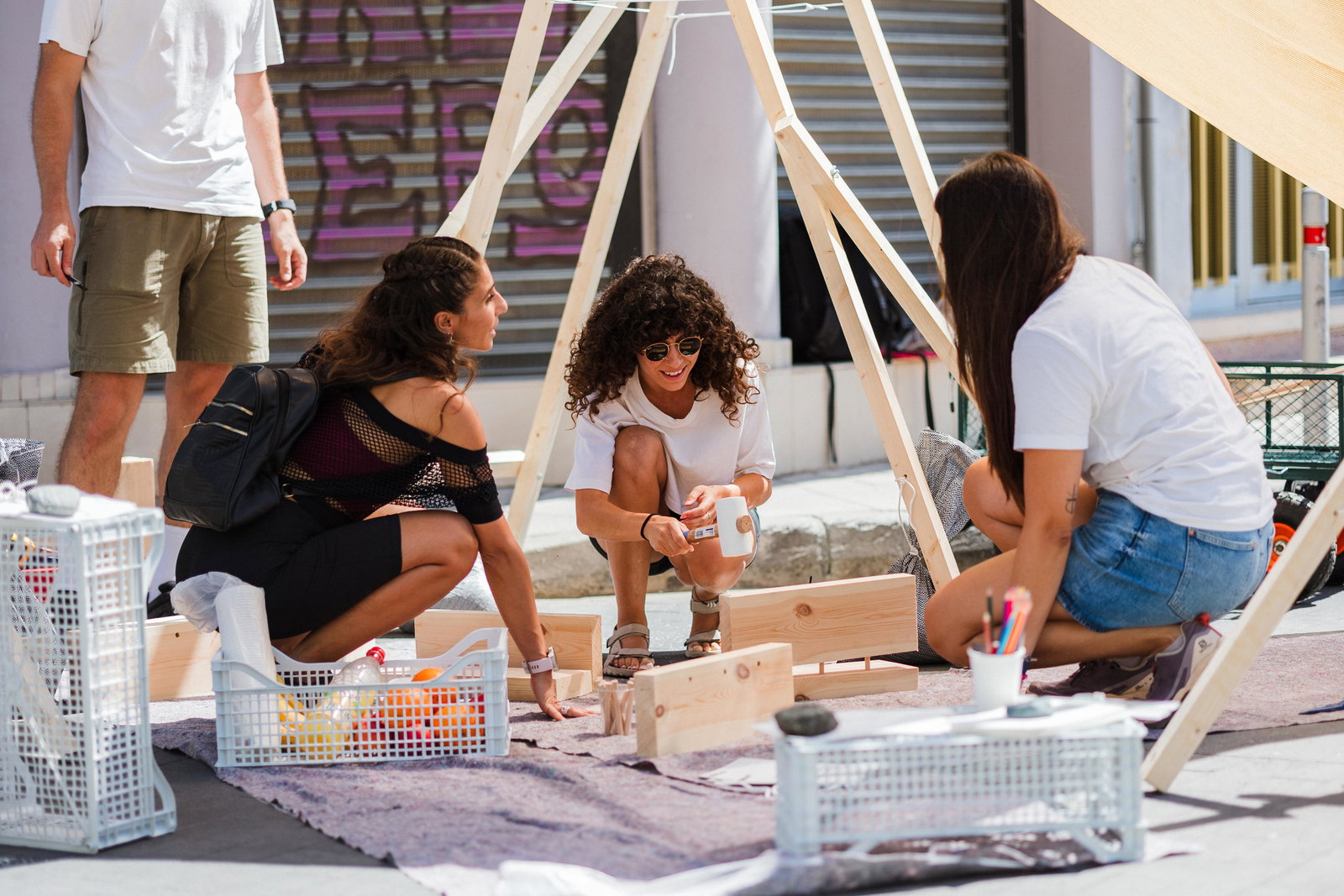
Photo: Building-workshop claiming a streetcorner with Building Neighbourhood during the European Mobility Week 2025, Limassol, Cyprus. Photo by Skevi Laou.