Djernes and Bell Exhibition
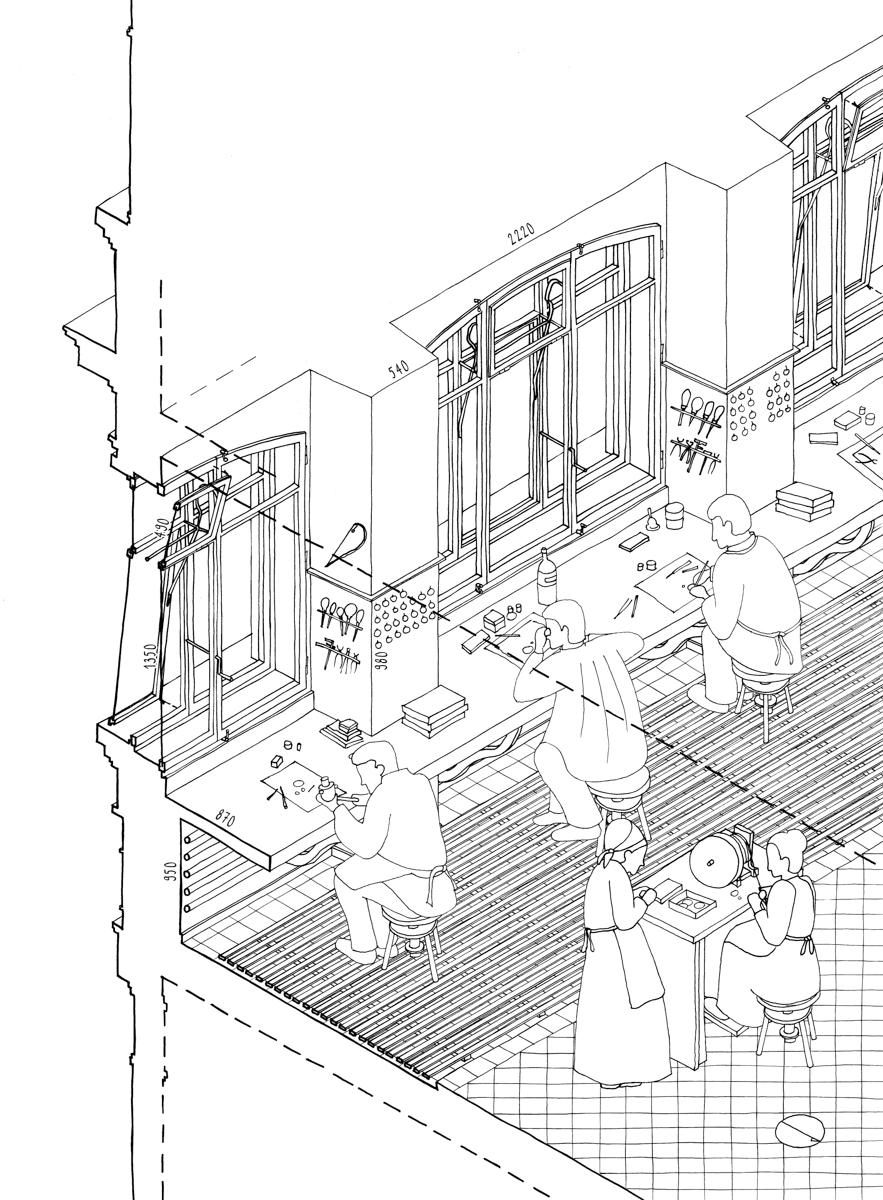
From March 6th, Djernes & Bell will take over our window gallery at Halmtorvet 27, showcasing their work on the Hedeskov Center for Regenerative Practice - a project rooted in repair and transformation.

We called the idea of being able to place a building on a site in Copenhagen or Abu Dhabi global. We called the architect creating as if in a vacuum an artist ordained with free expression. We filed it all under the rubric of freedom. The site was a ground zero, where forms could freely be erected.
The knowledge that architecture always transforms the world and its surroundings was suppressed and forgotten. The fact that every act is an intervention—into landscapes, into ecosystems, into cultural memory—was hidden behind gleaming facades. Now, we ask ourselves about the value of the modernist monuments to free crea- tion and of an architecture of severed connections.
Djernes & Bell’s work is an example of an architecture deeply anchored in place—an architecture that lets us think about transformation differently. An architecture grounded in the deep cultural, biological, and geological histories that humans, sites, and buildings belong to. With the Hedeskov project, Djernes & Bell transformed a former rural school in Djursland, Denmark, into the headquarters of Hedeskov Center for Regenerative Practice. The approach is interdisciplinary, emphasizing the necessity of collaborating with scientists, local craftsmen, anthropologists, foresters, and ecologists when building in a fragile world.
As much as the Hedeskov Center shows what the transformation of a building can look like, it shows us what a building essentially is: a repository of techniques, craft, and memory. What makes Hedeskov valuable is the knowledge it creates and makes us remember. It reminds us that all architectural actions are transformations and that architecture is a relationship, not an object. Transforming through care means acknowledging our deep connection to our surroundings but also to the past. Building for the future means passing on a livable ecology for all species.
DJERNES & BELL work to preserve and improve existing built, natural, and social structures through repair, conservation, and the use of post-carbon materials. Their cross-disciplinary approach fuses artistic and scientific research, spanning from ancient crafts to ecological innovation.
Working at the intersection of material science, traditional crafts, and nature-based design, they transform buildings and landscapes with a focus on continuity and regeneration. They collaborate across scientific, artistic, and civic sectors, bringing extensive experience in adaptive reuse across both rural and urban environments.
Credits
Djernes & Bell: Justine Bell, Jonas Djernes, Asger Højlund Olesen, Sophia Grotum, Lukas Donnerup, Philip Mar Serejo
CAFx team: Josephine Michau, Pernille Maria Bärnheim, Søren Nørkjær Bang, Ida Willadsen Bang Kjeldsen, Johann Sten Nielsen, Gerd Dahl, Maeve Collins, Justlugonja/Stanko Lugonja
Hedeskov team: Sofie Aagaard, Jørn Aagaard, Jette Søndergaard
Project team: Local Works Studio, VITA, Etos ingeniører, Stålpro ApS, FBJ Rådg. Ingeniører ApS, HUJ A/S, Tømrermester Svend Erik Sørensen A/S, Blik & VVS Kaj Dahl Andersen A/S, Entreprenørfirmaet Erik Pedersen A/S, Følle El-Service A/S, Malerfirmaet Kildahl ApS, Kalø Køkkenet, Lasse Koefoed Nielsen, Torben Valdbjørn Rasmussen, Marie Stender, Lene Wiell, Christoffer Ole Olsen, Regitze Kjær Zimmermann, Inga Sørensen, Termiske Boringer Varup, Kalø Økologiske Landbrugsskole, Forest and Landscape College KU, Jonas Edvard, Alexander Kirkeby
Opening Hours and Admission
The window exhibition can be experienced 24/7, free of charge.