In the summer of 2025, I took part in a Research Residency at the Fitzpatrick-Leland House, a modernist house designed by Rudolph Schindler in the Hollywood Hills. The house sits a few meters away from Mulholland Drive, the iconic road named after the engineer William Mulholland, who contentiously diverted water across distant geographies to Los Angeles and enabled the city to grow despite its arid climate and insufficient water. For five weeks I worked from California while focusing on another territory shaped by water scarcity: the Canary Islands. The project I worked on, titled A Permeable Atlas, investigated the complexities of the archipelago’s water infrastructure to understand how it had shaped the relationship to the liquid in a territory of dryness.
Thinking through water from across the Atlantic introduced a new perspective of the archipelago I grew up in. It allowed me to approach the islands from a comparable geography with a layered and often contradictory relationship with water. Much like in LA, water occupies a central place in the islands’ imaginary: from narratives of hedonistic pleasure to a contested resource, and from mundane luxury to an instrument of uneven power. Working from a distance introduced a sense of longing that shaped the project itself, prompting connections between archival materials, personal memories, and the observations of collaborators.
Within the archipelago, the island of Lanzarote is a territory where water scarcity is especially acute. Its hot climate, arid soils, limited rainfall and the absence of natural freshwater sources have long defined its cultural practices and infrastructure. Contrary to modern examples that have sought to exclude water from buildings —channeling it into pipes, drains, and repelling it through layers of synthetic barriers— Lanzarote’s built environment offers a different paradigm, one in which the relationship to water is more complex, situated, and permeable. In this context, the project began with a simple question: what can we learn from Lanzarote for an inevitably water-scarce future? Rather than a replicable set of architectural tools, the island offers more nuanced responses in its ways of dealing with unstable access to the liquid. It sheds light into alternative forms of collective water governance, attunement to ecological rhythms, and stories of shared infrastructural maintenance.
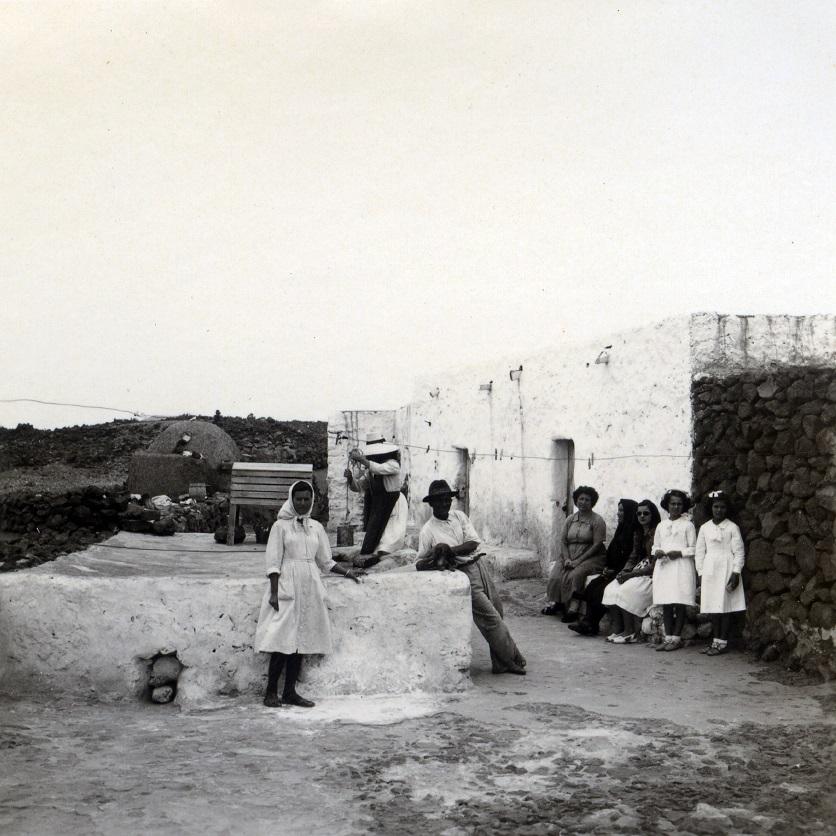
Family in Front of Their House in La Hoya. A Lanzarote family poses in front of their house, around the cistern, in La Hoya, in the Salinas de Janubio, Yaiza. In the background, a woman can be seen drawing water from the cistern. 1951–1960. Author: Jan Blauboer Source: Memoria Digital de Lanzarote
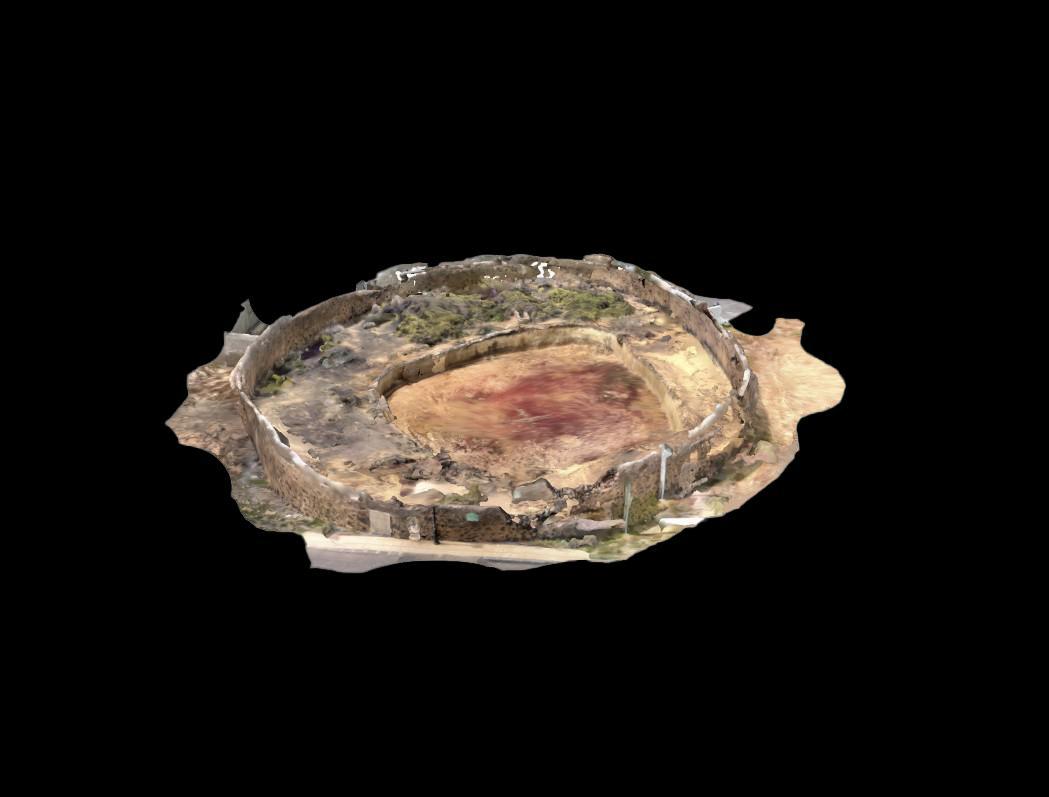
The project began by tracing Lanzarote's water infrastructures in the form of an atlas. A compilation of fragments of vernacular and modern mediators between the people and the liquid. Four of them are presented here as strategies for responding to scarcity across scales, from the communal to the domestic. Each infrastructure was 3D-scanned, archived, and reworked into a series of drawings.
- Maretas (1) are monumental, communal cisterns that anchor Lanzarote’s hydrological memory. These large-scale water repositories were collectively built to serve entire communities, storing winter rains for collective use during dry seasons. Dug into the volcanic ground and carefully plastered, maretas could hold immense quantities of water, functioning as survival infrastructure and social space. Maretas would serve as shared hydric infrastructures for the island. People from all municipalities drew water and participated in their regular maintenance, which turned them into an example of shared responsibility in common water infrastructures.
- Aljibes (2) are subterranean cisterns that embody Lanzarote’s long-standing negotiation with scarcity. Dug into volcanic rock and lined with stone, sea shells, or lime mortar, they collect and store the scarce rainfall channeled from rooftops, courtyards, and carefully sloped terrain. Aljibes are mediators between landscape and household that accumulate water for humans and non-humans –some feature built-in spaces for laundry as well as drinking troughs for animals– in a territory where each drop is precious. Their subterranean condition allowed them to keep water cool and protected from evaporation and contamination, while their lime-plastered walls often became part of domestic and agricultural architecture. To access them, families lowered buckets through narrow openings or climbed inside to clean and replaster in advance of seasonal rains. In this sense, the aljibe was a lived space that embodied the rhythms of water in the frequency of their maintenance. They offered a smaller grain of the island’s water infrastructure: a decentralized network of cisterns scattered across the territory to support the everyday water needs of households, animals, and agricultural life.
- La Geria (3) is a cultivated landscape that turned a volcanic catastrophe into agricultural ground. After the eruptions, farmers began planting vines in hollows carved into the lapilli, a porous volcanic ash, retaining traces of moisture in their small cavities that sustain the vines. Around each pit, a semicircular wall of stone—zoco—was built to shield the plant from the relentless winds. La Geria is both a resilient landscape and a productive infrastructure that folded adversities into a sustainable agricultural system.
- Destiladeras (4) are domestic filtration devices traditionally used in Canarian homes: a hollowed volcanic stone suspended above a clay vessel in a wooden stand. Water from the aljibes is poured into the stone and slowly seeps through its porous body. Along the way, it is cooled and filtered, nurturing the culantrillo fern that thrives in the rock’s humidity. The plant signals the presence of “good water” and helps keep the humidity of the rock, preventing the evaporation of the drops that fall into the clay container below. The clay vessel itself “sweats,” cooling the water through evaporation and extending the intimacy between liquid, stone, and air. The presence of these destiladeras in Cuba, Puerto Rico, and the Dominican Republic registers the colonial circulation of water practices—domestic furniture carrying residues of colonial routes, migration, and shared island imaginaries across the Atlantic Ocean. Destiladeras are porous mediators, from the microscopic scale of volcanic stone to transatlantic exchanges between the Canary Islands and the Caribbean.
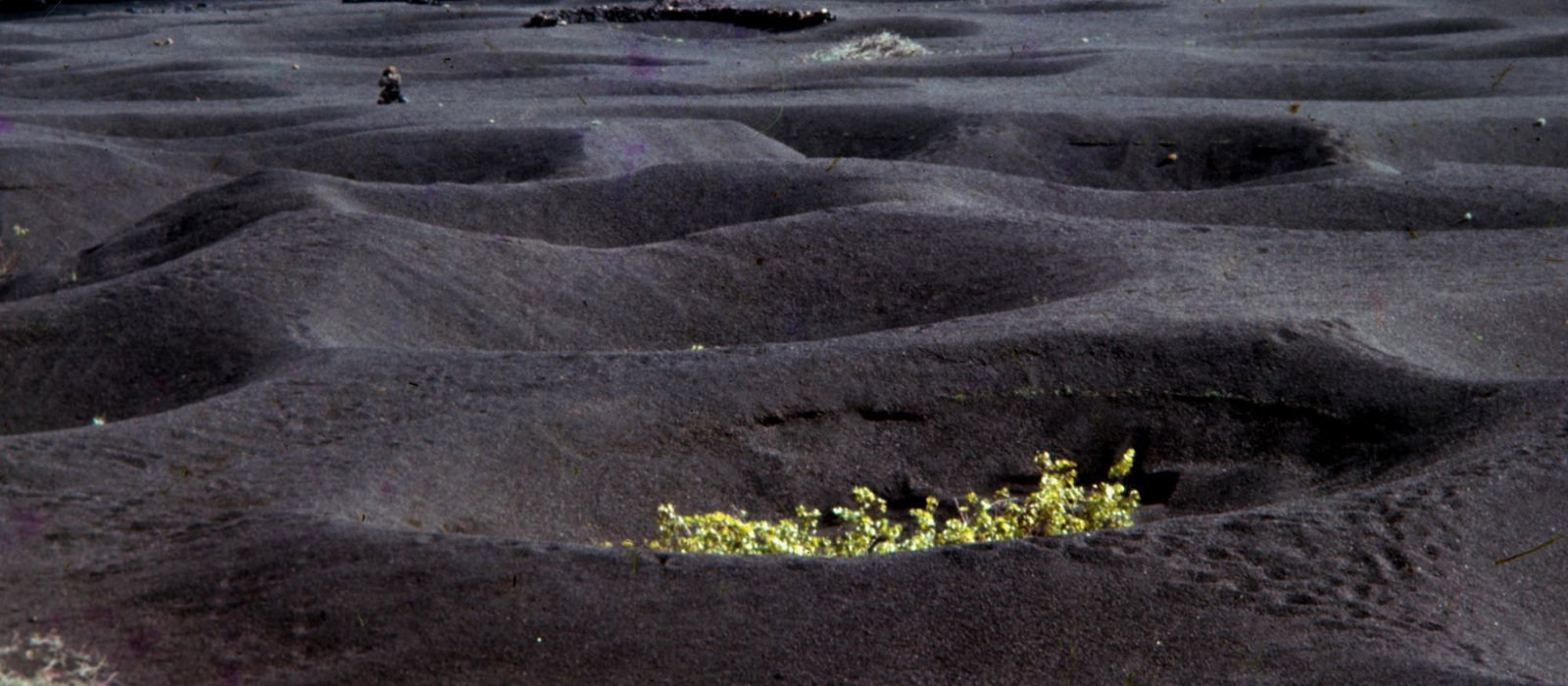
Geria. Fachico Rojas Fariña. 1970-1980. Source: FEDAC. Francisco Rojas Fariña Collection.
However, the above infrastructures alone could not guarantee a steady flow of water to the island. To address this deficit, desalination, a technology that turns seawater into drinking water by removing its salt, was imported in the 1960s to quench the island’s thirst. Desalination completely changed the relationship between people and water in Lanzarote. Communal practices such as the maintenance of maretas or seasonally cleaning family aljibes, once essential rituals before the rains, slowly disappeared with the arrival of the technology. Water management moved into the hands of technical experts, hoping that technology could deliver the abundance that rain could not. Water shifted from an element to live and contend with to a resource to be managed through the control panel of a desalination plant.
In this context, I traced an account of Lanzarote’s changing relationship with water during these years. Textual and visual materials produced before and during the arrival of desalination, books brought from Lanzarote to the United States, historical accounts, online archives, blogs, and old journals informed a more nuanced and complex story. Water on the island was intrinsically linked to cultural practices that were replaced by a technological system imposed through external expertise.
What first appeared as a shared condition of water scarcity between Lanzarote and California revealed a deeper infrastructural entanglement. Technologies, companies, military interests, and bodies moved across territories, reshaping the meaning of water on the island. The desalination technology that transformed Lanzarote’s relationship to water had been developed in Point Loma, also in California, and its history was deeply entangled with the Cold War. Desalination was, in fact, a U.S.-developed technology aimed to provide military advantage in this context. With the goal of granting human emancipation from nature and the constraints of terrestrial water, this approach turned the ocean into an “infinite resource.” By tracing the movements of the desalination plant and the migration of the technology, money, and people, the project uncovered new relationships between California, Cuba, and the Canary Islands, adding yet another layer to the already entangled relationships between territories on both sides of the Atlantic. Unsurprisingly, it was in Lanzarote where his technology was first tested on a civilian population in Europe. In this sense, desalination arrived to the archipelago as the carrier of modernity, but carrying with it the logics of militarization, extraction, and technical dependence into the everyday life of the island.
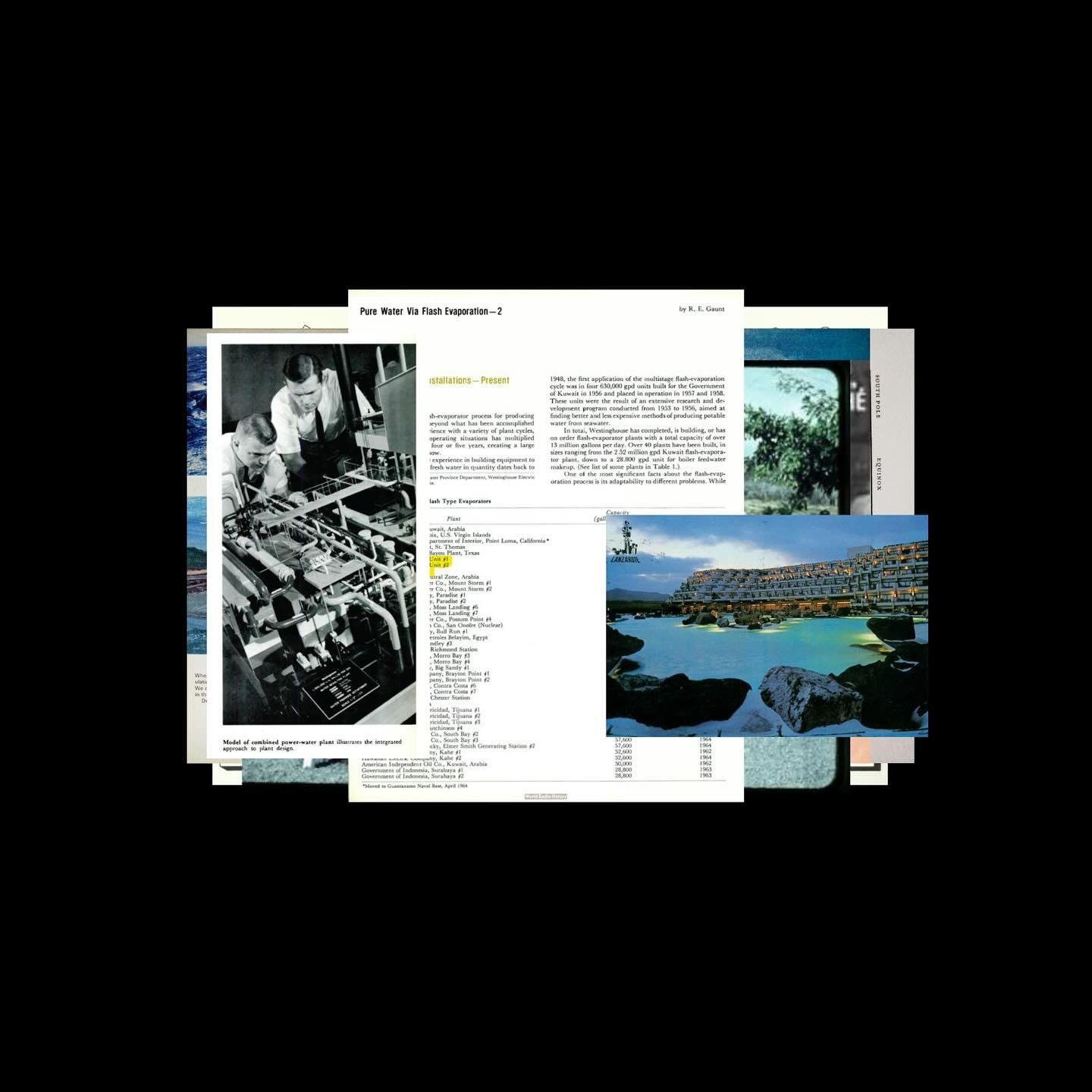
Archival material of the research developed during the 2025 Researcher-In-Residence for the project A Permeable Atlas, supported by the MAK Center for Art and Architecture and the SOM Foundation. Pablo Castillo Luna, 2025.
Desalination partially addressed drought in a territory completely surrounded by water. It offered reliability and access, two conditions that improved everyday life in Lanzarote while also enabling the island's rapid modernization and tourist industry. Yet it did not end scarcity. Even today, with access to this technology and the ocean, Lanzarote still faces water shortage. Repeated leakages and breakdowns, byproducts of this infrastructural paradigm desalination brought along, continuously disrupt the steady flow of water it promised to bring. Less visible in this managerial discourse is the slow accumulation of its externalities. Brine discharge, energy consumption and the growing demands of tourism are the slower, less apparent symptoms of environmental management folded into the language of progress and efficiency. Hotel pools and tourist dreams, brine from illicit dumps, freshwater leaking from fractured pipes and insufficient vernacular water infrastructures, personal stories and transoceanic relationships– resist a singular narrative, spilling beyond the island’s shores. Shores today are capitalized by a tourist industry enabled by the technologies that promised to quench the island’s thirst, and that today consume virtually half of Lanzarote’s water.
While the return to premodern water infrastructure would be unfeasible today, their knowledge practices and material presence remains very much relevant. The layered scales of historic water systems –from communal reservoirs, to family cisterns and domestic filtration devices– offers ways of thinking through contemporary pressures beyond technocratic solutions. Resurfacing these accounts challenges the notion of water as an abstracted universal resource and frames it as a cultural, social, and situated element that modern infrastructure has so often concealed. In the future, hybrid models could operate between desalination and a decentralized network of aljibes, bridging private, communal, and public sources depending on seasonal water availability. The design of the built environment, from buildings to cities, could regain agency in addressing water issues, roles that have been largely displaced onto technological systems. However, that alone will not be sufficient. As seen in Lanzarote, other forms of water governance, maintenance, and care for water infrastructures are also possible. All in all, a future for Lanzarote’s water culture may not only depend on technical capacity, but on renewed forms of ecological accountability.
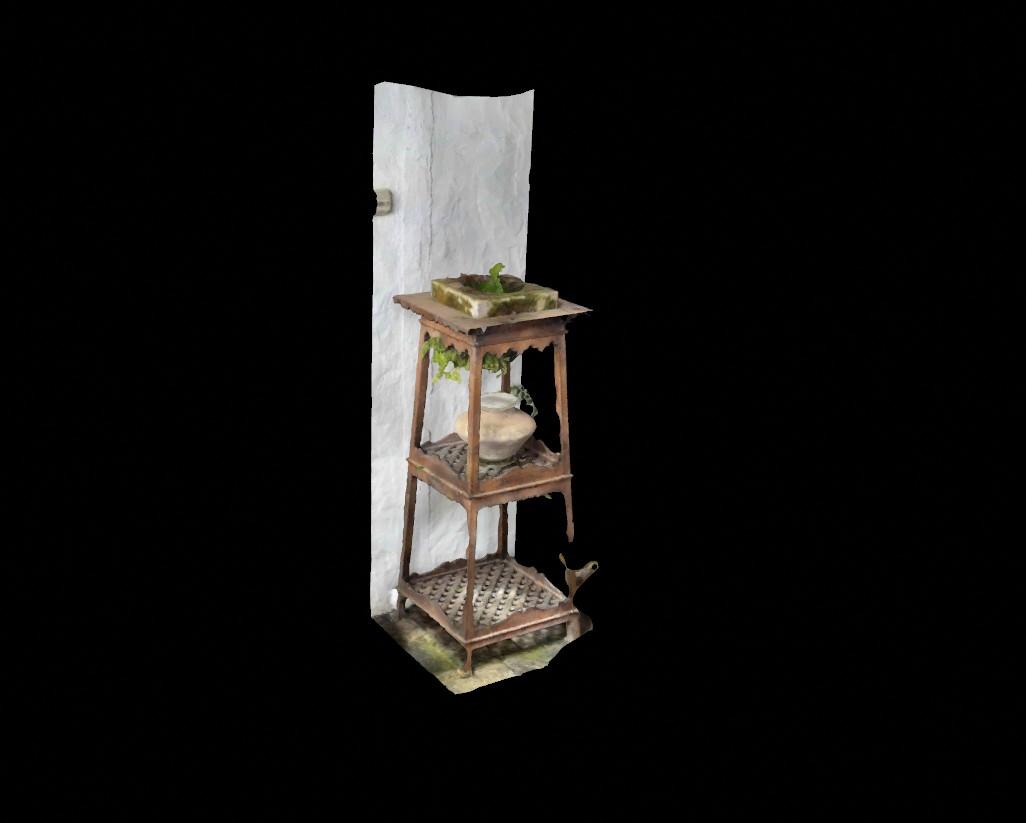
3D scans of a Destiladera for the project A Permeable Atlas, exhibited at the exhibition Slow Down, 2025. Pablo Castillo Luna, 2025.
The text by Pablo Castillo Luna builds on his project "A Permeable Atlas," shown in our exhibition "Slow Down" at the Copenhagen Architecture Biennial.
Pablo Castillo Luna is an architect and researcher from the Canary Islands and the co-founder of à la sauvette. His work explores processes, temporality, and material histories in architecture. Pablo Castillo Luna is currently the LeFevre Fellow at OSU, and has taught at Cornell University, Rhode Island School of Design, and Wentworth Institute of Technology.
Post Notes